
The UK will hold a general election in July. How are the UK stock market and the pound likely to perform?
Forex PlatformWith less than six weeks to go before a general election, opinion polls suggest that the center-left Labour Party could return to power in 14 years, and analysts say the British stock market will respond positively to the result, while the pound is more focused on inflation and interest rate policy.
Historically, the UK stock market has been "relatively flat or down" in the six months following an election, Citi said in a report analysing stock market movements since 1979 (the study excludes "volatile financial conditions" caused by the bursting of the dotcom bubble and the Great Financial Crisis).
According to Citi, the MSCI UK large and mid-cap index rose by about 6% six months after Labour's victory, while it fell by about 5% six months after the Conservatives' victory.
Citi also said the more domestically oriented FTSE 250 tended to outperform the FTSE 100 and would do better after a Labour victory. Citi also found that defensive stocks and financials tended to perform better after elections, with both energy and financials performing well.
According to Capital Economics, UK stocks have fallen five times during past Labour governments.
However, John Higgins, chief market economist at the consultancy, said it was dishonest to blame Labour for all this. He said in a report that these crises occurred during the Great Depression of the 1930s, the postwar 1940s, the aftermath of oil market shocks in the early 1970s, the bursting of the dotcom bubble in 2000 and the financial crisis.
Mr. Higgins also noted that the relative performance of the UK stock market since the Conservatives came to power in 2010 had been "generally not impressive".
John Higgins, chief market economist at Capital Economics, says there have been five previous Labour administrations in the past 100 years that have seen sterling plunge, but broader factors have come into play again. Three of these, he says, can be attributed to the "unsustainability of fixed exchange rates" in the 1930s and 1970s, one to the Great Financial Crisis and the last to the debt crisis of 1976.
Analysts expect there to be no fiscal disagreement between the two parties, meaning the outlook for the pound and gilts will remain more tied to the outlook for interest rates.
Joe Tuckey, head of foreign exchange analysis at Argentex Group, said: "foreign exchange marketThe reaction to the election is strongest when there is a lot of uncertainty about the election. This cannot be applied to the current situation, and if history is a guide, we should expect the pound to rise modestly in the coming weeks, with little reaction to the election result itself. "
That was before New Labour's victory in 1997, when sterling rose just 2.5 per cent in the weeks leading up to polling day, Mr. Tuckey said. In many ways, sterling will refocus on inflation and the Bank of England's interest rate policy, which could be more decisive for price movements than the election result.
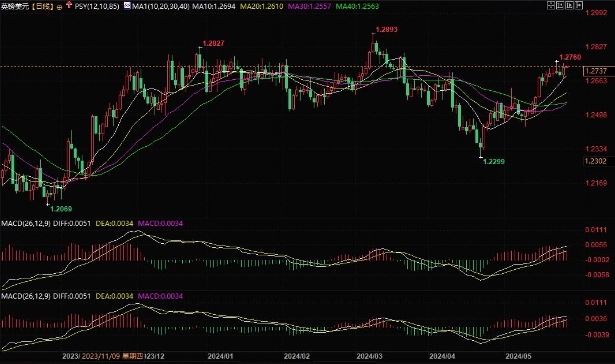
GBP/USD daily chart
At 9:00 on May 27, Beijing time, the pound was trading at 2738/39
Please indicate the source: https://www.daoctech.com/fxnews/1172.html
Disclaimer: The content of this article does not represent the views of the Institute of Foreign Exchange. The content is for reference only and does not constitute investment advice. Investors operate accordingly at their own risk.