
Crude oil trading reminder: OPEC + extends some production cuts to 2025, oil prices hit a new week low
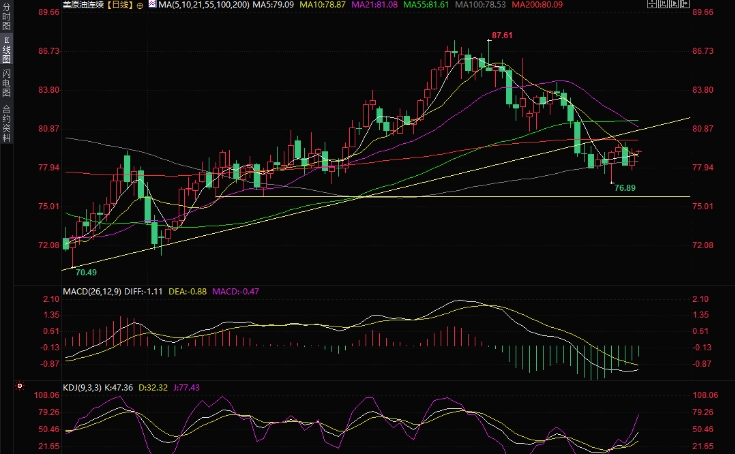
foreign exchange documentary platform- On Monday (June 3), U.S. crude oil fell slightly in early Asian trading, once setting a new low of more than a week to $76.39/barrel, but still stuck above the nearly three lows of $76.16/barrel set on May 24. The OPEC + oil-producing group composed of the Organization of Petroleum Exporting Countries (OPEC) and allies led by Russia agreed on Sunday to extend most of the deep production cuts to 2025, providing some support for oil prices.
Brent crude futures for July delivery closed at $81.62 a barrel on Friday, down $0.24, or 0.3 percent; more liquid August futures closed at $81.11 a barrel on Friday, down $0.77, or 0.8 percent. U.S. crude futures fell $0.92, or 1.2 percent, to $76.99 on Friday.
Last week, Brent crude futures fell 0.6%, while U.S. crude futures fell 1%.
Data released by the U.S. Energy Information Administration (EIA) on Friday showed that U.S. crude oil production rose to its highest level this year in March, pressuring oil prices, but the supply of refined oil products fell 0.4% to 19.90 million barrels per day, and the decline in oil prices was relatively limited.
After U.S. government data showed inflation held steady in April, oil prices briefly rose as the data prompted traders to increase their bets that the Federal Reserve would cut interest rates in September.
Eurozone inflation rose more than expected in May, according to data from the European Union's statistical office. The increase is unlikely to stop the European Central Bank from cutting borrowing costs this week but could slow the rate-cutting cycle.
Ahead of the OPEC + meeting, investors were generally hesitant last week.
Sources said on Friday that Saudi Arabia changed its plans at the last minute and invited oil ministers to Riyadh in person for the June meeting, which is still formally scheduled as an online meeting.
OPEC + agreed on Sunday to extend most of its deep production cuts until 2025, as the group seeks to prop up markets amid sluggish demand growth, high interest rates and rising output from rival U.S. producers.
Brent crude futures have been trading around $80 a barrel in recent days, below the price many Opec + members need to balance their budgets, as concerns about slow demand growth in Asia's biggest oil importer, coupled with rising inventories in advanced economies, weigh on prices.
The OPEC + group of producers, which consists of the Organization of the Petroleum Exporting Countries (OPEC) and allies led by Russia, has made a series of sharp cuts since the end of 2022. OPEC + members are currently reducing output by a total of 5.86 million barrels per day, or about 5.7% of global demand. The 3.66 million barrels per day cut will expire at the end of 2024, and the voluntary cuts of eight members 2.20 million barrels per day will expire at the end of June 2024.
OPEC + agreed on Sunday to extend the 3.66 million bpd cut by one year until the end of 2025 and extend the 2.20 million bpd cut by three months until the end of September 2024. OPEC + will phase out the 2.20 million bpd cut over a one-year period from October 2024 to September 2025.
Prince Abdulaziz, Saudi Arabia's energy minister, told reporters: "We are waiting for interest rates to come down and for a better trajectory in economic growth... rather than sporadic growth."
OPEC expects average demand for OPEC + crude oil to reach 43.65 million barrels per day in the second half of 2024, which means that if production is maintained at the 41.02 million barrels per day level in April, inventories will be reduced by 2.63 million barrels per day. If OPEC + begins phasing out voluntary cuts of 2.20 million barrels per day in October, the reduction in inventories will narrow.
Amrita Sen, co-founder of Energy Aspects, a think-tank, said: "At a time when demand concerns are still widespread, the deal should ease market concerns about OPEC + output increases."
Prince Abdulaziz said that if demand is not strong enough, OPEC + can suspend or reverse the cancellation of production cuts
Analysts had expected OPEC + to extend voluntary production cuts for several months because of falling oil prices and weak demand, but many also predicted the group would struggle to set a 2025 target because it has not yet agreed on capacity targets for each member, an issue that has previously caused tensions.
The United Arab Emirates, for example, has been pushing for higher production quotas, arguing that its capacity figures are chronically undervalued, but in a surprise development on Sunday, OPEC + postponed capacity discussions from this year to November 2025.
Instead, the group agreed to set a new production target for the UAE that would allow the UAE to gradually increase output 300,000 barrels per day from the current 2.90 million.
OPEC + agreed to use independently assessed capacity data as a production guide for 2026 rather than 2025, delaying a potentially difficult discussion by a year.
Prince Abdulaziz said one of the reasons for the delay was the difficulty for independent advisers to assess Russian data at a time when Western countries have imposed sanctions on Russia over the conflict with Ukraine.
Sunday's meeting lasted just under four hours - a relatively short time for such a complex agreement.
OPEC + sources said Prince Abdulaziz, the most influential figure in the OPEC group, spent days behind the scenes preparing for the deal.
Although the meeting was largely conducted online, he still invited some key ministers - mainly those from countries contributing to the voluntary production cuts - to the Saudi capital Riyadh on Sunday.
Countries that have voluntarily reduced production include Algeria, Iraq, Kazakhstan, Kuwait, Oman, Russia, Saudi Arabia, and the United Arab Emirates.
"This should be seen as a huge victory for the unity of the group and Prince Abdulaziz," said Mr. Sen.
OPEC + will hold its next meeting on December 1, 2024.
Please indicate the source: https://www.daoctech.com/fxnews/1182.html
Disclaimer: The content of this article does not represent the views of the Institute of Foreign Exchange. The content is for reference only and does not constitute investment advice. Investors operate accordingly at their own risk.