
Oil prices rebound to test box pressure, but influenced by global trade sentiment
Brent crude oil futures fell $0.21 to $69.37 a barrel, while US WTI crude oil fell $0.37 to $67.56 a barrel. The previous session, the two crude oil prices rose nearly 2%.
The US president announced that tariffs would be raised in August, heightening market fears of an economic slowdown.
The US president on Monday informed a number of trading partners including South Korea, Japan, Serbia, Thailand and Tunisia that the US would begin imposing higher tariffs on August 1, triggering a resurgence of trade concerns amid widespread investor fears that stalled global growth would dent demand for crude oil.
"If global trade flows are constrained, both industrial production and consumption will come under pressure, which will directly affect crude oil demand expectations," said analysts at energy consultancy Rystad Energy
Despite this, strong holiday travel demand in the United States remains supportive of oil prices.
Data show that a record 72.20 million people are expected to travel during the US Independence Day holiday, supporting strong short-term refined oil demand. Market analysts believe that this may offset some of the negative impact caused by global economic concerns.
"Strong US gasoline demand is the key short-term factor supporting oil prices right now," according to one analyst, according to market research
Data from the U.S. Commodity Futures Trading Commission (CFTC) showed that fund managers sharply increased their net long positions in crude oil futures and options in the week ended July 1, reflecting the market's remaining overweight operating sentiment ahead of the U.S. holiday season.
OPEC + decided to increase production 548,000 barrels per day in August, exceeding the monthly increase of 411,000 barrels per day in the previous three months.
The decision all but reversed the remainder of the previous voluntary 2.20 million bpd cut. Goldman Sachs analysts expect OPEC + to announce another 550,000 bpd increase in September at its next meeting on August 3, ending the current cycle.

However, it is worth noting that the actual production growth has not yet fully reached the announced level, and the main new production is still dominated by Saudi Arabia.
"Although the announced increase in production is large, most member states are unable to fully implement it due to technical or political constraints, and Saudi Arabia still bears most of the supply pressure," notes energy research firm Kpler.
At present, the price of WTI crude oil is hovering between the 20-day and 50-day moving averages, and the short-term upward trend has not been destroyed yet. However, the K-line has recorded an upper shadow for two consecutive days, indicating that the upward selling pressure is gradually emerging. The Relative Strength Index (RSI) is above 50 and has not yet entered the overbought range. The MACD indicator shows that the momentum of the red column is contracting, which may indicate that the price will be shaken in the short term.
The key support level focuses on the vicinity of $66.80 (the intersection of the previous low and the rising trend line). If it falls below this level, it will open the space for backtesting of $65; while the initial resistance level above is located in the $68.50-69 range. If it can break through effectively, it is expected to re-challenge the $70 mark.
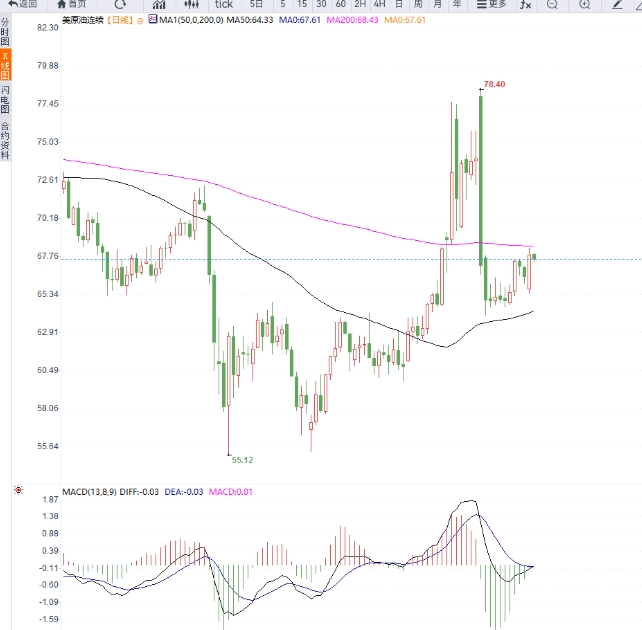
"If WTI crude oil continues to operate above $66.80, the overall multi-level structure is still expected to continue." - technical analysis opinion according to market research
Judging from the current trend, oil prices have entered a phase of policy and data-led fluctuations. On the one hand, the new US tariff policy has strengthened the market's concerns about trade. On the other hand, although OPEC + increased production more than expected, its implementation is limited.
In the short term, oil prices will struggle between "strong demand" and "macro uncertainty". It is recommended to pay attention to the OPEC + meeting in early August and further developments in US macro data, which will determine the direction of oil prices in the next phase.
Please indicate the source: https://www.daoctech.com/fxnews/1630.html
Disclaimer: The content of this article does not represent the views of the Institute of Foreign Exchange. The content is for reference only and does not constitute investment advice. Investors operate accordingly at their own risk.