
Before the release of the US PMI: The pound is long and short, and the short-term direction is about to be revealed?
On Tuesday (August 5), the exchange rate of the British pound against the US dollar (GBP/USD) fluctuated in a narrow range around 1.3280, continuing the previous sideways pattern as a whole. With the Bank of England about to announce the latest interest rate decision on Thursday, and the ISM service PMI data in the United States will also be released at 22:00 Beijing time tonight, market sentiment has clearly tended to be cautious, and the trading pace has slowed down.
Fundamentals:
In the United States, the market will focus on the upcoming ISM Services Purchasing Managers Index (PMI) for July. According to market expectations, the indicator will rise slightly to 51.5 from 50.8 in June, and it will be above the line of prosperity and decline for the second consecutive month, indicating that the service industry continues to expand moderately. Nonetheless, the sub-data performance is still divergent, with the employment index falling back to 47.2, indicating that employment in the service industry remains under pressure, while the new orders index rebounded to 51.3, indicating signs of recovery in demand. In addition, the price payment index fell to 67.5, indicating that inflationary pressures remain. The recently released PCE price index also strengthened this judgment, with the core PCE increasing by 2.8% year-on-year in June, well above the Federal Reserve's 2% target level.
In the UK, the Bank of England is widely expected to cut interest rates from 4.25% to 4.00% on Thursday, which will be the fifth rate cut since the easing cycle began in August 2024. Although inflation has picked up faster than expected, weak demand in the labor market and companies have tended to hire conservatively in the context of increasing social security burdens have raised concerns about stagflation in the UK economy. The market generally expects the Bank of England to continue its "gradual and cautious" easing pace, and the market focus will be on the content of Governor Bailey's press conference to determine the follow-up policy path.
Technical aspects:
From the observation of the 4-hour K-line chart, the GBP/USD exchange rate started a downward trend from the high point of 1.3588, stabilized and rebounded after reaching the lowest point of 1.3140, and entered the sideways finishing stage in the short term. The current exchange rate is running near the middle rail of the Bollinger Band, and the Bollinger Band is converging, indicating that volatility is contracting, and the market outlook may be brewing a directional breakthrough.
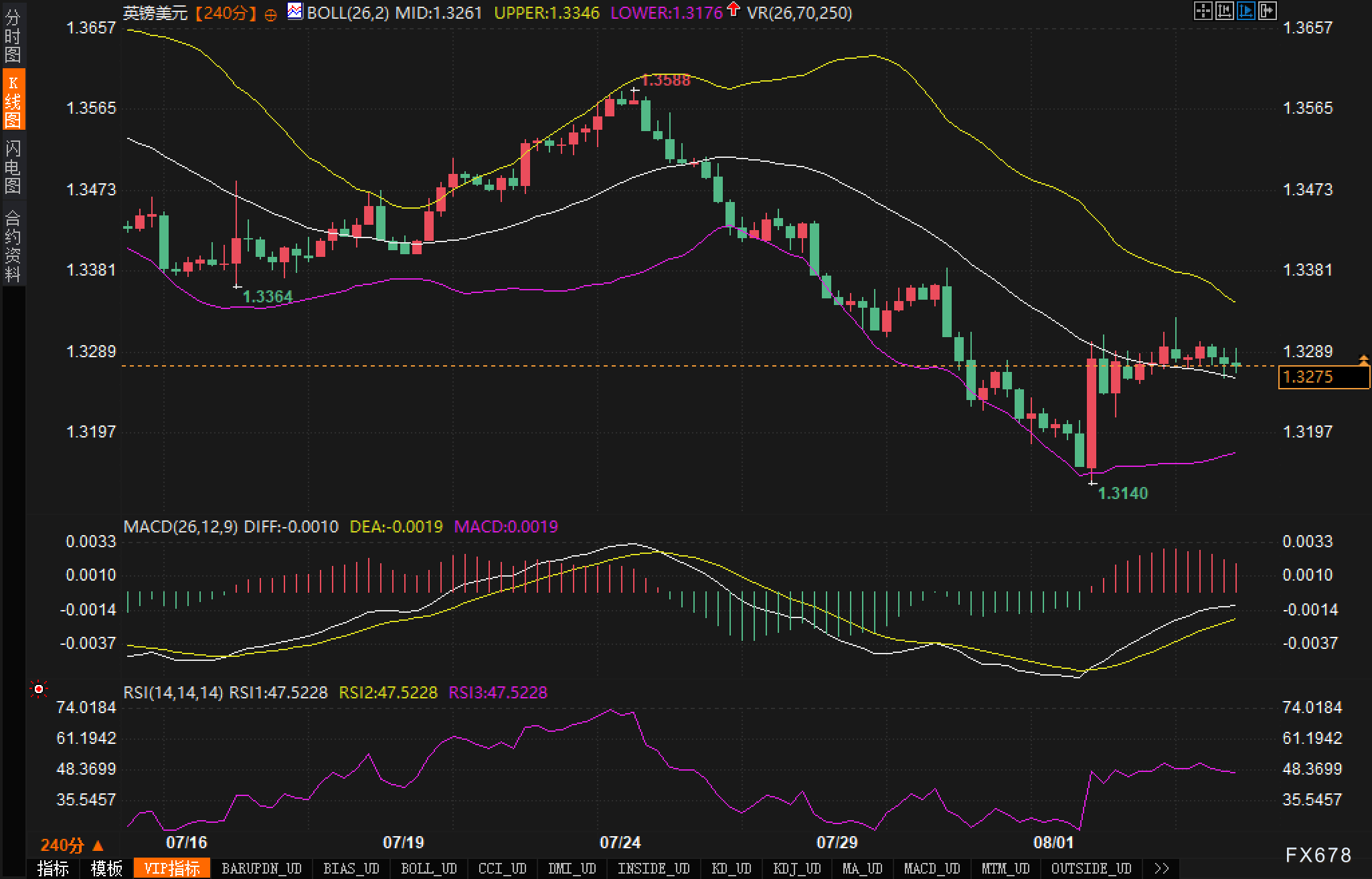
The analysis believes that the price is subject to pressure at the intersection of the Bollinger upper rail (1.3346) and the short-term moving average, and the short-term support below is located near the previous low of 1.3140. If it falls below, it may further test the 1.31 integer mark.
The MACD indicator shows that the fast and slow lines have formed a golden cross, but the red bar chart has slowed down and the momentum is limited, indicating that the short-term upward momentum is not sufficient and it is still in a state of multi-empty sawing.
The Relative Strength Index (RSI) is stable at around 47.5, in the neutral zone, and lacks clear overbought and oversold signals, further evidence that the market may remain volatile.
Overall, the analysis shows that the current exchange rate is located near an important technical watershed, and it is necessary to pay attention to whether the Bollinger Band track has been effectively broken through to determine the future direction.
Market sentiment observation:
The current market generally maintains a wait-and-see mood. On the one hand, there is uncertainty about the future path of the Federal Reserve's interest rate cut. The CME FedWatch tool shows that the market's expectation of a rate cut in September has risen sharply, and the probability has risen to 92.2%. On the other hand, the Bank of England is about to cut interest rates, but in the context of high inflation, the market is still divided on whether it will continue to be loose in the future, which makes the pound hesitant.
From the perspective of volatility, the pound has narrowed significantly in recent days, and Bollinger Band compression indicates that the market is accumulating energy. If there is an unexpected change in the news, the market may experience severe fluctuations.
In addition, from the non-farm payrolls report to PCE data, traders' perception of the resilience of the US economy has been shaken, causing the market's short-term risk appetite to decline and risk aversion to rise.
Please indicate the source: https://www.daoctech.com/fxnews/1812.html
Disclaimer: The content of this article does not represent the views of the Institute of Foreign Exchange. The content is for reference only and does not constitute investment advice. Investors operate accordingly at their own risk.