
The US-Japan exchange rate has emerged from the long upper shadow. Is 146.70 the last line of defense for bulls?
On Monday (September 1), the dollar rose by 0.22% against the yen in early Asian trading to 147.37. After that, the exchange rate failed to continue the rebound momentum in early trading, and the gains narrowed. It came out of the positive line with a long upper shadow. Now it is trading around 147.10, up 0.04%. The exchange rate has always been operating below the 147.50 mark. From the perspective of market drivers, Russia launched a large-scale military strike against Ukraine, Israel and Hamas continued to escalate the conflict, and the dual geopolitical risks fermented. At the same time, the market's expectation that the Bank of Japan will soon start raising interest rates continued to strengthen, further providing a foundation for the decline of the US-Japan exchange rate.

It is worth noting that the current hawkish pricing of the Bank of Japan's policy in the market contrasts sharply with the Federal Reserve's bet to complete two interest rate cuts by the end of 2025. This policy expectation polarization not only inhibits the willingness of the dollar bulls to enter the market aggressively, but also substantially suppresses the exchange rate of the dollar against the yen. In addition, the US macroeconomic data will be released intensively at the beginning of this month, and traders generally choose to wait and see and do not make directional aggressive bets for the time being. This cautious sentiment also restrains the dollar bulls.
Fundamental data is improving, and the yen is supported
In August, the S & P Global Japan Manufacturing PMI final value recorded 49.7, although still below the line of prosperity and decline, but it shows that the deterioration of the industry's operating conditions has narrowed, and only slightly contracted, with marginal improvement in sentiment.
According to data released by the Japanese Ministry of Finance on Monday, capital expenditure on plant equipment for enterprises rose by 7.6% year-on-year in the fourth and sixth quarters of 2025 (the second quarter of Japan's fiscal year), providing some support for economic fundamentals.
The escalation of geopolitical conflicts highlights the risk-averse nature of the yen
In terms of the geopolitical situation, US President Trump made it clear in an interview with the Daily Caller that he is skeptical about the possibility of a bilateral meeting between Russian President Vladimir Putin and Ukrainian President Zelensky, further increasing the uncertainty of the geopolitical game.
Last weekend, Russia launched a large-scale air strike on Ukraine, using more than 500 drones and 45 missiles. In response, Zelensky said he would retaliate and ordered more strikes on targets deep in Russia. The intensity of the Russian-Ukrainian conflict has escalated significantly.
On the Israeli side, the Israeli army launched intensive strikes on the outskirts of Gaza City through coordinated air and ground operations overnight; Israeli Defense Minister Katz confirmed that Abu Ubayda, a spokesperson for the Hamas armed faction, had been killed, and the Palestinian-Israeli conflict continued to be tense.
The above-mentioned geopolitical risks continue to ferment, providing upward impetus for the safe-haven yen; while the market's expectations for the Bank of Japan to raise interest rates further solidify the yen's support foundation.
The Fed's dovish shift to expectations is heating up, which is good for the yen
On the dollar side, traders are pricing in a clear easing of Fed policy as the market sees a significantly higher probability of a 25 basis point cut in September and two cuts before the end of the year.
The divergence of policy expectations between the Bank of Japan and the Federal Reserve will continue to benefit the low-interest currency yen; superimposed on the current dollar as a whole in a bearish pattern, the upward space of the dollar against the yen exchange rate will be strictly limited.
It should be noted that the US market was closed on Monday due to the Labor Day holiday, and liquidity was relatively light; and this week's key macro data including non-farm payrolls in the United States are about to be released. Before that, traders are likely to remain cautious and not engage in aggressive directional operations for the time being.
Technical analysis:
From a technical perspective, the USD/JPY is still constrained by the four-week box range that has been maintained. The lower edge of the range is anchored near 146.70, which needs to continue to be regarded as a key support - if the exchange rate can fall below it, it is regarded as a short starting gun. If it falls below and rebounds no more than 146.70, the exchange rate is likely to drop to the area near the August low of 146.21, and then advance to the 146.00 integer mark; once there is a follow-up sell-off, it will become a new trigger signal for the shorts of the currency pair, opening up space for subsequent deep corrections.
Conversely, if the exchange rate breaks through the resistance range of 147.50-147. 70, although it may temporarily release the upper action energy, it is necessary to be vigilant for the selling suppression before the integer level of 148.00 above - this position is the upper edge of the current trading range and is the key long-short demarcation point.
If it can decisively break through 148.00, it will trigger the short cover market and push the exchange rate closer to the recent high 148.75-148 area; and the area is approaching the 200-day simple moving average (SMA), if the exchange rate can stand at 149.00, the short-term trend will reverse and officially turn to bulls.
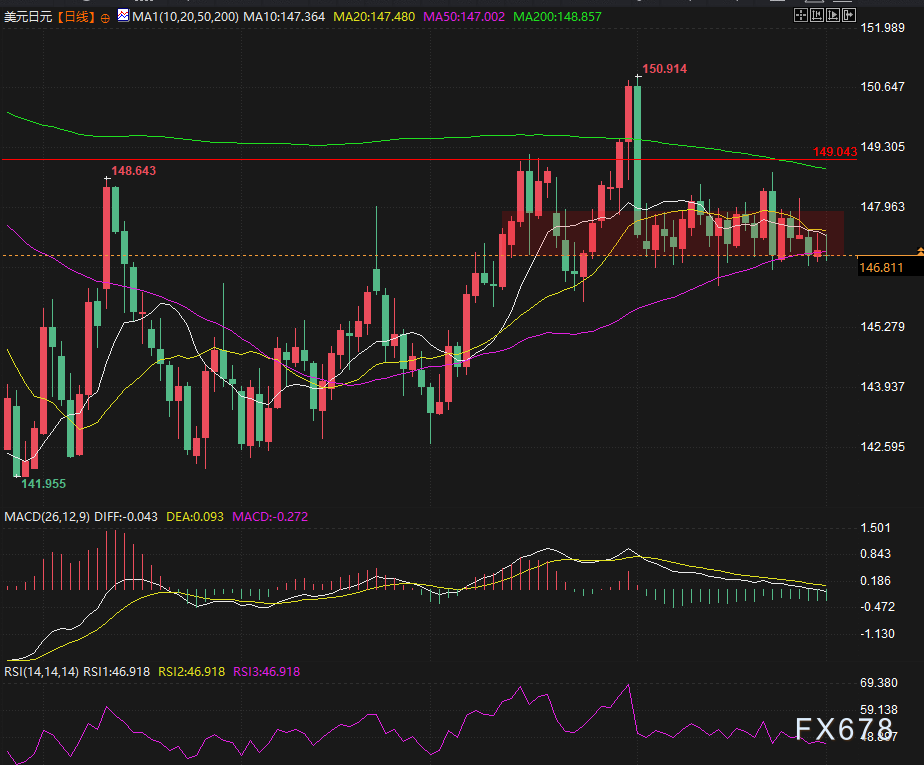
(Dollar/yen daily chart, source: Internet)
Beijing time 15:25, the dollar against the yen is now reported: 147.11/12
Please indicate the source: https://www.daoctech.com/fxnews/1953.html
Disclaimer: The content of this article does not represent the views of the Institute of Foreign Exchange. The content is for reference only and does not constitute investment advice. Investors operate accordingly at their own risk.