
The Federal Reserve's policy shift is in sight, and gold may face opportunities after a short-term adjustment.
On Tuesday (August 12), the spot price of gold maintained a moderate intraday gain in the first half of the European trading session and is currently trading around $3,345. The market is in a cautious wait-and-see attitude, as traders await the release of US consumer inflation data, which will have an important impact on the expected path of the Federal Reserve's interest rate cut, which will in turn drive the dollar and provide key momentum for non-yielding gold.

Fundamentals
Gold prices have been underpinned by rising expectations of interest rate cuts by the US Federal Reserve, which is widely betting that the central bank will cut rates by 25 basis points in September and at least twice before the end of the year. This expectation stems from a series of recent disappointing US economic data, including a closely watched non-farm payrolls report, suggesting the economy may be weakening.
The easing of geopolitical risks weighed on traditional safe-haven assets, with markets optimistic that the upcoming US-Russia summit will increase the likelihood of ending the conflict between Russia and Ukraine.
US inflation data will be the key risk event this week. Traders are widely expected to stay on the sidelines ahead of the release of the consumer price index. In addition to this, Thursday's producer price index and Friday's retail sales and Michigan consumer confidence data, together with speeches from several Federal Reserve officials, will jointly influence the direction of the dollar and provide directional guidance for gold prices.
technical
From a technical perspective, gold spot is facing a key technical watershed. The current price is below $3374.19 on the middle Bollinger Band, indicating short-term pressure. $3,408.52 on the upper Bollinger Band constitutes an important resistance level, while $3,339.87 on the lower rail is a near-term support. Prices are moving in the middle and lower Bollinger Band, reflecting a cautious market sentiment.
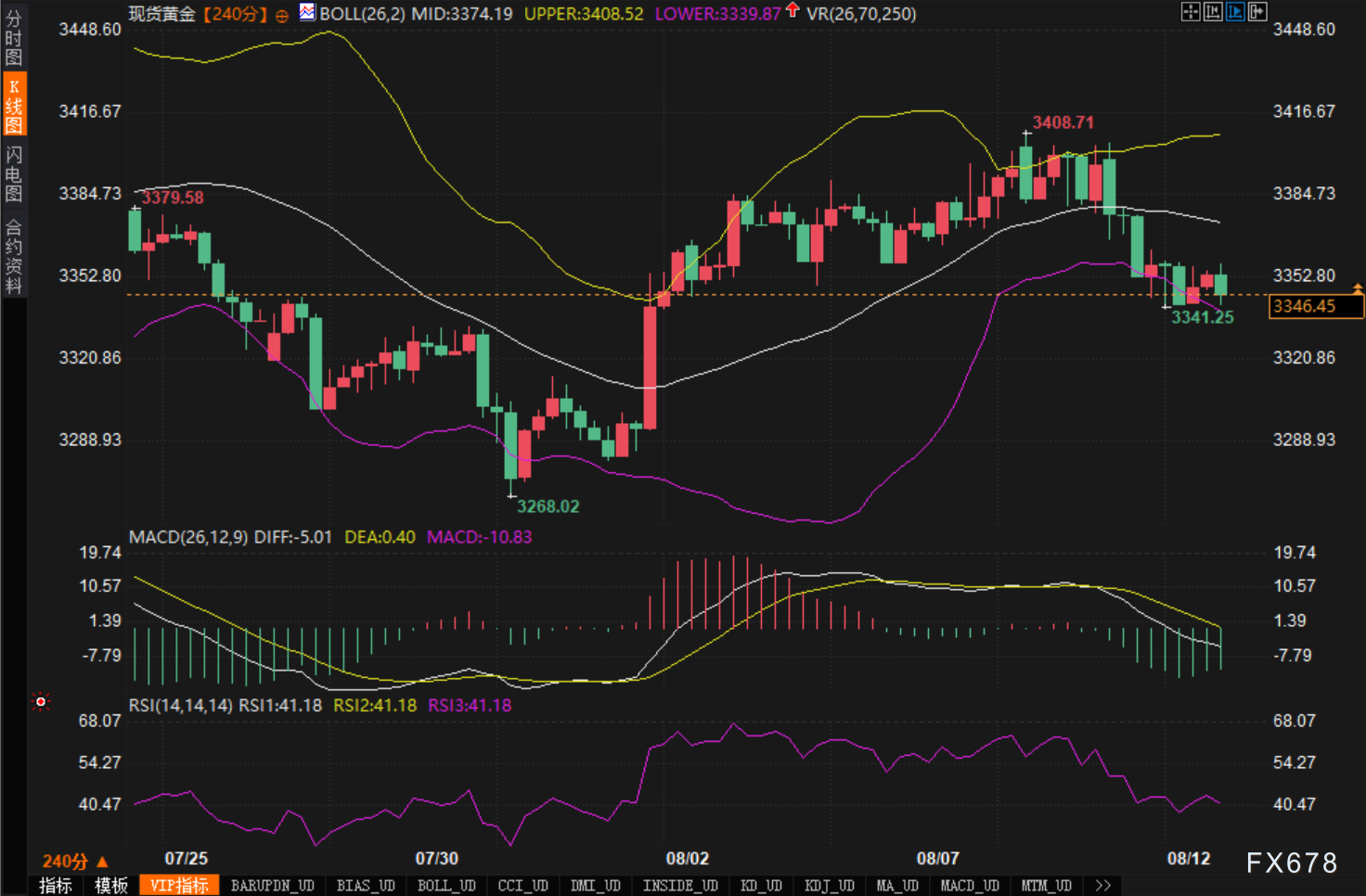
The MACD indicator shows a divergent signal. The MACD line is -10.83, the DEA line is 0.40, and the DIFF value is -5.01, indicating that the momentum is still bearish. The current reading of the relative strength index RSI is 41.18, which is in the neutral and weak area, and there is still a certain distance from the oversold level of 30. There is no obvious bottom divergence signal in the RSI, indicating that although the downward momentum has slowed down, there is still the possibility of further bottoming. The trend of this indicator will provide an important reference for judging the strength of the short-term rebound.
From the price action analysis, gold rallied after forming a phased low at $3268.02, reaching a maximum of $3,408.71, and then retreated to the current level. This fluctuation constitutes a relatively complete decline-rebound-correction cycle. The current price is testing the key support area near $3,340, and the degree of stability of this position will determine the direction of the subsequent trend.
Market Sentiment Watch
The current market sentiment is divided. On the one hand, the increase in the expectation of interest rate cuts by the Federal Reserve and the weakening of the US dollar provide fundamental support for gold; on the other hand, the easing of geopolitical risks has weakened the demand for safe havens. This ambivalence is fully reflected in the technical charts, with prices repeatedly competing near key technical levels.
Panic has eased, but caution remains dominant. The relative plateau of the VIX index reflects a reduced expectation of extreme volatility, providing a relatively stable trading environment for risk assets. However, forthcoming inflation data could still trigger a new bout of volatility.
Outlook
In terms of short-term outlook, gold is facing a critical moment of direction choice. If it can effectively maintain the support of $3,340 and cooperate with the volume to break through the resistance of $3,370, it will open a rebound space to $3,400 or even $3,408.52 on the Bollinger Band. On the contrary, if it falls below the support of $3,340, it will re-test the psychological barrier of $3,320 and lower $3,300.
The medium-term outlook is relatively optimistic. The start of the Federal Reserve's interest rate cut cycle will provide long-term support for gold, and it is expected that the price of gold is expected to re-challenge the historical high after the policy shift is confirmed. However, the degree to which interest rate cut expectations are fulfilled and the actual performance of economic data will determine the sustainability and magnitude of the rise. The evolution of geopolitical risks cannot be ignored either, and any unexpected event can quickly change market risk appetite.
From a volatility perspective, the coming week will be a crucial period in determining the short-term direction. The market reaction before and after the inflation data is released will provide traders with important directional clues. Traders are watching the stability of the $3,340 support level and whether the MACD indicator can form a golden cross signal.
Please indicate the source: https://www.daoctech.com/fxnews/1970.html
Disclaimer: The content of this article does not represent the views of the Institute of Foreign Exchange. The content is for reference only and does not constitute investment advice. Investors operate accordingly at their own risk.