
Crude oil trading reminder: Oil prices rose by more than 1.4% at one point, OPEC + production increase was lower than expected
West Texas Intermediate crude oil (WTI) rose more than 1.4% in the Asian market on Monday (October 6), so the monthly increase announced by the former OPEC + was milder than expected, easing some concerns about the increase in supply.
Brent crude oil rose about 1.7% in a row to $65.42 a barrel; U.S. crude oil rose more than 1.4% in a row to $61.75 a barrel.
Tina Teng, an independent analyst, said: "The price jump was mainly boosted by OPEC +'s decision to increase production next month by less than expected, which is intended to cushion the recent downturn in the oil market."
She added: "However, crude oil prices are likely to remain weak due to the gloomy global economic outlook."
OPEC + said on Sunday it would raise oil production by 137,000 barrels per day from November, opting for a fairly modest monthly increase as in October, amid persistent fears of a supply glut.
"OPEC +'s decision to increase production by another 137,000 bpd in November is likely to be manageable given the intensification of supply disruptions resulting from tightening US and European restrictions on Russia and Iran," ANZ analysts said in a note on Monday.
"At the same time, Ukraine continues to intensify its attacks on Russian energy facilities, targeting one of Russia's largest refineries - the Kirishi refinery, which has an annual processing capacity of more than 20 million tonnes."
G7 finance ministers said last week they would take joint measures to increase pressure on Russia by restricting countries that continue to increase purchases of Russian oil and assisting in circumventing restrictions.

OPEC + agrees to increase production slightly
OPEC + agreed to a modest, restrained increase in output similar to previous moves, betting that the move would increase revenue as much as possible without triggering a sharp drop in oil prices.
Eight OPEC + members, led by Saudi Arabia, said they would raise output by 137,000 barrels a day in November, the same amount as in October, OPEC said after an online meeting on Sunday.
OPEC wants to regain market share lost to US shale producers, Brazil and Guyana, and rein in other OPEC members that regularly exceed production quotas. The drop in oil prices will also please US President Donald Trump, who has repeatedly called for lower gasoline prices.
The move builds on OPEC's earlier decision to lift production quotas totaling about 1.65 million barrels per day, first imposed in 2023. An earlier round of cuts totaling 2.20 million barrels per day was fully lifted in September, a year earlier than originally planned.
Jorge Leon, head of geopolitical analysis at Rizdell Energy and a former OPEC veteran, said OPEC had "acted cautiously" by imposing a more restrained 137,000-barrel increase after witnessing how nervous the market was about the possibility of a larger increase. "The real test will come when the fundamentals and the political situation shift again," he said.
Due to OPEC + production increases and concerns about an imminent global oil supply glut, Brent crude oil and U.S. crude oil have both fallen by more than 13% this year.
Oil prices have traded roughly in the $60- $66-a-barrel range for the past three months, indicating a relative balance between supply and demand for the world's most important energy source.
Strategists said a number of factors had contributed to the bottom, including strong summer demand, aggressive inventory restocking by China and continuing conflicts in the Middle East and Ukraine.
Analysts at JPMorgan expect an oil market glut of about 2 million barrels a day for the rest of this year and next year, with the International Energy Agency raising its previous forecast for supply growth of 2.70 million barrels a day this year and 2.10 million barrels a day next year.
OPEC +, which produces 40% of the world's oil, began cutting production in 2023 in an effort to stabilize prices as economic growth slows. The decision drew criticism from the United States at the time, which accused OPEC + of indirectly supporting the Russia-Ukraine conflict by maintaining high oil prices.
OPEC + reversed course in April and began unwinding previous voluntary production cuts.
The eight oil-producing countries that voluntarily cut production, namely Saudi Arabia, Russia, Iraq, the United Arab Emirates, Kuwait, Kazakhstan, Algeria, and Oman, will meet again on November 2.
technical analysis
On the 14th, the Relative Strength Index (RSI) was significantly below the midline, indicating that bearish momentum continued, and the upside for oil prices may be limited this time.
On the downside, a fall below the multi-month low of $61.50-61 set in September would open the way for a deeper decline. Oil prices could then accelerate below the $61.00 mark, dipping into the middle support level of $60.40-60, and finally testing the psychological level of the late May low of $60.00.
On the upside, any attempt to rebound above $62.00 is expected to encounter resistance at the intraday high of $62.65-62. If it can continue to break through this level, it may trigger a short cover, which will push the oil price to break through the $63.00 integer mark, and then challenge the $63.60-63 resistance band, and eventually move towards the $64.00 or even $64.25 area.
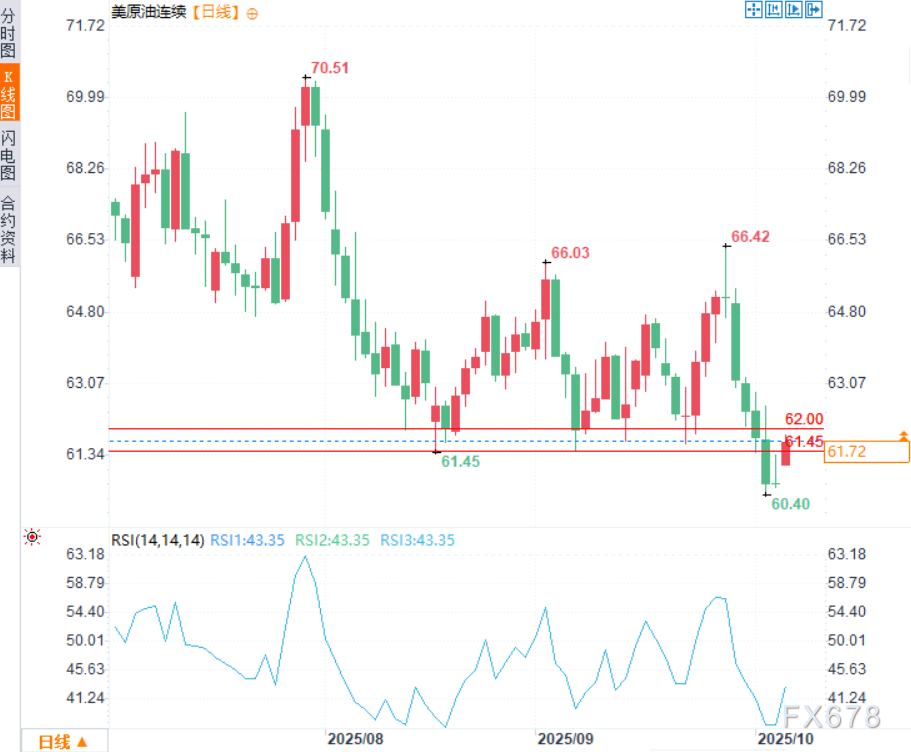
(U.S. crude oil continuous daily chart, source: Internet)
At 9:40 Beijing time, US crude oil was reported at $61.75/barrel in a row.
Please indicate the source: https://www.daoctech.com/fxnews/2002.html
Disclaimer: The content of this article does not represent the views of the Institute of Foreign Exchange. The content is for reference only and does not constitute investment advice. Investors operate accordingly at their own risk.