
Core PCE meets Brin's downside: Will USD/JPY ignite volatility?
On Friday (August 29), the European session saw a narrow range of USD/JPY around 147.00. The market focused on the US July PCE price index released at 20:30 today. The current US dollar index (DXY) is near 98.00, and the exchange rate is showing a "sideways trend before the data" in the short term. Volatility is suppressed, but the sensitivity to key inflation readings has increased significantly.
Fundamentals
The core PCE annual rate is expected to be 2.9% in July, up from 2.8% in June; the monthly rate is expected to remain at 0.3%. Since the core PCE is the inflation caliber favored by the Federal Reserve, a subtle change in the reading will directly affect the "market consensus" of the policy path. CME FedWatch shows that the probability of a rate cut of 25bp to 4.00% -4.25% in the September meeting is about 85%. If the data is higher than 2.9% or the monthly rate is faster than 0.3%, the short-end interest rate is expected to pull back, and the dollar is supported in stages. If it is lower than expected, the interest rate cut bet will expand, and the dollar will face retracement pressure. In addition, the legal dispute surrounding Federal Reserve Governor Lisa Cook and President Trump will progress in court. Although it is not a macro main line, noise-like uncertainty may amplify fluctuations in risk appetite at sensitive times.
In Japan, the cooling of inflation - Tokyo CPI slowed to 2.5% year-on-year (previous value 2.9%), and the same 2.5% after deducting fresh food and in line with expectations - weakened the bet of another interest rate hike this year, making the spread driver biased towards the positive USD/JPY, but the magnitude is affected by the US inflation data to be confirmed. Overall, the fundamentals are in the hedging pattern of "US inflation - Fed expectations" and "Japanese inflation cooling - Bank of Japan wait and see", and the short-term dominance is in the US data.
Technical aspects:
The daily chart shows that the Bollinger Band is 147.764 in the middle rail, 149.440 in the upper rail, and 146.089 in the lower rail. The Bollinger Band is about 3.351 wide, which is in the medium-narrow range, suggesting that the direction selection after the volatility contraction is approaching. The current trading is near 147, running below the Bollinger middle rail and close to the lower rail. The position reflects the "lower edge backtest in the weak shock". The recent high of 150.914 and the previous low of 139.887 form the upper and lower boundaries of the medium-long range. The price has retreated since touching 150.914 and entered the horizontal channel of 146-149. In terms of MACD, the DIFF is -0.010, the DEA is 0.126, and the bar chart is -0.272, showing that the kinetic energy above the zero axis has cooled significantly and there is a characteristic of "weak dead fork continuation". The momentum is empty but not extreme; as long as the cylinder continues to contract, there are potential conditions for the formation of "bottom departure from the prototype". RSI (14) reported 47.380, which is located in the neutral and weak area below 50, which does not constitute oversold, indicating that the selling pressure is orderly and the time-for-space of "consolidating the market" is the main one.
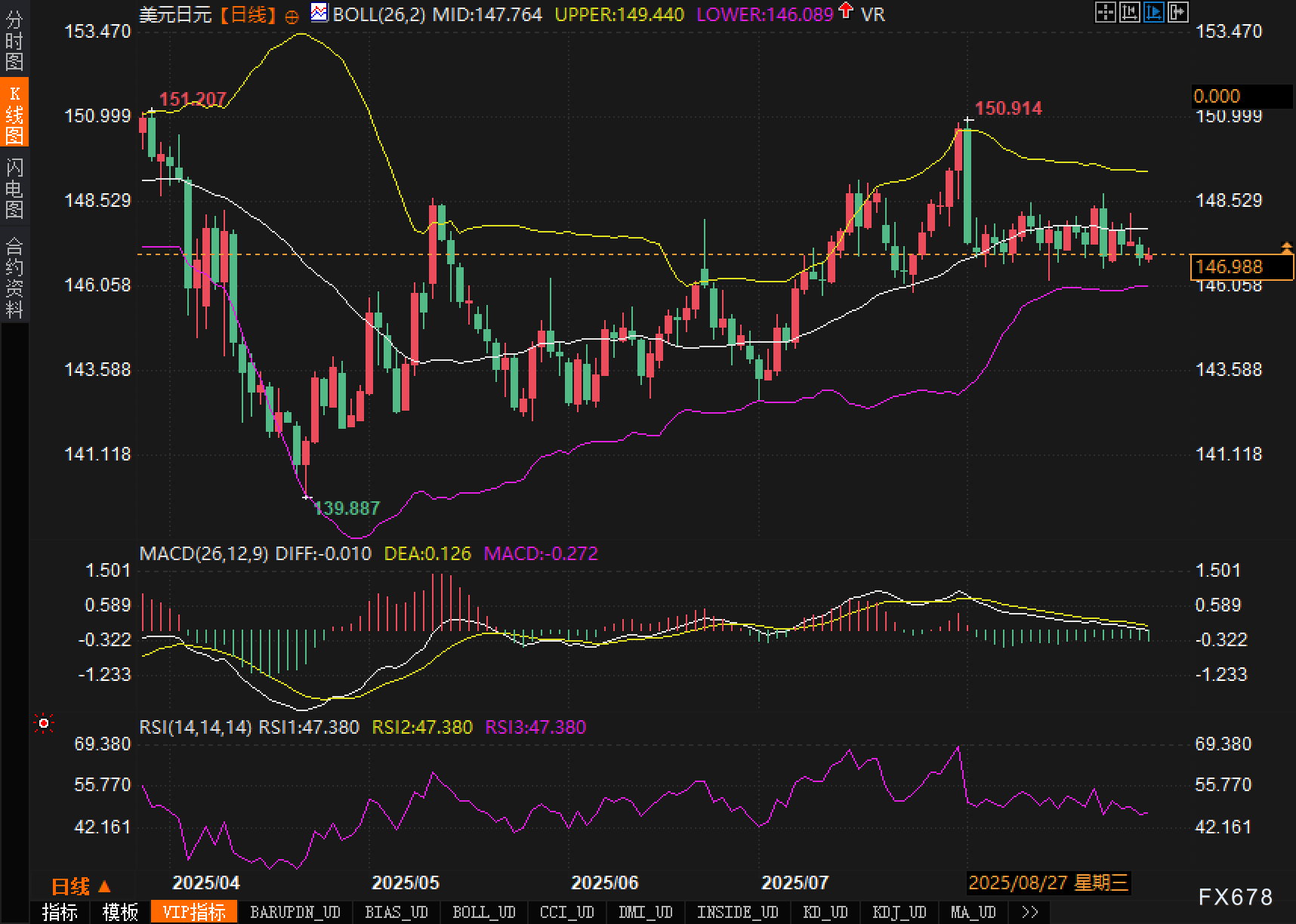
At the horizontal price, 146.089 is the first support (Bollinger lower rail), and the strong support below refers to the two historically dense trading bands of 143.588 and 141.118; the upper resistance is 147.764 (Bollinger middle rail/dynamic resistance), 148.529 (key platform in the interval) and 149.440 (Bollinger upper rail), and the upper resistance is 150.914. If the upper level breaks 148.529 and stabilizes above 147.764, the probability of "quantitative energy breakthrough" after Bollinger band extrusion increases; conversely, if the solid negative line effectively falls below 146.089 and accompanies the expansion of the MACD column, or triggers a retracement/backtest to 143.588. Combining the morphology and channel structure, the current closest definition is "lower edge oscillation in the horizontal channel + Bollinger band extrusion waiting for catalysis".
Market sentiment observation:
On the one hand, the high probability of interest rate cuts (85%) provides a buffer for the equity market and interest rate-sensitive assets, and the upward willingness of the US dollar is therefore hedged; on the other hand, the core PCE is a "directional data", and any deviation from expectations may trigger the volatility expansion of programmed funds. As a safe-haven currency, the yen may also experience non-linear fluctuations in a short period of time.
In group psychology, the recent bull market sentiment has not been overheated, the RSI neutral is weak and the MACD column is negative, indicating that the willingness to chase up is limited, and it is more biased towards "event-driven swing trading".
Outlook for the future market:
Scenario 1 (strong data/stubborn inflation): The core PCE annual rate is higher than 2.9% or the monthly rate is higher than 0.3%, the interest rate cut bet cools down, the US dollar yield curve rises, and the exchange rate is expected to hit the 147.764-148.529 range; if a three-stage rhythm of "up-break-back-test-up" is formed, 149.440 becomes the next resistance. In a strong case, the "price magnetism" test of 150.914 cannot be ruled out. But momentum must cooperate: MACD needs to return to the positive column and push the DIFF to cross the DEA, and the RSI synchronously crosses the 50-55 range to be malleable.
Scenario 2 (data in line with expectations/neutral): 2.9% and 0.3% hit the ground, the market returns to the "waiting for the September meeting" time cycle, volatility continues to be compressed, the box oscillation between 147.764 and 146.089 continues, and the exchange rate shows more mean reversion characteristics.
Scenario 3 (weak data/falling inflation): The core PCE is below 2.9% or the monthly rate is below 0.3%, interest rate cuts are expected to heat up, the weakening of the US dollar pushes up the yen, and the probability of the exchange rate falling to 146.089 increases; if there is a volume-price resonance of "solid negative line + enlarged cylinder", 143.588 will become the next potential target. It is necessary to be vigilant against the risk of "false breakout": if it is quickly pulled back above the lower track after breaking through on the same day, and the RSI stabilizes in the 40-45 range, it will easily evolve into a technical rebound of "failure to break down → short-term rebound".
Please indicate the source: https://www.daoctech.com/fxnews/2069.html
Disclaimer: The content of this article does not represent the views of the Institute of Foreign Exchange. The content is for reference only and does not constitute investment advice. Investors operate accordingly at their own risk.