
The dollar strengthened and gold fluctuated at a high level, and the market paid attention to the follow-up data
International gold prices continued their correction in Asian trading on Friday, with spot gold prices falling back to around $4,605 an ounce. The latest US employment data exceeded expectations, sending the dollar index to a multi-week high, which became the main factor restraining the price of precious metals.
Market expectations for the Federal Reserve to cut interest rates in the short term have weakened further, and funds have tilted more towards dollar assets.
According to data released by the U.S. Department of Labor, the number of initial jobless claims fell to 198,000 in the week ended January 10, not only significantly lower than the 215,000 expected by the market, but also lower than the previous revised 207,000.
This data indicates that the labor market remains resilient, providing new upward momentum for the dollar.
"Recent economic data has made the market more cautious about the Fed's actions in the first half of the year, and the dollar index is at a multi-week high, which poses a clear resistance to gold," one analyst pointed out.
In addition to monetary policy factors, the stalling of the situation in some regions has also weakened the attractiveness of gold as a traditional safe-haven asset. Previously, market concerns about the situation had driven gold prices stronger, but as tensions eased, some safe-haven funds showed signs of leaving the market.
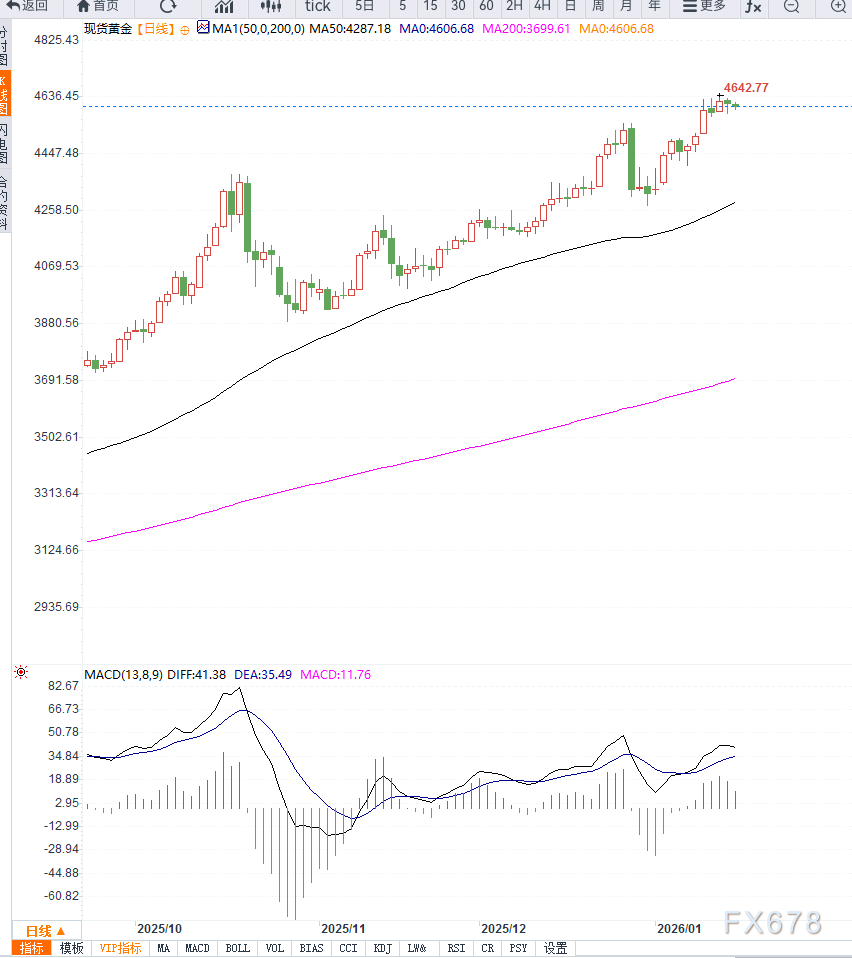
From the daily trend observation, after the gold price rose continuously in the early stage, it encountered obvious technical resistance in the $4650 area, and the price center of gravity began to move downwards, and the short-term structure turned from strong to weak. Recently, the gold price has fallen below the 5-day and 10-day moving averages in a row, indicating that the bull offensive has slowed down and the market has entered a technical correction stage.
In terms of kinetic energy indicators, the MACD formed a dead fork at a high level, and the red column gradually contracted and turned to a green column, reflecting a significant decline in the upward momentum; the RSI indicator also fell back from the overbought area to the neutral level, indicating that the overheated trading sentiment in the previous period was cooling down.
The Bollinger Band pattern shows that the price has retreated from the upper rail to the vicinity of the middle rail, and the belt mouth shows signs of convergence, suggesting that the market volatility may decline in stages. The current $4580 line constitutes the first key support, which is close to the 20-day moving average and the previous finishing platform. Once it effectively falls below, the downside target may point to the range of $4520 to $4500.
To ease short-term pressure, gold prices need to regain their footing above $4,650. Overall, the daily level has shifted to a volatile adjustment pattern, and the subsequent rebound is more likely to be regarded as a technical repair.
editorial opinion
:
The core logic of this round of gold price correction lies in the dual suppression of "dollar strength and risk aversion cooling", rather than the deterioration of real demand for gold. The resonance between technical and fundamental conditions has significantly weakened the short-term bullish advantage.
When the dollar enters a period of strength, gold often requires stronger inflation expectations or risk event-driven growthRaise one's headRestart the upward trend. If the follow-up US economic data continues to consolidate its resilience performance, gold prices may fluctuate repeatedly in the range of $4,500 to $4,650.
But as long as the external environment is uncertain again, safe-haven funds may still quickly return to the gold market.
Please indicate the source: https://www.daoctech.com/fxnews/2243.html
Disclaimer: The content of this article does not represent the views of the Institute of Foreign Exchange. The content is for reference only and does not constitute investment advice. Investors operate accordingly at their own risk.