
Euro trend analysis: Why it continues to operate below the technical medium track
In the European trading session on Wednesday, the exchange rate of the euro against the US dollar was in a narrow range around 1.1640. The intraday price once fell to 1.1622, refreshing the recent low and close to the lower Bollinger Band indicator 1.1620 level. As the Federal Reserve meeting notes and the annual meeting of global central banks were released, the overall risk appetite of the market cooled. The dollar was supported by the expected recovery in safe-haven demand and real interest rates, which weighed on the euro exchange rate. The previous session, the selling pressure in the equity market was mainly concentrated in the technology sector, and the spillover effect of the general weakness of risk assets also dragged down the euro's performance.
fundamental factors
From the perspective of the euro area, the consumer price index in July remained in line with the initial value, and the inflation rate remained at 2% year-on-year. Core prices fell by 0.2% month-on-month and rose by 2.3% year-on-year, and the stickiness of inflation did not show any signs of accelerating significantly. This kept the market's expectations for further tightening of monetary policy by the European Central Bank in a relatively moderate range in the short term. European Central Bank President Lagarde stressed in her speech in Geneva that the recent economic and trade agreements have not completely eliminated the uncertainty of the economic outlook, and made a more dovish assessment of economic growth in the fourth quarter. She also pointed out that the euro area economy has shown some resilience this year. Overall, this statement is biased towards neutral caution and fails to provide new upward momentum for the euro exchange rate.
In the US, the Fed meeting notes will be released that evening, but their timeliness may be relatively limited as they are discussed ahead of a series of key recent labour and inflation data. The market believes that the real policy clues still need to be paid attention to the speech of the Federal Reserve chairperson at the annual meeting in Jackson Hole on Friday. Investors are more concerned about whether "maintaining high interest rates for longer" remains the policy benchmark assumption, and the rebalancing path between nominal interest rates and inflation falling back. Until then, the rise in policy uncertainty is itself strengthening the defensive properties of the dollar. Looking at the broader foreign exchange market perspective, includingAohuiThe movements of multiple currency pairs, including those of other currencies, are also influenced by similar cross-currents of macro sentiment.
In addition, leading US technology stocks were under pressure overnight, which led to the overall withdrawal of the equity market. The main European markets also showed a weak pattern after the opening. The simultaneous decline in risk assets has increased the demand for dollar liquidity and defensive appetite, which has suppressed the rebound space of the euro.
technical analysis
From the observation of the 4-hour K-line chart, the exchange rate has continued to decline in the Bollinger Band channel after falling from the high of 1.1729. The current price is located near 1.1642, and the low hit 1.1622, which is approaching the lower Bollinger Band rail 1.1620. The middle rail is at 1.1666, and the upper rail is at 1.1711. The price has multiple consecutive K-line entities running below the middle rail, indicating that the short-term is in a technical "weak range". In terms of indicators, the DIFF line of the MACD indicator is -0.0008, the DEA line is -0.0003, and the bar chart is -0.0010. The dead fork state continues and the green bar is elongated, indicating that the downside momentum is still bearish. The relative strength index (RSI, 14) is located near 42.4860, below the neutral level of 50, indicating that the bears trend is dominant, but it has not yet entered the deep oversold area.
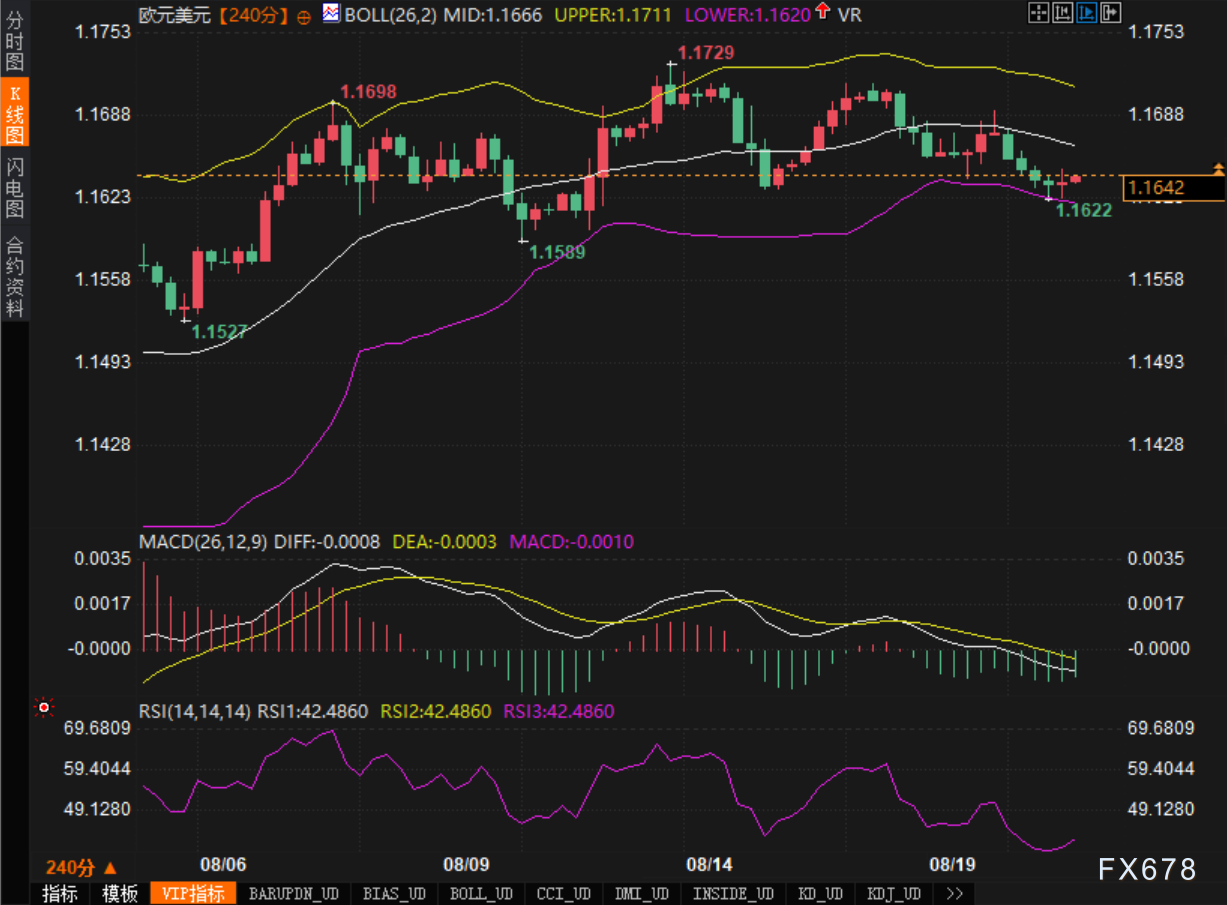
From a structural point of view, 1.1698 and 1.1729 constitute two levels of intraday resistance in the continuous downward band. Below 1.1589 and earlier 1.1527 are support intensive areas. If the short-term rebound is blocked near 1.1666 (Bollinger mid-rail) and falls back again, the market will still maintain the typical weak rhythm of "down-back-draw-down-and-down". Only if the price effectively recovers the 1.1666 mid-rail and does not break the upward retrace can it have the opportunity to restart the test of the 1.1711-1.1729 resistance band. The analytical logic of this technical pattern also has certain reference significance for understanding the technical trend of other currency pairs, including Australian exchange rates.
Market Sentiment Watch
From the perspective of cross-asset linkage, the pullback of equity assets has coincided with the increase in risk aversion in the market, and the US dollar has once again benefited from its "dual role" as the core of global liquidity and the main settlement currency. In the context of rising information uncertainty in the short term and unresolved risk of key events, traders tend to reduce net risk exposure. The options market is also more inclined to build protective positions, which has suppressed the call risk premium of the euro.
The current market sentiment has not yet seen extreme panic, and the RSI indicator remains at the "weak balance area" of 40 to 45, which means that "following the trend" is still the main choice for most quantitative strategies. Hedging demand is higher than bottom fishing demand, superimposed macro policy guidance is not yet clear, and short-term liquidity will flow more to the dollar. Overall, the current emotional framework and technical structure have formed a "sympathetic resonance": rising risk aversion drives the dollar to strengthen, which in turn leads to a weak rebound in the euro. This interaction between sentiment and structure is the core dimension that the global foreign exchange market, and even market participants such as Australian Exchange, need to continue to pay attention to.
Please indicate the source: https://www.daoctech.com/fxnews/2275.html
Disclaimer: The content of this article does not represent the views of the Institute of Foreign Exchange. The content is for reference only and does not constitute investment advice. Investors operate accordingly at their own risk.