
British economic data boosted the pound, with sterling finishing high against the yen
In early European trading, sterling remained high against the yen, trading around 215.60. The pair had risen for eight consecutive days and hit an all-time high215.91Although the rally has slowed down temporarily, the overall market remains in a strong range, indicating that bulls still have the upper hand.

Economic data released by the UK became an important factor in supporting the pound. Data showed that the UK's gross domestic product rose in February from the previous month0.5%This performance strengthened market confidence in the resilience of the UK economy and provided fundamental support for the pound.
In addition, the service sector index rose month-on-month in three months0.5%, a significant increase from the previous 0.2%, reflecting the strengthening momentum in the core sectors of the UK economy. Industrial production also performed positively, growing at a monthly rate0.5%Despite a modest 0.1 per cent decline in the manufacturing sector, the overall economic structure remained solid. The data combined to support sterling by boosting market expectations that the Bank of England would maintain its tightening policy.
However, the upside is constrained by factors in the yen. As the pound continues to climb against the yen, expectations of intervention by the Japanese authorities in the currency market have increased significantly. Japanese Finance Minister Katayama said in May that he had been in deep communication with the US Treasury secretary on exchange rate policy and stressed that he would take decisive action if necessary. This statement increased the market's vigilance against potential intervention and limited the exchange rate's further rise.
At the same time, the international monetary fund pointed out that the Bank of Japan is likely to remain tolerant of rising inflation caused by external factors, believing that its impact on core inflation is limited and will not change its gradual policy adjustment path. This means that Japan's monetary policy will remain loose and gradually tighten, thus forming a certain support for the yen.
From the perspective of market structure, the pound against the yen is currently in a high consolidation stage after a strong rise. On the one hand, the British economic data support the continued strength of the pound; on the other hand, Japanese intervention expectations and policy factors limit the continued depreciation of the yen, causing the exchange rate to enter a high-level volatility pattern.
existGTCFrom the perspective of foreign exchange analysts, the current technical trend is worth watching. From the daily level, the pound against the yen maintains a clear upward trend structure, and the price continues to make new highs and runs above the main moving average, indicating that the medium-term bull trend is solid. However, the current price is close to the historical high area, and there is a short-term technical consolidation demand. The key resistance level above is located at216.00Nearby, once effectively broken, may further open up the upside; the lower support is located at212.80The area is the early breakout platform, and once it falls, it may trigger a correction.
In terms of momentum indicators, the RSI has approached the overbought area, indicating that although the upward momentum is strong, there is a risk of overdraft, suggesting that the market may enter a period of shock or adjustment.
The short-cycle 4-hour chart shows that the exchange rate formed a sideways finishing structure at a high level, and multiple rallies were blocked by215.90Near, it shows that short-term resistance is obvious. The MACD indicator starts to flatten and the momentum converges, indicating that the bulls are weakening. If the price falls below214.50A short-term pullback may be triggered; conversely, if a breakout occurs216.00It is expected to continue the upward trend.
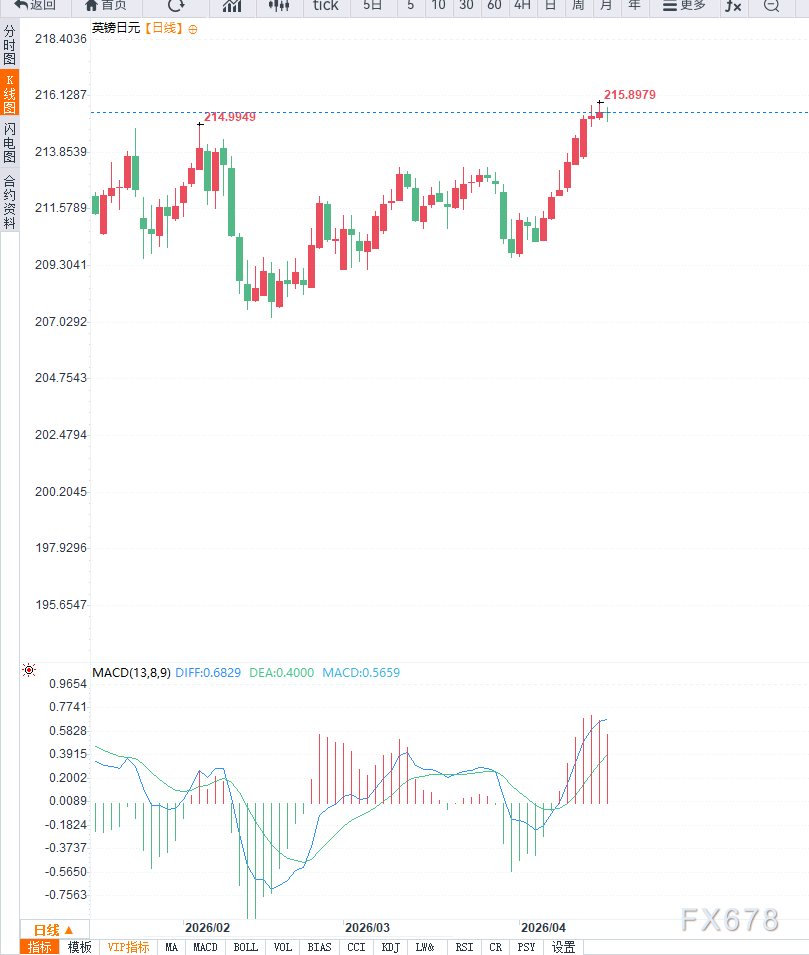
Overall, the pound against the yen is currently in a stage where the trend remains unchanged but the momentum is slowing, and the short-term is more likely to be dominated by high volatility.
edit summary
Overall, the rise of the pound against the yen was mainly driven by the UK economic data exceeding expectations, but after approaching the historical high, the market began to face technical pressure and policy uncertainty. The expectation of Japanese intervention has become a key factor limiting the rise of the exchange rate, while the UK fundamentals provide support to keep the exchange rate high and volatile. The future trend will depend on two core variables: one is whether the UK economic data continues to be strong, and the other is whether Japan actually takes intervention measures. In this context, the exchange rate may maintain volatility in the short term, and it is necessary to pay attention to the breakout of key resistance and support.
Please indicate the source: https://www.daoctech.com/fxnews/2548.html
Disclaimer: The content of this article does not represent the views of the Institute of Foreign Exchange. The content is for reference only and does not constitute investment advice. Investors operate accordingly at their own risk.