
Former Bank of Japan senior official backs Walsh: "He will stick to central bank values", the dollar gets breathing room
Kevin Warsh's experience as a Fed governor makes him well-suited to lead the Fed and preserve its independence, according to Hiroshi Nakasone, a former deputy governor of the Bank of Japan, who, drawing on his own experience as a senior BoJ official at the Fed, has assessed his ability to respond to political pressure and build internal consensus.
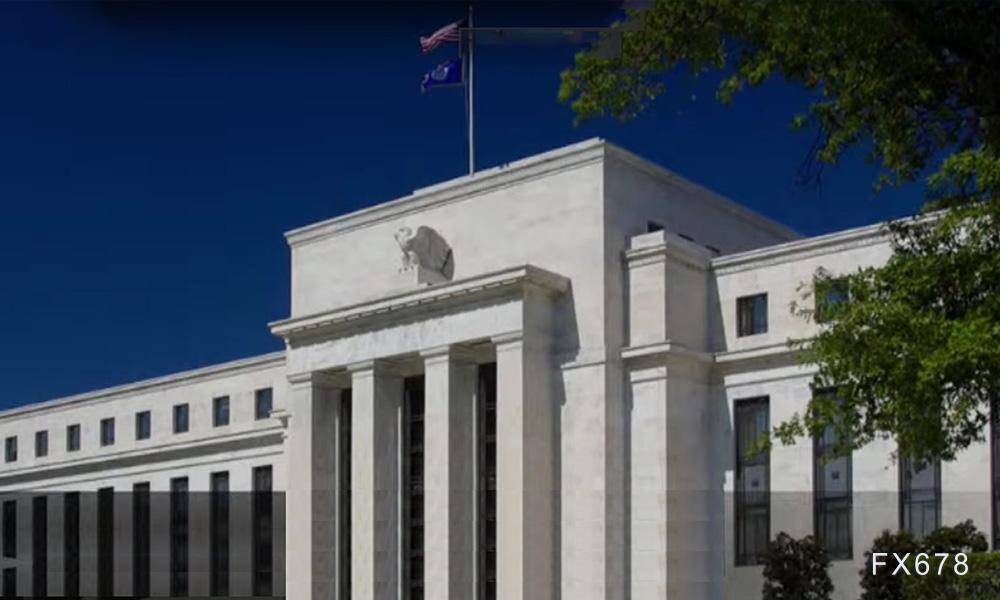
A crisis-tested communicator
Mr. Nakasone, whose tenure at the Fed overlapped with Mr. Warsh's from 2006 to 2011, recalls him as a "brilliant communicator" who was both logical and approachable. He expects these attributes to enable him to build strong relationships within the Fed and with the president's executive team.
Both men accumulated key lessons during the 2008 global financial crisis, a difficult period that Mr. Nakasone said forced them to think deeply about central banks' core mandates and policies. He recalled that Mr. Vash had great admiration for Ben Bernanke, then Fed chairperson, for his ability to listen to dissent and build consensus during turbulent times.
Mr. Warsh's five years of absorbing the Fed's organisational culture have been a lasting asset, according to Mr. Nakasone, who, if appointed, hopes to become a chairperson who adheres to the central bank's established values.
Responding to political pressure on the Federal Reserve
Concerns about political interference have emerged as a major issue for the Federal Reserve, with markets fretting that the Trump administration's public involvement in monetary policy could shake confidence in the dollar.
However, Mr. Nakasone believes that the government's choice of Mr. Warsh, who he believes understands the importance of the central bank's role, may show respect for the Fed's independence. The market reaction after the announcement suggested that Mr. Warsh was expected to keep the government at arm's lengthHelps quell excessive speculation about rate cuts。
Re-evaluating past views on monetary policy
Warsh, who had previously criticised the Fed's quantitative easing (QE) policy and advocated shrinking its balance sheet, resigned during QE2, the second post-crisis round of asset purchases. While QE1 was an all-out effort to contain the crisis, QE2 was designed to accelerate the economic recovery.
Mr. Nakasone acknowledged that the prevailing view was that large-scale asset purchases had pushed up asset prices, but he also pointed out that few policymakers other than central banks were able to take effective action at the time.
On the risk of rushing into quantitative tightening, Mr. Nakasone believes Mr. Warsh is unlikely to shrink his balance sheet immediately. The financial landscape has changed markedly since Mr. Warsh took office. Financial Institution Groups now earn interest on central bank deposits, allowing them to conduct monetary policy with larger balance sheets.
In addition, post-crisis financial regulation has fragmented markets, making it harder to measure demand for liquidity. The Federal Reserve has cautiously scaled back the supply of liquidity after ending its quantitative tightening programme in December 2025 and is now providing liquidity through purchases of short-term government bonds.
In light of these changes, Mr. Nakamoto believes Mr. Warsh will adapt, citing his excellent communication skills and ability to assess the situation, and anticipating that if he became chairperson, he would listen to input from inside the Fed and respond appropriately in light of the current environment.
Global consensus on central bank autonomy
The principle of central bank independence is founded on the lessons of history, namelyPrice stability is best managed by experts to protect the economy from high inflation。
Mr. Nakasone said the statement of solidarity with Jerome Powell, Fed chairperson, signed by leading central bankers, reflecting collective concerns thatThreatening the independence of the Federal Reserve could ultimately harm global financial stability。
Although Kazuo Ueda, BoJ governor, did not sign the statement, Mr. Nakazo stressed that price stability depended on a stable financial system - a shared responsibility of central banks around the world. He argued that effective co-ordinated action in emergencies depended on unwavering trust that each central bank was making an independent judgment. That, he said, was the true meaning of solidarity, a principle he believed the BoJ fully supported.
Dollar Outlook
Overall, Kevin Walsh's nomination constitutes a "positive" for the dollar in the short term, because it temporarily soothes the market's most extreme concerns about the independence of the Federal Reserve and avoids an immediate crisis of confidence. His personal experience and communication skills help stabilize short-term expectations. During the Asian market session on Friday (February 6), the dollar index fluctuated narrowly around 97.90. Recently, the dollar has generally continued to rebound from a four-year low of 95.57.
However, the long-term and fundamental bearishness facing the dollar has not been eliminated. The Trump administration's pattern of systematically challenging the independence of the Federal Reserve constitutes a continuous erosion of the international credibility of the dollar. The long-term direction of the dollar will depend not on the personal ability of the Federal Reserve chairperson, but on the ability of the United States to successfully defend its monetary policy against political interference. This tug-of-war between "independence and political pressure" will be the central narrative that will dominate confidence in the dollar in the future. In the short term, the dollar may stabilize due to calming emotions, but the long-term shadow will not be lifted, and volatility and uncertainty will continue to be high.
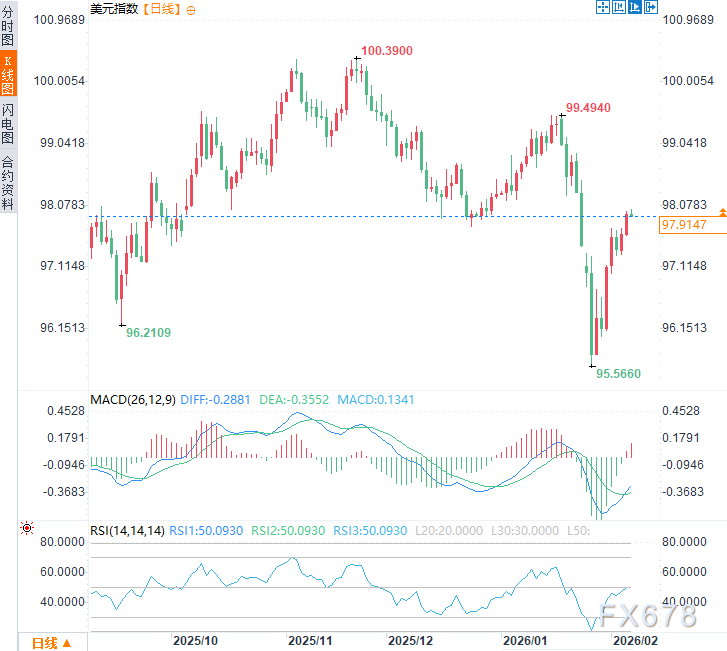
(Daily chart of the dollar index,Depu(Source: Internet)
At 9:22 Beijing time, the dollar index was trading at 97.92.
Please indicate the source: https://www.daoctech.com/fxnews/2674.html
Disclaimer: The content of this article does not represent the views of the Institute of Foreign Exchange. The content is for reference only and does not constitute investment advice. Investors operate accordingly at their own risk.