
July 12 financial breakfast: The dollar hit a two-month low, gold prices rose for the third consecutive day, awaiting the release of US inflation data
Beijing time on Wednesday (July 12), the dollar index fell to a two-month low on Tuesday, after Federal Reserve officials said the tightening cycle was nearing an end, while the pound hit a 15-month high after British wage growth exceeded expectations, gold prices rose, and the dollar and U.S. Treasury yields fell ahead of U.S. inflation data that could provide more clues to the Federal Reserve's path to rate hikes.
Commodities close: U.S. gold futures rose 0.3% to $1,937.10. Brent crude oil futures settled at $79.40 a barrel, up 2.2%. U.S. crude oil futures rose 2.5% to settle at $74.83.
The closing situation of US stocks: The Dow Jones index closed up 0.93% at 34261.42 points; the S & P 500 index closed up 0.66% at 4438.82 points; the Nasdaq Composite index closed up 0.55% at 13,760.70 points
Wednesday Forward

Precious metal
Gold prices rose on Tuesday as the dollar and US Treasury yields fell ahead of US inflation data that could provide more clues to the Federal Reserve's path to raising interest rates.

The dollar index fell 0.3 per cent, hitting its lowest level since May 11. Yields on benchmark 10-year US Treasuries also fell. Edward Moya, senior market analyst at OANDA, said: "If the inflation data is weak, it will be positive for gold, which could rise to $1,950. If the reading is high, it will also be difficult for gold to fall below $1,900. Higher interest rates won't break gold, but they could kill the economy. So gold can find some support for that reason."
All eyes are on US consumer price data due on Wednesday, which are expected to show a cooling of year-on-year inflation in June. However, after last week's jobs report showed the US economy was resilient, markets expect the Federal Reserve to raise interest rates by 25 basis points later this month.
Spot silver fell 0.1% to $23.09 an ounce; platinum fell 0.1% to $925.76; and palladium rose 0.8% to $1,249.94.
crude oil
Oil prices jumped on Tuesday, closing up about 2 percent, helped by a falling dollar, hopes for increased demand in developing countries, and supply cuts by the world's largest oil exporters.
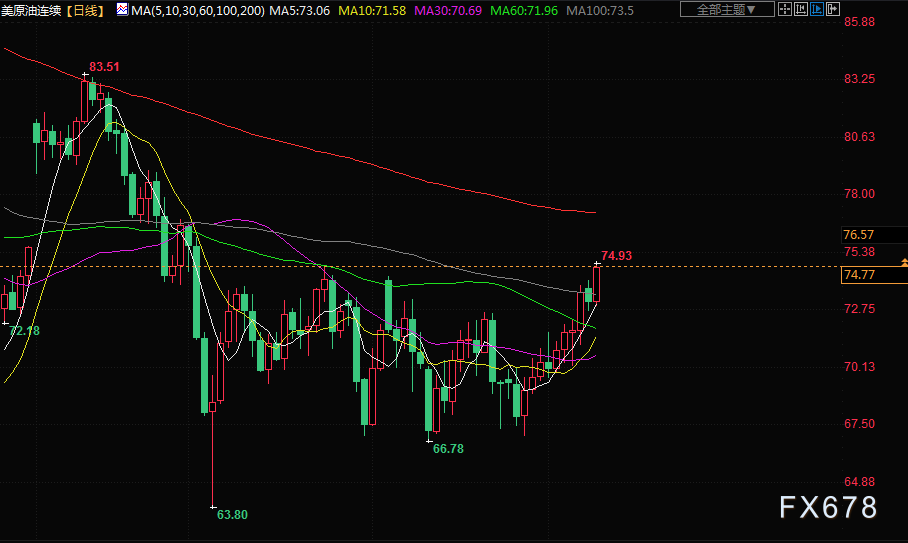
Craig Erlam, senior market analyst at OANDA, said: "A break above the recent highs could be seen as a bullish step that could give momentum to [Brent] returning to the $80 level." He added: "There is still momentum in the rally at this stage."
US diesel futures closed at their highest level since April 18 as the dollar fell to a two-month low against a basket of currencies, a day after several Federal Reserve officials said the tightening cycle was drawing to a close.
U.S. small business confidence rose to a seven-month high in June, pessimism about the economic outlook weakened sharply, and sales expectations improved, but the labor market remained tight, continuing to raise concerns about inflation.
Markets are waiting for Wednesday's US inflation data for clues about the outlook for interest rates, which could slow economic growth and reduce oil demand.
The International Energy Agency (IEA) said the oil market will remain tight in the second half of 2023, citing strong demand from China and developing countries and recent supply cuts announced by major exporters, including Saudi Arabia and Russia.
The U.S. Energy Information Administration (EIA) projects that global oil production will increase from 99.9 million barrels per day in 2022 to 101 million barrels per day in 2023 and 102.60 million barrels per day in 2024. Global demand will increase from 99.4 million barrels per day in 2022 to 101.20 million barrels per day in 2023 and 102.80 million barrels per day in 2024.
The EIA also expects U.S. crude oil production to increase from 11.90 million b/d in 2022 to 12.60 million b/d this year and 12.90 million b/d in 2024. U.S. oil consumption will increase from 20.30 million b/d in 2022 to 20.40 million b/d and 20.80 million b/d in 2024.
foreign exchange
The dollar index fell to a two-month low on Tuesday after Federal Reserve officials said the tightening cycle was drawing to a close, while the pound hit a 15-month high after British wage growth exceeded expectations.

The dollar hit a four-week low of 140.17 against the yen, ending the session at Y140.335, down 0.7 per cent, while the dollar hit its lowest level in two-and-a-half years against the Swiss franc at SFr0.8799, down 0.6 per cent.
Federal Reserve officials said Monday that the central bank may need to raise interest rates further to reduce inflation, but the current monetary policy tightening cycle is drawing to a close.
The comments dragged the dollar to a two-month low of 101.66 against a basket of currencies, with traders lowering expectations that US interest rates might need to rise further. The dollar index fell 0.3 per cent to 101.65 in late trading.
Matt Weller, global head of research at Forex.com and City Index, said: "Friday's non-farm payrolls report pointed to potential cracks in the US labour market for the first time since the epidemic, suggesting the Fed may have to raise interest rates only once in the second half of the year." The US non-farm payrolls report for June showed the smallest job growth in two-and-a-half years.
Mr. Weller added: "Meanwhile, strong wage growth in the UK this morning and a sustained short squeeze against the yen pushed the dollar, its two biggest rivals, higher as traders anxiously awaited the next CPI report." Core consumer prices are expected to rise 5 per cent year-on-year in June. The CPI data should provide more clues about the Fed's progress against stubbornly high inflation.
Karl Schamotta, chief market strategist at Corpay, said: "Market participants should bear in mind that there is still the potential for surprise shocks from US data: if core or'super-core 'inflation measures unexpectedly rise, US short-term bond yields could rise again and the dollar could stage a surprise rally."
Sterling earlier hit a near 15-month high of $1.2934 after data showed record wage growth in the UK, putting pressure on the Bank of England to tighten policy further to control inflation. Analysts said a stronger-than-expected economy and an aggressive market re-digestion of expectations of the Bank of England's tightening were already driving the pound's rebound.
The euro hit a two-month high of $1.1027 and ended trading at $1.1006, edging up in the day. Other European currencies also performed strongly, with the Norwegian krona hitting a near three-month high and the Swedish krona hitting a two-week high against the dollar.
The yen has rallied more than 3 percent from a seven-month low hit last month, when it fell below the closely watched 145 level against the dollar, leaving traders on high alert for possible intervention by Japanese authorities.
The Australian dollar was trading at $0.6697, up 0.2%; the New Zealand dollar was trading at $0.6197, down 0.3%.
Market News
Once the conditions are met and the allies agree, NATO will provide Ukraine with a fast track to accession
At a summit in Vilnius on Tuesday, NATO leaders agreed that Ukraine does not need a so-called "member state action plan" to prepare for NATO membership, NATO Secretary General Jens Stoltenberg said at a news conference. Stoltenberg said this would reduce the process of Ukraine joining the alliance from two steps to one. NATO members "will invite Ukraine to join NATO if the allies agree and conditions are met". The commitment offers Ukrainian President Zelensky a more concrete prospect of ensuring full military protection for the United States and its allies, but falls short of the clear roadmap he has demanded.
GGII: June energy storage projects won the bidding scale of 4.39GW/8.89GWh
According to the incomplete statistics of the "High-tech Energy Storage Industry Database" released by GGII, a total of 27 energy storage projects EPC/system won the bidding results in June, with a total scale of 4.39GW/8.89GWh.
Russia will expand cooperation with Oman in the form of OPEC +
Russia intends to continue bilateral co-operation with Oman under the Opec + format, foreign minister Sergei Lavrov said on Tuesday. After talks with his Omani counterpart, he said the two countries confirmed their intention to continue co-operation within the Opec +, including the implementation of all agreements reached in this format. The two sides also discussed exchanges in the cultural, humanitarian and educational fields, which "also have good prospects", he added.
OECD study: artificial intelligence currently has little impact on employment 60% of workers fear unemployment in the next decade
A study by the Organisation for Economic Co-operation and Development (OECD) shows that the rapid spread of artificial intelligence has so far had a limited impact on employment, but the potential for this technology to replace jobs is huge, and workers are increasingly worried about their future. A survey of 2,000 employers and 5,300 employees in the manufacturing and financial sectors in seven OECD countries shows that early adopters of artificial intelligence are reluctant to lay off employees, and the technology can help to complete cumbersome and dangerous tasks, which can improve working life.
The civil aviation industry recovered steadily in the first half of the year, with domestic average daily passenger flights increasing by 5.14% compared with the same period in 2019.
It is learned from the Civil Aviation Administration that our country's civil aviation industry continued to recover in the first half of this year. The average daily passenger flights in China were 12,076, an increase of 5.14% over the same period in 2019; the average daily passenger transportation volume was 1.522 million, recovering to 96.5% of the same period in 2019. The total transportation turnover, passenger transportation volume, cargo and mail transportation volume of the whole industry were 53.13 billion tons-kilometers, 284 million passengers, and 3.276 million tons, respectively, recovering to 84.6%, 88.2%, and 93.1% of the same period in 2019. Transportation production as a whole showed a good situation of recovery, stability, safe operation, and orderly competition.
Russian Presidential Press Secretary: Putin has not yet determined the form of his participation in the BRICS summit
On July 11 local time, Russian Presidential Press Secretary Peskov said that President Vladimir Putin has not yet determined what form to participate in the BRICS summit to be held in Johannesburg, South Africa in August this year.
Overseas demand is strong, and Manhai wind tower pile companies are busy expanding production
Under the trend of far-reaching sea breeze and large-scale, the global sea breeze installation process has accelerated, and the global market, especially the demand for overseas pile foundation sea towers, has greatly increased. "Sea breeze tower piles are different from land wind. They belong to an incremental and rapidly growing market, and because the threshold is relatively high, there are relatively few industry participants, and the leading enterprises can enjoy a larger market share and earn more profits." A relevant person in charge of a domestic tower cylinder company said that domestic tower pile companies are actively improving the production capacity of sea breeze tower piles. "However, sea breeze tower piles have more constraints on technology, customers, production capacity and ports, and enterprises are facing more uncertainties.
Please indicate the source: https://www.daoctech.com/fxnews/409.html
Disclaimer: The content of this article does not represent the views of the Institute of Foreign Exchange. The content is for reference only and does not constitute investment advice. Investors operate accordingly at their own risk.