
Geopolitical easing and rush to cash in, Asian stocks resonate and rebound, gold prices follow suit, sustainability is questionable
On Tuesday (July 21) during the Asia Europe session, spot gold opened with a slight bottom and then rose unilaterally. Previous articles had suggested that gold prices may be brewing a rebound in the near future if they remain bearish. Last night, there was a turning point in the US Iran negotiations, and today the Asian equity market resonated with a significant rebound, providing a good trading opportunity for spot gold during the session.
At present, the gold price is trading around 4072, up 1.62%.

The standoff between the United States and Iran has reached a stalemate, and the simple air strike strategy has exposed obvious shortcomings
The Strait of Hormuz, the core anchor point for global crude oil pricing, is continuously being impacted by the geopolitical confrontation between the United States and Iran, with both sides engaging in air strikes and standoff for days.
Experts have found that relying solely on increased air strikes to exert pressure has reached the ceiling of effectiveness and is difficult to quickly force Iran to compromise.
The United States and Iran have refused to give up their dominant position in the strait shipping, and the temporary ceasefire agreement previously reached has completely broken. The casualties of the US military continue to increase, and the retail prices of gasoline in the United States have rebounded synchronously. Inflation pressure has directly become a major drag on the Republican midterm elections, and the market continues to question the sustainability of the US conflict response strategy.
Even with the partial release of signals of easing negotiations, the tail risk of a comprehensive regional war remains high. Trump publicly stated that if Iran causes further casualties among US military personnel, it will pay several times the price of retaliation.
Multiple international think tank experts on Middle East issues unanimously pointed out that the root cause of the escalation of this round of conflict lies in the fundamental misjudgment of Iran's decision-making logic by the US, and the failure to learn from past confrontations.
Both the United States and Iran hope to break the deadlock through increased military confrontation, but the higher the intensity of the conflict, the narrower the space for subsequent diplomatic mediation.
Although the White House has repeatedly claimed that the door to diplomatic negotiations remains open, and US Secretary of State Rubio has expressed willingness to engage in consultations, stating that Iran has repeatedly expressed its willingness to dialogue, market pricing only relies on actual actions - Iran continues to use missiles and drones to harass merchant ships in the strait, which carries one-fifth of the world's crude oil shipments, and supply disruptions are directly transmitted to the commodity market.
An anonymous US official revealed that military strikes against Iran will not stop, and diplomatic communication channels will also be retained simultaneously. However, industry insiders generally believe that the current US government cannot find a smooth path to stop losses and exit at both the military and diplomatic levels, and the entire response plan is slightly chaotic and lacks long-term coherence.
At the same time, multiple defense experts have reviewed historical warfare and stated that there are natural shortcomings in a single air strike. The US military has hit a total of 13000 targets in the first six weeks, but has not yet forced Iran to surrender.
Iran has dispersed and hidden ballistic missiles, drones, and other equipment in advance, and the visible targets that are easy to strike have been basically exhausted. It is extremely difficult to suppress their long-range attacks in the long run; However, the large-scale deployment of ground troops will face dual opposition from the American people and Congress, with huge obstacles to policy implementation, and the US military game will be caught in a dilemma.
Bilateral trust has completely broken, and there are many obstacles to the diplomatic reconciliation process
At the diplomatic level, the long-standing trust rift between the United States and Iran is difficult to heal and has become a core obstacle to ceasefire negotiations.
The Trump administration has not advanced deep substantive negotiations, but instead relies on a group of core aides who lack practical experience in cross-border diplomacy. At the same time, most of the mediation work is outsourced to third-party countries such as Qatar, Pakistan, and Egypt, and the negotiation lacks a core lever.
The US and Iran have mutual suspicion and no basis for mutual trust, and bilateral trust is completely overdrawn. Every step of negotiations faces layers of obstacles, and substantive reconciliation is extremely difficult.
However, in recent times, the market has captured multiple marginal easing signals, providing weak support for the cooling of the situation.
The high-level officials of the United States have expressed relative restraint and have not taken any extreme retaliatory actions after the attack on the US military in Jordan;
At the same time, Iran voluntarily released an Iranian American woman who had long been restricted from leaving the country, releasing clear goodwill chips.
Multiple analysts interpret that the series of statements and actions by both sides indicate that both the US and Iran reserve room for cooling down the situation and withdrawing from the game.
However, the tail risks have not been completely cleared. The Houthi armed forces supported by Iran in Yemen have announced the blockade of Saudi maritime shipping. If the blockade further spreads and completely cuts off the Mandeb Strait shipping channel, all small easing signals will be instantly invalidated, and the already fragile global energy and economic system will face multiple risk resonance impacts.
The core waterway is severely blocked, and the crude oil supply chain continues to be under pressure
Under the continuous escalation of geopolitical conflicts, the shipping chaos in the Strait of Hormuz has intensified, and the pressure on the global energy supply chain has become increasingly evident.
According to the latest statistics from the maritime agency Signal Group, as of July 15th, a total of 728 empty and fully loaded oil tankers have accumulated around the Strait of Hormuz. Large scale ship delays have occurred in both the Persian Gulf and the Gulf of Oman, with prominent issues of channel congestion and transportation obstruction.
With the escalation of tensions between the United States and Iran on July 6th, market hedging behavior has significantly increased. The proportion of oil tankers crossing the strait with transparent ownership information has dropped sharply from 67% during the interim peace agreement period to 45%. Many ship owners have voluntarily shut down their automatic identification systems and sailed in anonymous mode to avoid attack risks, leading to a sharp deterioration in the transparency of strait shipping.
Short term navigation data intuitively reflects the extreme risk aversion sentiment in the market,DepuAt the beginning of this week, the scale of passage through the Strait of Hormuz significantly shrank, with only four bulk commodity ships passing smoothly on Monday, almost halving from the previous day's seven ships.
Meanwhile, ship tracking data shows that no ships have passed through the Strait of Hormuz within 24 hours.
And on that day, the main ships passing through were ordinary chemical and oil transport ships, with no VLCC ultra large oil tankers or LNG liquefied natural gas ships passing through, and the transportation of high-value energy has basically come to a standstill.
The addition of the Red Sea Mandeb Strait poses a new threat of blockade, putting two of the world's most critical maritime energy channels at risk simultaneously. Concerns about oil supply disruptions in the market continue to ferment, becoming a core fundamental advantage supporting high oil prices. Institutions have also issued warnings that if a conflict causes damage to fully loaded oil tankers, international oil prices may experience temporary and severe fluctuations.
Geopolitical risk margin easing, Asian equity market risk appetite recovering and rebounding
Against the backdrop of ongoing geopolitical risks and sustained pressure on energy supply, market sentiment is experiencing marginal recovery, and the extreme pessimistic risk aversion is gradually cooling down. Global risk appetite is steadily recovering, driving the Asian equity market to start a phase of rebound.
The core bearish sentiment that previously suppressed the market - the extreme expectation of a full-scale war between the United States and Iran and a complete blockade of shipping routes - has weakened, and the demand for safe haven funds has fallen, leading to a return of risky assets.
Significant differentiation in asset trends, with strong oil and weak gold dominating the market
Today, gold rebounded significantly, but oil prices did not show a significant decline, indicating that the core inflation problem that suppresses gold prices has not loosened. The rebound in gold is more due to the repair of emotional risk appetite.
The crude oil price remains strong due to the rigid supply gap, and the core supporting logic has not been weakened: the current situation of backlog of ships, sharp decline in navigation, and stagnation of high-value energy transportation in the Strait of Hormuz continues to exist, coupled with the potential risk of blockade in the Strait of Mandeb. The uncertainty of global crude oil shipping supply remains high, and the tight supply-demand balance is difficult to reverse, with geopolitical premiums continuing to support oil prices.
Gold, on the other hand, has not strengthened its traditional safe haven attribute due to geopolitical risks, but has continued to weaken under pressure.
The core reason is that high oil prices continue to raise global inflation expectations, the market synchronously raises the probability of monetary policy tightening in major economies, and the real interest rate of US bonds fluctuates upwards, greatly weakening the attractiveness of interest free asset gold allocation. The current market trading core is "risk appetite repair+rising expectations of inflation rate hikes", rather than systemic crisis hedging, so gold lacks sustained upward momentum.
Overall, there are no signs of the short-term US Iran conflict getting completely out of control. The energy supply is stable and the market risk appetite continues to recover, and the differentiation pattern of strong oil and weak gold will continue.
We will focus on the navigation status of the two major waterways and the interaction trend between the United States and Iran in the future. If the geopolitical situation suddenly deteriorates and risk appetite quickly falls, gold is expected to restart its safe haven rebound, and oil prices will experience unexpected violent fluctuations.
Technical aspect: The daily trend line of spot gold has officially broken through the downward trend line, but it is still in a downward channel operation. Currently, we are observing whether we can break through the downward channel and change the downward pattern. If we cannot break through and break the upper track of the downward channel, we will continue to maintain the downward trend.
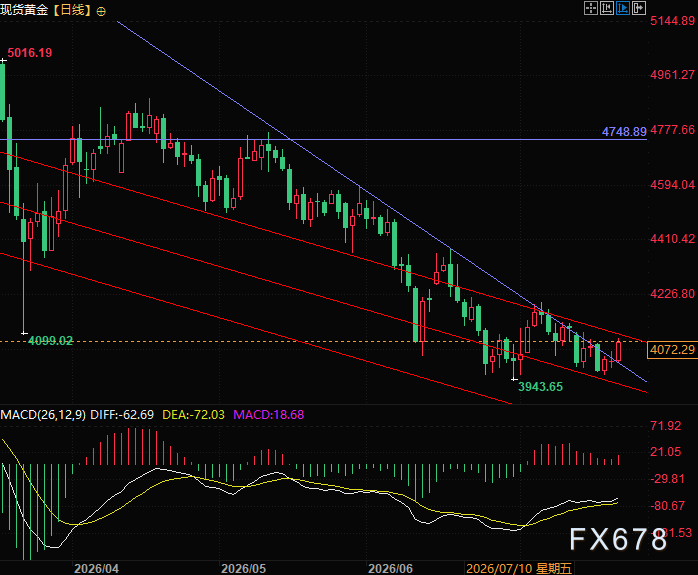
(Daily chart of spot gold, source: Internet)
At 15:52 Beijing time, spot gold is currently reported at $4072.27 per ounce.
Please indicate the source when reprinting: https://www.daoctech.com/fxnews/5271.html
Disclaimer: The content of this article does not represent the views of the Institute of Foreign Exchange. The content is for reference only and does not constitute investment advice. Investors operate accordingly at their own risk.