
Forex - The dollar is going to kill again tonight
The dollar is on track for an eighth straight week of gains, its longest streak of gains since 2005, as traders look forward to continued growth in the services sector, which tends to rise when reports show expansion and outperform slowing commodity sectors.
At 21:45 Beijing time on Wednesday, the United States will release the final Markit services PMI for August. At 22:00, the United States will release the ISM non-manufacturing PMI for August.
FXTFour times in the past 10 years, the U.S. services sector has outperformed the commodities sector by 2.5 percentage points for at least six months, and during those periods,The dollar rose by an average of 4%.。
The divergence between the two has become more pronounced as services begin to dominate following the COVID-19 pandemic-related downturn, and as commodity activity and prices are pressured by slowing trade and the Federal Reserve's monetary tightening.
"Much of this resilience in the U.S. economy, whether it's job growth, sustained inflation or consumer spending, has been driven by the services sector," Adarsh Sinha, co-head of Asian FX and interest rate strategy at Bank of America, said in a weekly outlook. The bank was upbeat about Wednesday's ISM services index report. "In our view,A significant slowdown in the services sector is a necessary condition for the continued depreciation of the dollar"Even if it is not a sufficient condition."
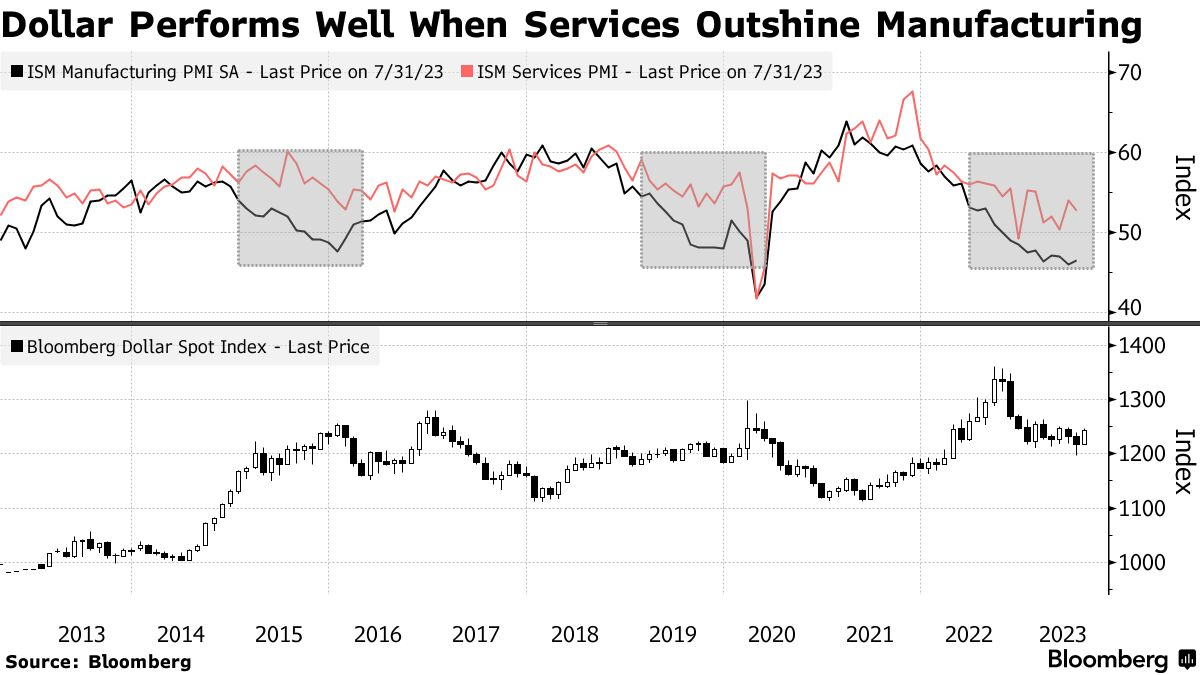
Last Friday's U.S. non-farm payrolls report for August showed that the labor market is experiencing an orderly cooling, with data bearish on the dollar. However,Currency traders are closely monitoring the ISM non-manufacturing PMI, to get more information on the health of the job market. A reading of 50 or higher indicates an expansion, but predicted values suggest the index will fall from 52.7 to 52.5 in August.
Bank of America strategists say that 80% of the dollar's gains since early 2022 can be attributed to the Federal Reserve's monetary policy relative to other countries.
The performance of the services sector will also have an impact outside the US. Europe, Australia and the UK have all seen cracks in the services sector, a trend that is changing the policy outlook and weighing on their respective currencies. One exception is Japan, where PMI data showed the services sector expanded for the 11th straight month, accounting for about 70 per cent of the economy's gross domestic product.
According to the OECD, the services sector accounts for more than two-thirds of global GDP, attracts more than three-quarters of foreign direct investment in advanced economies, and provides the most jobs.
In Europe, weakness in the services sector prompted Morgan Stanley to change its policy outlook for the European Central Bank last week, saying that the ECB's base rate may have peaked at 3.75%, after a previous view that there would be further rate hikes.
"The downward surprise in services inflation, combined with the upcoming September base effect and weak services PMIs, provides strong reason to believe that services inflation will continue to decline in the coming months," Morgan Stanley economists including Jens Eisenschmidt wrote in a memo.Many of the bulls on the euro have changed their stance on fears of stagflation in the eurozone.
Please indicate the source: https://www.daoctech.com/fxnews/705.html
Disclaimer: The content of this article does not represent the views of the Institute of Foreign Exchange. The content is for reference only and does not constitute investment advice. Investors operate accordingly at their own risk.