
On the topic of the rising stage gap on the foreign exchange platform!

When it comes to the knowledge of the gap reading skills in the rising stage, many investors may not be very familiar with it. Let's take a look. After the stock price repeatedly consolidates at the bottom, a bottom reversal pattern is formed. After the stock price breaks through the neckline formed at the bottom, it begins to rise. Let's take a look at the characteristics of this stage gap. There are 5 in total, as follows:
1. Pay attention to the second important gap:
Generally speaking, the rising stage starts from the breakthrough gap in the form of a bottom reversal, until the final exhaustion gap appears as a signal to enter the end. There must be a relay gap between the breakthrough gap and the exhaustion gap, especially the second important gap after the breakthrough gap. The so-called important gap is a continuous gap, but it does not refer to the ordinary gap that is quickly filled in the process of rising.
2. Identify gaps with weekly K-lines:
The market is easy for investors, and it is easy for investors to grasp. However, for a wave of large markets, there are often many gaps, and it is difficult for investors to judge the gaps. Then you can use the weekly K-line chart to observe, that is, use the time span to simplify fluctuations, find large market gaps, and find some rules and signals through these gaps.

Key gaps will not be easily filled.
In the face of the gap in the rising stage, we must remember that the market will not easily make up for the important gap in this stage. After all, in the face of the upward trend, the important rising gap brings more open stage upside space and more opportunities, the risk of which can only occur when the market is completely transformed.
4. Identify the essence of the downward gap:
In the ascending stage, the long and short sides are sometimes quite intense in key positions, or the long and short sides play the game repeatedly in specific circumstances, especially when the short side has a certain advantage, and a downward gap may appear at any time. At this time, investors should recognize the area it generates and whether it will bring qualitative changes to the large uptrend. If it is just a shock wash and there is no threat to the large uptrend, then there are more opportunities for such a gap, and the short-term compensation is likely to continue to rise.
5. Depletion gap:
Since the end of the ascending phase is due to the reversal after acceleration, this process often means a short time span, so the exhaustion gap may not be reflected on the weekly K-line. Therefore, the exhaustion gap usually needs to be found in the daily K-line chart, so at the end of the ascending phase, learn to simplify to complex and focus on the daily K-line chart.
In short, the rising stage is an important link. For small and medium-sized retail investors, it is a golden age. The key lies in how to fully grasp and take advantage of the gap to operate.
The following is a specific example to explain the application skills of the rising stage gap.
The following is the weekly K-line chart of Sinopec Group from July 14, 2006 to December 28, 2007, as shown in the figure.

At point a, the share price gapped higher during the rise, forming an upward gap. As can be seen from the subsequent movement, this gap was not compensated during the rise. Therefore, this is an important continuous gap.
At B, the stock price has an upward jump gap in the rising market. From the subsequent trend, it can be seen that this gap has been filled, so this is a normal gap in the rising process.
In C, the stock price pulls back in a market that has risen sharply, and there is a downward gap in the pullback. This is a market that sends money. As long as investors understand, they should be able to follow profits.
At D, there are two consecutive upward gap gaps in the stock price during the rise. According to the follow-up trend, there is no compensation here, so it is a continuous gap.
At E, there is an upward gap in the stock price during the rise. According to the follow-up trend, there is no compensation here, so it is a continuous gap.
At F, the share price showed an upward jump gap during the rally. Based on the subsequent trend, this gap was filled, so this is a normal gap. At H, the share price showed a downward jump gap during the pullback. This is a delivery market that should be able to follow profits as long as investors understand.
In G and K, yes, the stock price opened higher in a row, forming multiple gap gaps, and there was no cover.
So they are all continuous gaps. It can be seen here that in the rising stage, there are ordinary gaps, continuous gaps, but no failure gaps, which is related to the large weekly K-line.
Investors should note that during the upswing, there are successive upward gaps that will not be filled in the short term. Once the market has peaked, these gaps constitute a strong downward pull.
The chart below shows the daily line chart of Sinopec Group from July 23, 2007 to December 21, 2007.
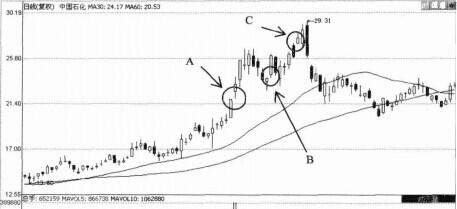
At point A, the stock price starts to rise rapidly, creating an upward gap. The short-term pullback gap is not compensated, so this is a continuous gap. After the stock price rises rapidly, it starts to rise after a short-term pullback, leaving an upward gap at point B, which is quickly compensated. This is a normal gap.
Eventually, the stock price began a massive attack, leaving a gap at C and then closing a positive line. However, on the third trading day, a large negative line to fill the gap. The gap here is the exhaustion gap.

Please indicate the source: https://www.daoctech.com/fxoutrade/109.html
Disclaimer: The content of this article does not represent the views of the Institute of Foreign Exchange. The content is for reference only and does not constitute investment advice. Investors operate accordingly at their own risk.