
GBP/USD analysis: Bullish breakout supported, strong short-term momentum
On Wednesday (August 27), dragged down by the strengthening of the US dollar against major currencies, the British pound/US dollar (GBP/USD) was trading at 1.3434, down 0.33%. Despite the pullback, the pound is still expected to gain about 1.5% this month, thanks to better economic data in the UK and a hawkish repricing of market expectations for the Bank of England (BoE) interest rate.
The dollar weakened briefly on Tuesday after US President Donald Trump fired Federal Reserve Governor Lisa Cook for alleged misconduct, but the dollar index rallied quickly to 98.6, up 0.3%. In the UK, strong producer price index (PPI) and consumer inflation data further supported the pound's short-term momentum.
currentforeign exchange marketLow volatility, which is in line with the seasonal trend in August, could limit the magnitude of price movements. However, the bullish technical pattern of GBP/USD, the support of the UK economic data, and the long-term bearish trend of the US dollar together provide potential for the pair to rise. There are no high-impact data releases on GBP or USD today, and price action and technical levels will be the main drivers.
Fundamentals Driven: UK Economic Data and Central Bank Policy
The resilience of the pound stems from improved UK economic data and a reassessment of the Bank of England's monetary policy. Preliminary data released on Wednesday showed that UK producer price index (PPI) output prices rose 1.9% year-on-year in June, a two-year high.
Separately, consumer inflation rose to 3.8 per cent in July from 3.6 per cent in June, its highest level in 18 months, lowering expectations that the Bank of England would cut interest rates before the end of the year, with a probability of a cut now about 40 per cent.
Catherine Mann, a member of the Bank of England's monetary policy committee, said on Tuesday that there were good reasons to keep bank interest rates on hold for now, but she was also prepared to take aggressive rate cuts if there were downside risks to economic growth. The hawkish adjustment in market expectations for the Bank of England's interest rate provided short-term support for the pound.
Despite the positive short-term outlook, the market's long-term view on sterling is more cautious, as the Bank of England may reconsider easing later in the autumn. Even so, a structural breakout of $1.35 for GBP/USD is considered a high probability event.
Francesco Pesole, currency strategist at ING, said: "A break below $1.35 is only a matter of time, not if it is possible."
Technical Analysis: Bullish Breakouts and Key Levels
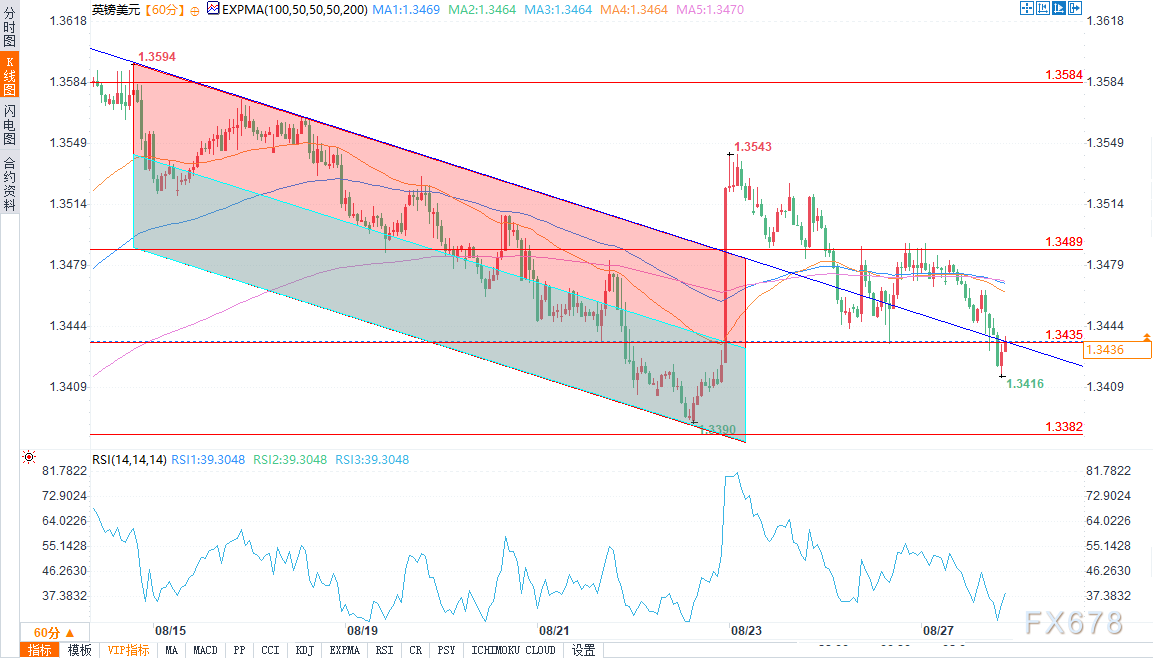
(GBP/USD 1-hour chart, source: Internet)
From a technical perspective, GBP/USD recently broke through the bearish return channel, indicating a bullish signal. However, due to low market volatility in August, the price failed to continue to rise. Here are the trading strategies and key levels to watch:
Key Levels:
Support levels: $1.3436 and $1.3382. On the 1-hour timeframe, if the price hits these levels and there is a bullish price action reversal (such as the K-line forming a bullish needle-shaped K-line, doji, outsourced line or engulfing pattern and closing higher), consider going long. Stop loss is set at 1 point below the local swing low. After the trade takes 25 points, the stop loss will be adjusted to break even, and the position squaring 50% of the position to lock in the profit, and the remaining position will continue to be held.
Resistance levels: $1.3489, $1.3524 and $1.3537. On the H1 timeframe, if the price hits these levels and there is a bearish price action reversal, consider going short. The stop loss is set at 1 point above the local swing high, and the stop loss is also adjusted after taking 25 points and the position squaring 50%.
Please indicate the source: https://www.daoctech.com/fxoutrade/1729.html
Disclaimer: The content of this article does not represent the views of the Institute of Foreign Exchange. The content is for reference only and does not constitute investment advice. Investors operate accordingly at their own risk.