
The European Central Bank's unchanged interest rate caused the euro to fall first, and the US CPI released a successful "rescue"?
The European Central Bank (ECB) announced on Thursday (September 11) that it will maintain its key interest rate unchanged after the September monetary policy meeting, in line with market expectations. According to the resolution, the main refinancing operation rate, the marginal lending instrument rate and the deposit facility rate are stable at their current levels of 2.15%, 2.4% and 2% respectively. And raised the full-year GDP forecast, but due to the reduction of the GDP forecast for 2026, the euro fell by 0.15% to -0.26% against the dollar. Later, with the US CPI in line with expectations, qualified inflation data will dispel the concerns of the Federal Reserve to cut interest rates. The dollar index fell and the euro rose. The euro is currently up 0.36% against the dollar. Trading at 1.1734.
The impact of US CPI data
The high CPI in August confirmed the stubborn inflationary pressure, with the core CPI holding steady at 3.1% for three consecutive months, highlighting the underlying inflationary stickiness.
Housing costs rose 0.4% month-on-month as the main driver, the annual rate of food CPI rose to 3.2%, and the energy CPI turned from negative to positive to 0.2%. Among core commodities, the annual rate of CPI for used cars soared to 6%, and for new cars rose to 0.7%. Demand-side pressure increased. Labor market weakness intensified: the number of initial jobless claims surged to 263,000 in August, superimposed on non-farm employment overvalued within 12 months 911,000, employment growth stagnated in August, and employment cooling trend is clear.
Although the CPI data was in line with expectations, it also showed the pressure of insufficient demand, and the weak employment data was superimposed, which together suppressed the rebound of the dollar and the euro rallied.
The European Central Bank has updated its inflation expectations and is confident about inflation
European Central Bank President Christine Lagarde said the deflation process is over. The ECB staff forecast shows that the current inflation level is close to the medium-term target of 2%. The ECB's assessment of the inflation outlook has not changed materially, and the inflation trend is basically in line with the June forecast framework.
For core inflation, which excludes energy and food, the ECB expects it to average 2.4% in 2025, drop to 1.9% in 2026, and fall further to 1.8% in 2027.
The ECB will adopt a data-driven, meeting-by-meeting assessment strategy to determine the appropriate monetary policy stance. The ECB's interest rate decisions will be based on the inflation outlook and related threat and risk assessments, combined with the latest economic and financial data, core inflation dynamics and monetary policy transmission effectiveness.
The ECB will not pre-commit to a specific interest rate path. The portfolio of asset purchases (APP) and emergency bond purchases (PEPP) is shrinking at a steady and predictable pace, as the Eurosystem stops reinvesting principal in maturing securities. The ECB's latest inflation forecasts: 2.1% in 2025, 1.7% in 2026, and 1.9% in 2027.
The ECB's latest core inflation forecasts: 2.4% in 2025, 1.9% in 2026, and 1.8% in 2027. Meanwhile, the eurozone's harmonized consumer price index (HICP) rose 2.1% year-on-year in August from 2.0% in July; this reading not only exceeded market expectations of 2.0%, but also exceeded the ECB's 2% inflation target.
The European Central Bank has updated its economic forecasts
The European Central Bank's latest economic growth forecast: raised to 1.2% in 2025. The European Central Bank slightly revised down its growth forecast for 2026 to 1.0%, and left its growth forecast for 2027 unchanged at 1.3%.
Since the suspension of interest rate cuts in July, the United States and the European Union reached a trade agreement, which agreed to impose a unified 15% tariff on European Union exports to the United States.
Eurozone gross domestic product data showed that the economy grew 0.1% in the second quarter (to June) from a month earlier, after growing 0.6% in the previous quarter, beating market expectations of "zero growth".
analyst commentary
"The swap market has fully priced in the probability of a 75 per cent cut in 25 basis points over the next 12 months," notes analysts at Brown Brothers Harriman. By contrast, most economists believe the ECB has stopped cutting rates.
In addition, industry experts and analysts say Ms Lagarde and her core team have set a high bar for future rate cuts - which could prompt the ECB to resume the easing cycle only if the growth outlook deteriorates significantly and there is a persistent deflationary trend.
"The press conference focused on the resilience of the economy and could signal an easing of trade uncertainty," said analysts at TD Securities.
TDS analysts further added: "When asked about near-term risk factors, President Lagarde hinted that the Governing Council is ready for a policy response, but did not clarify the path of future rate cuts."
The impact of the European Central Bank meeting on the euro-dollar exchange rate
The euro remained at its highest level against the dollar since late July on the eve of the ECB policy risk event, supported by rising expectations of divergent monetary policy prospects between the ECB and the US Federal Reserve.
Meanwhile, the French Parliament voted on Monday to oust Prime Minister Francois Bayrou and his minority government over plans to overhaul the government's finances. President Emmanuel Macron will seek a fifth prime minister in less than two years.
However, the current intensifying political crisis in France, the eurozone's second-largest economy, is not expected to materially interfere with the ECB's decision-making and forecasts this week.
In July, European Central Bank President Christine Lagarde said the central bank was in a "policy range appropriate to maintain interest rates and wait for data changes".
A follow-up to the ECB's monetary policy statement (MPS), in line with President Christine Lagarde's stance of being cautious about the monetary policy outlook and showing that inflation is well under control, could provide additional momentum to the euro's current upward trend against the dollar.
Some upward revisions to inflation and growth in 2025 could be interpreted by the market as a "hawkish" signal, further boosting the euro-dollar exchange rate. Conversely, if quarterly staff forecasts unexpected downgrades to growth and inflation expectations for the year, the euro could face significant selling pressure against the dollar.
In addition, if the European Central Bank does not release any clear clues on the direction of the next interest rate change, the euro/dollar may also trigger a downward adjustment.
technical analysis
Analyst Dhwani pointed out that the EUR/USD is testing the key 21-day simple moving average (SMA) support of 1.1678; but the 14-day relative strength index (RSI) is firmly above 50, indicating that the pair's upward movement has not changed despite a small retreat from its two-month high.
On the upside, if the bulls break through the 9-week high of 1.1780, the next bullish target will point to the July high of 1.1830; when further upward, the 1.1900 integer mark will become the core focus of the market. On the contrary, if the exchange rate continues to fall below the intersection support area of the 21-day SMA and the 50-day SMA, it may open a new round of downside, targeting the 1.1600 mark; the low of 1.1574 on August 27 may become a strong support level that bears are difficult to break through.
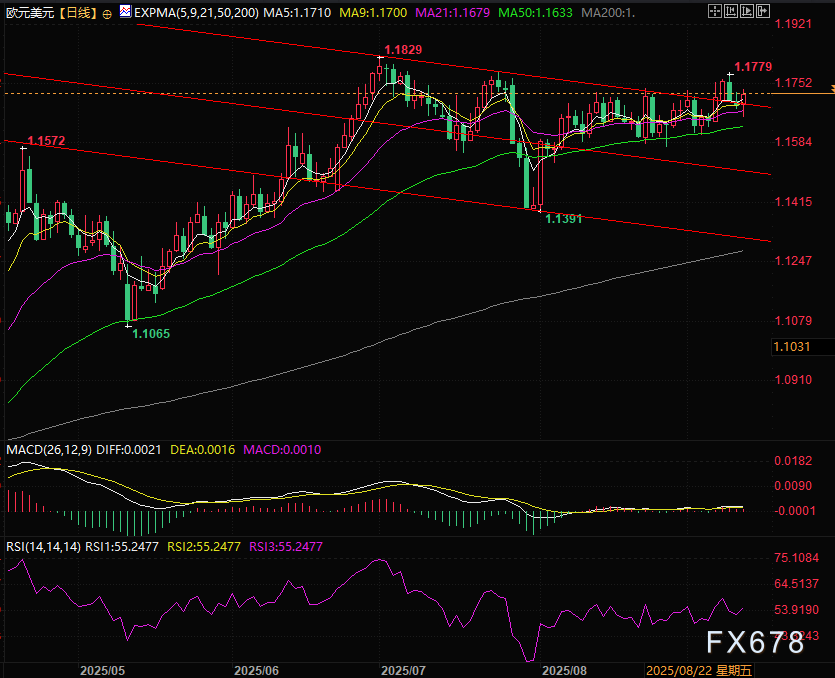
(EUR/USD daily chart, source: Internet)
At 21:55 Beijing time, the euro was trading at 1.1735 against the dollar.
Please indicate the source: https://www.daoctech.com/fxoutrade/1765.html
Disclaimer: The content of this article does not represent the views of the Institute of Foreign Exchange. The content is for reference only and does not constitute investment advice. Investors operate accordingly at their own risk.