
The more the Australian dollar rises, will it fall worse? The carnival on the eve of key data
On Wednesday (January 21), the Australian dollar/US dollar traded around 0.6750 in the European session. The recent uptrend structure continued on the disk, and the price strengthened again after repeated consolidation above 0.6700, and once reached around 0.6760. The short-term rhythm showed a typical bull push pattern, but the upper resistance area has not been effectively penetrated, and the market is accompanied by sensitive fluctuations in the headlines of key events.
Fundamentals
On the dollar side, the dollar was generally weak in the first half of this week. The core driver was more repeated from policy communication and the escalation of external issues, which accelerated the market's repricing of the dollar risk premium. The long positions in the dollar accumulated based on slightly hawkish pricing adjustments experienced short-term squeeze-and-take, causing the dollar to weaken simultaneously in multiple major currencies. If there is a clear cooling signal in the follow-up, the dollar will often experience a restorative rebound, and the strength of the rebound is closely related to the performance of the follow-up data. At this stage, special attention needs to be paid to Trump's public speeches and social media statements in the context of international conferences, because the "sudden nature" of such information flows will amplify volatility and change the risk budget of short-term funds.
On the Australian dollar side, the Reserve Bank of Australia adopted a more hawkish tone in its last policy decision. The background is that inflation data has been higher than market expectations continuously, and the possibility of further tightening at some stage in 2026 has also been discussed at the policy level. In terms of interest rate expectations, the market has factored in a rate hike probability of about 29% for the February meeting, and expects a cumulative tightening of about 38 basis points by the end of the year. The short-term focus is on the upcoming employment report: although the Reserve Bank of Australia is more focused on next week's quarterly inflation report, if there is a significant deviation in the labor market, it may still be quickly transmitted to the exchange rate through "expectations repricing". More crucially, under the premise that partial eagle expectations have been priced, the impact of weak data on the Australian dollar is usually greater; on the contrary, strong data is more reflected in the reinforcement of existing bullish narratives, while non-linearity pushes up.
Technical aspects:
From the daily K-line chart, the Australian dollar against the US dollar has formed a clear upward trend since the low of 0.6420, and the price has risen all the way and stood in the early transaction intensive area. The current exchange rate is above 0.6700, indicating that 0.6700 has changed from stage resistance to a key support line, which has the meaning of "support to support confirmation"; if there is a subsequent withdrawal and stabilization near 0.6700, it will be more in line with the common backtest logic in trend trading. The upper resistance is concentrated near 0.6765, which corresponds to the falling point after the recent rise, which belongs to the effective breakthrough threshold that short-term bulls must complete. If it is repeatedly blocked near 0.6765 and the upper shadow increases, it is necessary to be vigilant against false breakouts and momentum decay. The lower support band is in the 0.6660 range, which is not only the lower edge of the sideways consolidation, but also the "stop loss dense area" that is easy to trigger when the bull market sentiment weakens.
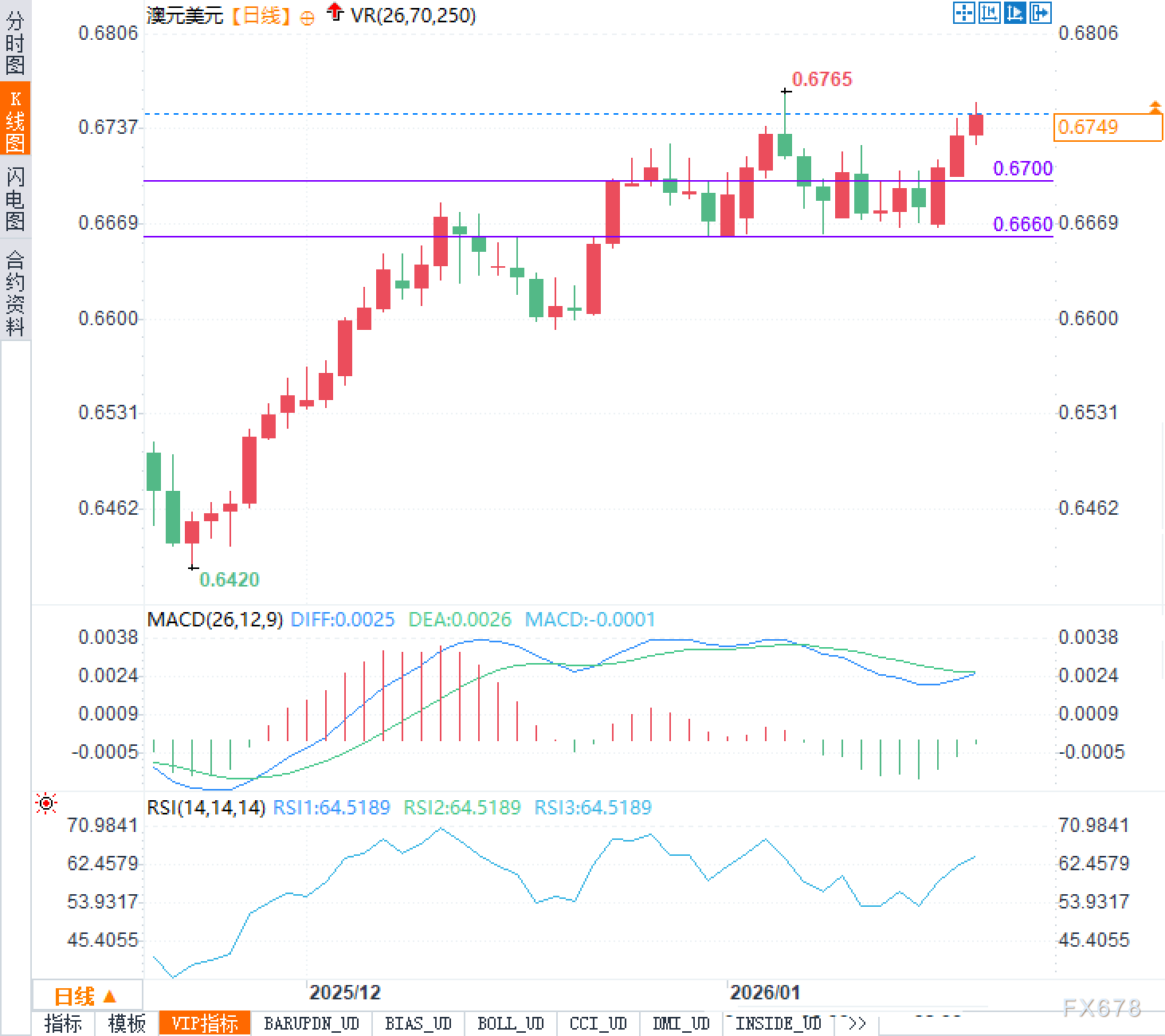
At the indicator level, the MACD shows that the DIFF is 0.0025, the DEA is 0.0026, and the MACD is -0.0001, indicating that the long-short gap has not widened significantly in terms of kinetic energy. The RSI (14) is 64.5189, which is in a strong but not extreme range, indicating that the bulls' advantage is still there, but to continue to rise requires new incremental information, otherwise it is easier to evolve into a high-level consolidation market rather than a straight-line rally.
Market Sentiment Watch
The current market sentiment presents a state of superposition of two clues: "the US dollar pullback driven by macro uncertainty" and "the Australian dollar resilience supported by the Australian Federal Reserve's eagle expectation". Short-term funds are more inclined to adjust positions driven by events: on the one hand, the US dollar is prone to a rapid liquidity vacuum under the impact of information flow, amplifying intraday volatility; on the other hand, the pricing of the Australian dollar is more like rebalancing around data and policy expectations. As the market has taken into account a certain amount of tightening space in advance, the tolerance of Australian dollar bulls for bad news has decreased, and the sentiment structure is closer to the asymmetric characteristics of "stable tailwinds and urgent headwinds". For traders, the key is not to judge whether sentiment is over- or bearish, but to identify emotional inflection points, which usually occur at the combination moment of "data deviation from expectations + key price loss".
Outlook
Bulls Outlook: If the employment data and follow-up inflation clues are generally hot, the market may further tighten the price of the Reserve Bank of Australia to a higher level, and the exchange rate maintains a higher low structure above 0.6700, and then repeatedly hits 0.6765 and seeks an effective breakthrough. Once the breakthrough is confirmed, trend trading funds often regard the "unbreakable breakout level" as a signal of a second acceleration, and the market may turn to a smoother upward channel.
Short Outlook: If the employment data is soft and triggers a downward revision in interest rate expectations, the Australian dollar is more likely to experience a rhythm of "first rapid retracement, then position consolidation", and 0.6700 will become the first line of defense; if this level falls and forms support resistance, the 0.6660 range will enter the field of vision, and the market may look for a new equilibrium point here. At the same time, if the risk premium on the dollar side falls rapidly, the information surface cools down and drives the dollar to repair, the Australian dollar may also encounter a "retracement + deleveraging" resonance at a high level, resulting in a temporary shift in the upward trend to sideways consolidation or even a phased reversal.
Please indicate the source: https://www.daoctech.com/fxoutrade/2088.html
Disclaimer: The content of this article does not represent the views of the Institute of Foreign Exchange. The content is for reference only and does not constitute investment advice. Investors operate accordingly at their own risk.