
Supply concerns support oil prices. Can the upward trend be confirmed?
On Tuesday (September 9), influenced by the lower-than-expected increase in OPEC + production, China's continued crude oil reserves, and renewed geopolitical risks related to Russia, crude oil futures prices rose slightly, rising nearly 1% during the session.

Can we break through the 20-day moving average at $63.75?
Traders are keeping a close eye on the 20-day moving average at $63.75, which remains an important resistance level. If prices can continue to break through this level, the technical trend will be more bullish, which is expected to move towards the 50-day moving average of $64.61. A break above the volatile high of $66.03 would confirm a broader uptrend.
On the downside, immediate support is at $61.45, with the main support at $61.12. If the price falls below this level, crude oil may face the risk of re-testing the May low of $56.09 - a key line of defense for bulls.
Opec + production increase is less than expected - is supply tightening?
OPEC + announced that it would increase output by just 137,000 barrels a day from October, well below the 550,000 barrels a month in August and September. The news provided support for crude prices, and traders were skeptical that the modest increase could be fully realized. Analysts at UBS and Saxo Bank both pointed out that OPEC + has limited spare capacity, which means there is very little cushion against sudden supply shocks.
China's crude oil reserves provide additional support
China remains the "invisible stabilizer" of the crude oil market. Analysts estimate that China is currently purchasing crude oil at about 500,000 barrels per day for storage, absorbing most of the world's excess production. Gunvor's chief strategist believes this trend will continue until 2026, indicating continued underlying buying support in the physical market.
Sanctions against Russia could exacerbate global supply constraints
Geopolitical risks also injected bullish sentiment into the market. Speculation about additional sanctions against Russia intensified after reports that Russia had carried out its largest air strike on Ukraine to date. US officials have said they are preparing to introduce a new round of restrictions that could directly affect Russian crude exports and further exacerbate global supply pressures.
The Federal Reserve's interest rate cut is expected to boost demand
The bullish factors also include growing expectations that the Federal Reserve will cut interest rates at its next meeting. Lower interest rates could stimulate economic activity, which in turn supports demand for crude oil.
Oil price forecast: Supply concerns dominate, bullish outlook unchanged
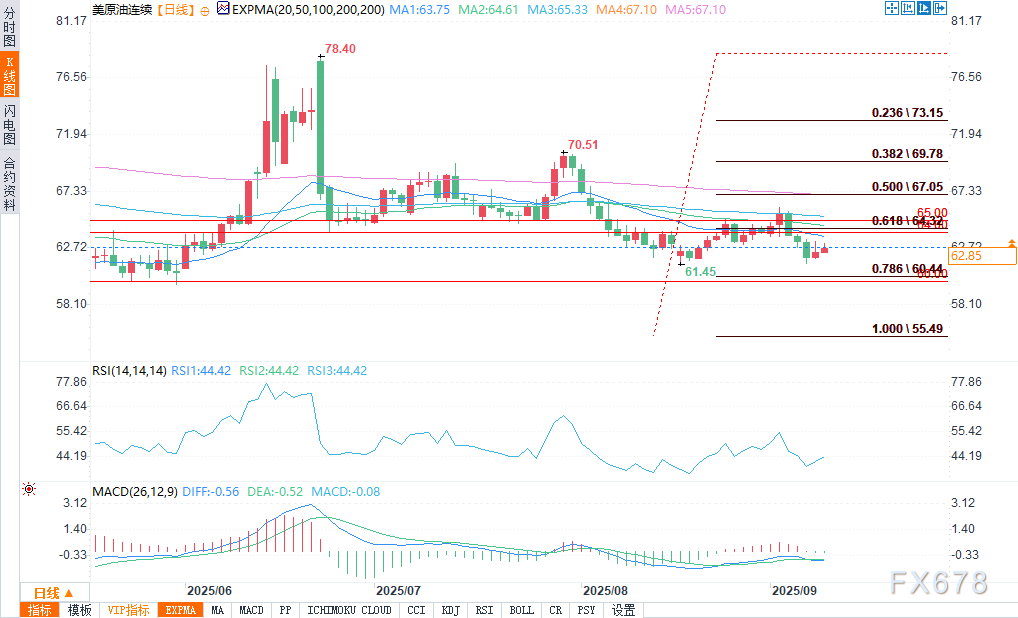
(WTI crude oil daily chart, source: Internet)
From a technical point of view, crude oil prices are still trading below the 20-day moving average, but the overall market tone is skewed towards bullish. With Opec + supply tightening, China digesting excess crude oil, and rising geopolitical risks, traders appear ready to test resistance levels. If the price can stand above $63.75, it is expected to attract subsequent buying, targeting the middle of the $60 range. Until then, support at $61.12 remains a key indicator of short-term movements.
At 20:07 Beijing time, WTI crude oil was reported at $62.86 per barrel, an increase of 0.96%.
Please indicate the source: https://www.daoctech.com/fxoutrade/2185.html
Disclaimer: The content of this article does not represent the views of the Institute of Foreign Exchange. The content is for reference only and does not constitute investment advice. Investors operate accordingly at their own risk.