
The US dollar against the Canadian dollar is sorted out in the non-farm range, and foreign exchange focuses on key data
During the Asian trading session on Tuesday, the US dollar maintained a low volatility against the Canadian dollar, and was generally sorted around the 1.3775 line. The market was in a strong wait-and-see mood, mainly due to the upcoming release of the delayed US non-farm payrolls report. AtIEXSForex PlatformInvestors are closely monitoring the impact of this data on the foreign exchange market.
The non-farm payroll data will be combined to reflect the employment situation in October and November, and is seen as a key basis for assessing the resilience of the US labor market.
The dollar's overall performance was weak, with the dollar index hovering around 98.15, near an eight-week low.
Previously, the Federal Reserve has cut interest rates by a total of 75 basis points, lowering the policy rate to 3.50% -3.75%. Its policy shift is largely due to signs of a cooling labor market.
Therefore, the upcoming non-farm payrolls data is crucial for the market to judge the next policy path of the Federal Reserve. At present, the market generally expects the US unemployment rate to remain at 4.4% in November. If the data continue to show weak employment demand, or further strengthen expectations for easing policy, it will put continued pressure on the dollar.
In addition to non-agricultural data, US retail sales data in November and S & P global purchasing managers' index preliminary value in December will also be concerned. The market expects retail sales to increase by 0.2% month-on-month. If consumption performs solidly, it may form a certain buffer against the US dollar in the short term. However, the overall impact still needs to be combined with the employment and inflation prospects.
In contrast, the Canadian dollar performed relatively flat. Canada's consumer price index data for November showed that headline inflation was at an annual rate of 2.2%, slightly lower than market expectations, but still growing modestly.
Stripping out volatile items, the Bank of Canada's core inflation measure remained at 2.9 per cent, indicating underlying inflationary pressures remained manageable. The central bank had said underlying inflation was roughly around 2.5 per cent and expected inflation to be broadly close to the 2 per cent target as spare capacity in the economy offset cost pressures.
This statement has left the market with relatively stable expectations for the Bank of Canada's policy, and the Canadian dollar lacks a clear directional driver. Many IEXS foreign exchange analysts also pointed out that the Canadian dollar's short-term trend still needs external data guidance.
Overall, before the release of key US data, the US dollar against the Canadian dollar showed a more consolidated trend, with both sides remaining cautious.
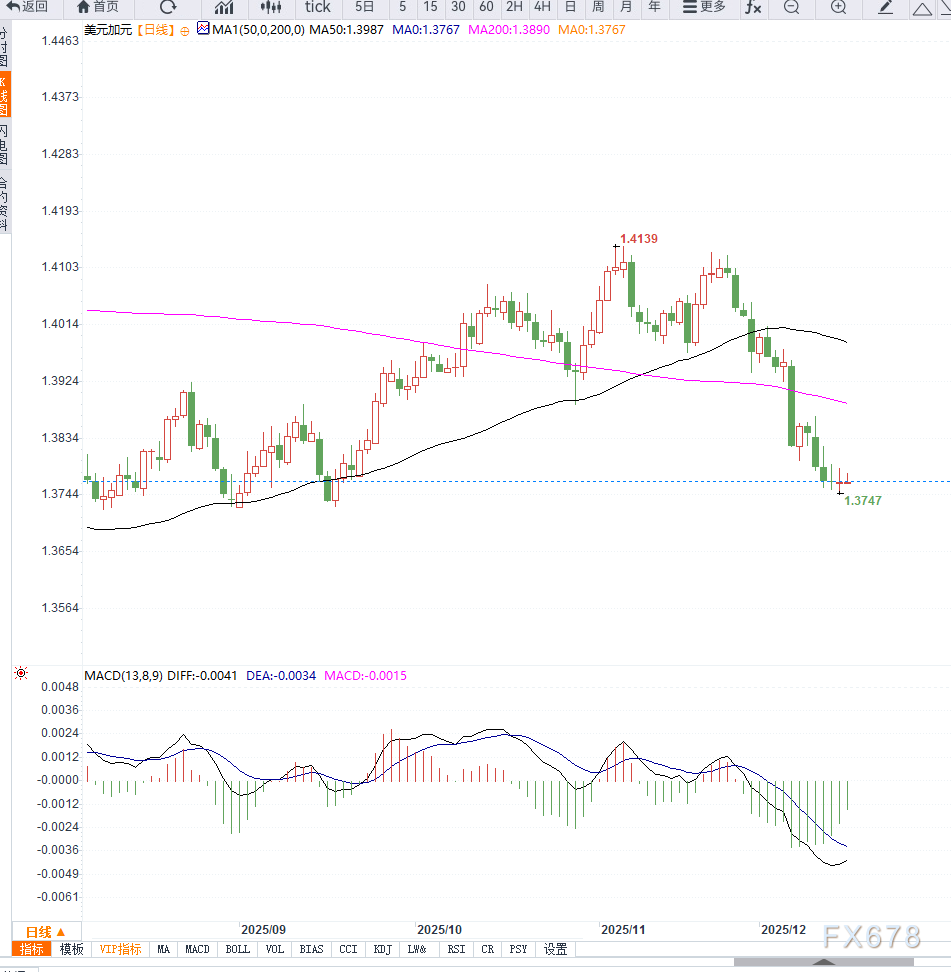
From a technical perspective, the US dollar against the Canadian dollar as a whole is still operating within a short-term volatility range. The exchange rate has not been able to further break the key support after falling behind recently, indicating that there is still a certain willingness to buy below, but the rebound momentum is also limited, reflecting the lack of clear direction in the market before major data.
On the lower structure, the vicinity of 1.3750 constitutes an important short-term support area, which has restricted the price from falling many times. Once it effectively breaks through, the exchange rate may further move closer to the 1.3700 integer mark, and the downside space is expected to be opened at that time. If 1.3700 falls, the short-term technical structure will weaken significantly.
On the upside, the 1.3800 mark has become the main resistance level at present, and this area is close to the upper edge of the previous consolidation range. If the exchange rate regains its foothold under the impetus of US data, the upper target may point to the 1.3850 line. However, in the context of the overall weakness of the US dollar, the upside space may still be limited if there is a lack of sustained fundamental positivity.
Overall, the technical aspects show that the US dollar against the Canadian dollar is in the momentum stage before the direction selection, and the breakout between the key support and resistance areas will provide important guidance for the follow-up trend.
editorial opinion
:
The current sideways trading of the dollar against the Canadian dollar reflects the high sensitivity of the market to the Federal Reserve's policy outlook. The performance of the US non-farm payrolls data may be a key trigger to break the volatile pattern.
In the context of relatively stable inflation in Canada and clear policy expectations, the short-term direction of the exchange rate depends more on changes in the US dollar. If the US data continues to be weak, there is a risk of further decline in the US dollar against the Canadian dollar; conversely, stronger-than-expected data may only bring a staged rebound.
Please indicate the source: https://www.daoctech.com/fxoutrade/2322.html
Disclaimer: The content of this article does not represent the views of the Institute of Foreign Exchange. The content is for reference only and does not constitute investment advice. Investors operate accordingly at their own risk.