
Interest rate cuts are expected to diverge from the trend of the bond market, and the market has a strong wait-and-see sentiment
Recently, the global financial marekt is in a wait-and-see stage waiting for important events to come to fruition. The US dollar index fluctuated narrowly at the 99.17 line, falling slightly during the day; the 10-year US Treasury yield rose slightly to 4.208%, maintaining a recent high; spot gold is under pressure below the $4,200/ounce mark, trading around $4,198. The core focus of the market is all on the upcoming interest rate decision and subsequent related statements. Investors remained cautious before the expected interest rate cut and urgently sought clear signals on the future policy path, which led to narrowing of major asset price fluctuations and a technical consolidation pattern.
US bond yields are high pressure, and the dollar faces the risk of a pullback after "boots fall"
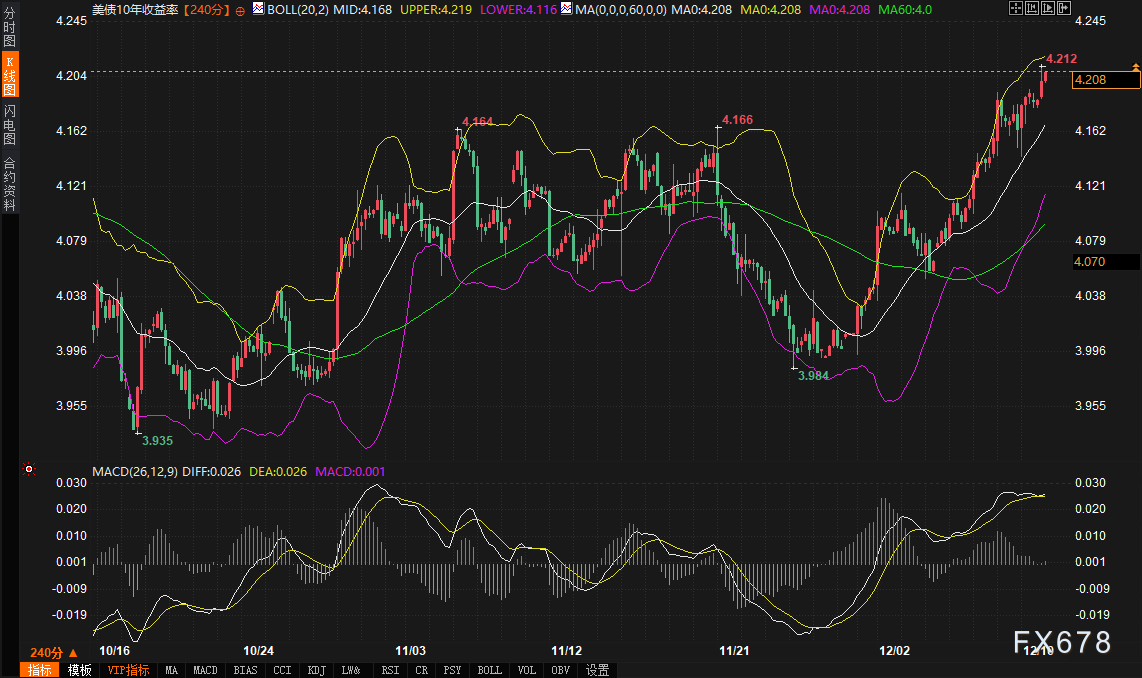
The current market pricing shows that the probability of a 25 basis point rate cut at this meeting is as high as 88%, which has almost become a consensus expectation. However, the recent performance of the bond market has run counter to the easing expectation. The 10-year Treasury yield has risen to its highest level in more than three months. Technically, its 4-hour chart shows that prices are running between the upper Bollinger Band (4.219%) and the middle rail (4.168%), and the MACD double line is above the zero axis, suggesting that the short-term upward momentum is still continuing. The unexpected firmness in US Treasury yields may have reflected persistent concerns about the stickiness of inflation, while also partially digesting the possibility of "hawkish rate cuts" - that is, rate cuts are accompanied by signals of caution about the pace of further easing.
The trend of US Treasury yields has been a key support for the US dollar index recently. From a fundamental perspective, rising yields have enhanced the relative attractiveness of the US dollar, making the US dollar still show resilience in the context of strong interest rate cut expectations.Raise one's headRemain relatively strong. According to analysts from well-known institutions, this resilience built up in anticipation before the resolution has actually raised the threshold for the degree of hawkishness in the market, thus increasing the risk of "hawkishness less than expected". Once the resolution is implemented, whether it meets expectations or not, the pre-factors supporting the dollar may subside, which may trigger a "buy expectations, sell facts" type of market adjustment. Some opinions compare the exchange rate trend after a previous event: the extremely pessimistic sentiment and a large number of short positions before the event triggered short covering after the event became clear, which promoted the currency rebound.
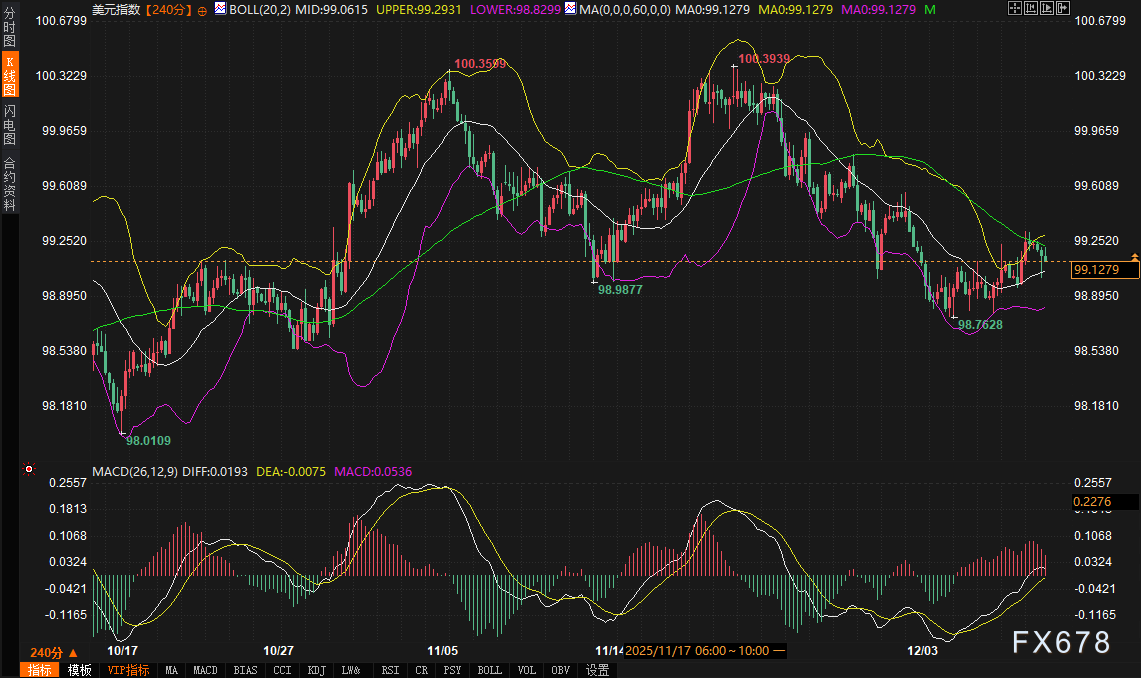
From a technical perspective, the 4-hour chart of the US dollar index shows a narrowing and leveling trend in the three-track Bollinger Band (upper rail 99.298, middle rail 99.064, lower rail 98.829). The price is currently hovering near the middle rail, and the MACD is entangled near the zero axis, indicating that the long and short forces are temporarily balanced. In the next 2-3 days, the market reaction after the decision will become dominant. The key support range focuses on the lower rail of the Bollinger Band near 98.83 and the early important psychological barrier of 98.50; the upper resistance first observes the upper rail of the Bollinger Band at 99.30. If it breaks through, it may test the 99.50-99 area. During the session, it is necessary to pay close attention to the linkage between the immediate reaction of US bond yields and the tone of relevant speeches. Any hint of concerns about the inflation outlook or slowing the pace of interest rate cuts may provide short-term support for the dollar by pushing up US bond yields. On the contrary, if more concerns are expressed about economic downside risks, it may weigh on yields and weigh on the dollar.
Gold is subject to bond market and policy uncertainty, and the risk-aversion transmission effect is temporarily delayed
The gold market is currently being pulled by two forces. On the one hand, the widely expected interest rate cut environment in the market is theoretically positive for the non-interest-bearing asset gold; but on the other hand, what is actually happening is that the US Treasury yield continues to strengthen, which increases the opportunity cost of holding gold, which directly suppresses the price of gold. As one institutional commodity strategist said, the current pressure on gold is not the expectation of interest rate cuts themselves, but the continuously rising government bond yields. In addition, compared with the hot scene of the silver market being driven by multiple factors such as industrial demand and tight inventories, the inflow of funds into gold spot-backed ETFs is relatively flat, indicating that the demand of institutional investors is hesitant at current prices.
This discrepancy underlines the core of gold's current logic: its traditional risk-off and monetary hedging functions are being complicated by the "risk-off" of the bond market (reflected in rising yields) and the uncertainty of monetary policy. Normally, rising risk aversion in the market will push up the price of US Treasuries (lowering yields) and the price of gold at the same time. But at this stage, some safe-haven funds may have chosen to pour directly into US Treasuries rather than gold due to concerns that repeated inflation may limit the room for central bank easing, resulting in a delay or distortion in the transmission of risk-off effects from the bond market to gold.
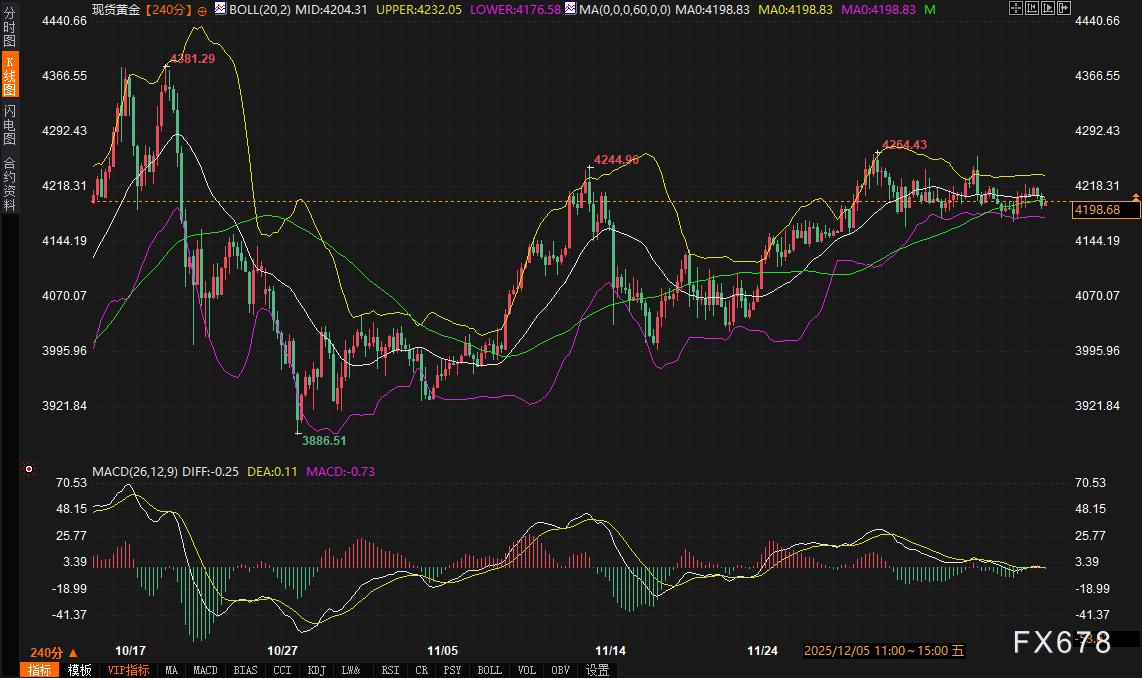
On a technical level, the 4-hour chart of spot gold shows that the price has fallen below the middle Bollinger Band ($4,204) and is looking for support at the lower rail of the downward channel (near $4,176). The MACD indicator diverges downward after forming a dead fork above the zero axis, and the green column appears, indicating that the short-term kinetic energy is bearish. In the next 2-3 days, the direction of gold prices will be more clearly guided after the decision. The key support range is located in the $4170-4176 area. This area is the lower edge of the recent consolidation range and the lower rail of the Bollinger Band. If it falls, it may open further downside space to the $4,150 line. The main resistance above is in the $4204-4210 area (the middle rail and the integer mark), and the stronger resistance is at $4232 (the upper Bollinger Band). Investors need to focus on the linkage between the trend of US bond yields and gold after the resolution. If yields fall significantly after the resolution, the maximum suppression on gold may be lifted, and gold prices are expected to gain rebound momentum. On the contrary, if yields rise further for any reason, gold prices may continue to be under pressure.
Outlook: Clear policy path will reshape short-term trading logic
Taken together, market movements over the next 48 hours will be fully defined by the interest rate decision and the forward guidance it conveys. For the dollar, risks are biased towards a profit-taking pullback after the "boots fall", and year-end seasonality and the relatively hawkish stance of other major central banks may also come back into focus after the resolution, weighing on the dollar. However, any hawkish stance that exceeds expectations could provide a cushion for the dollar through the Treasury yield channel.
For gold, its short-term fate remains closely tied to the US Treasury market. After the resolution, the market's understanding of the medium-term policy path will reprice long-term interest rate expectations, which will determine the direction of yields. If the market interprets this interest rate cut as a "one-off" or a short-term correction in a tightening cycle, with yields remaining high or even continuing to rise, then gold's attractiveness will continue to be limited. Conversely, if there is a signal of greater concern about economic growth or financial stability, suggesting the start of a clearer easing cycle, the downward trend in yields will most likely become the catalyst for gold prices to break through upwards.
One institutional analyst's comments hit the nail on the head: silver's mania is still partly driven by gold, and any directional correction in gold could cause volatility in the silver market to be amplified. This is a reminder that gold, as a traditional core asset, still plays a key role in defining global sentiment amid the current market noise. The market is waiting for a clear signal to end the current consolidation and stalemate.
Please indicate the source: https://www.daoctech.com/fxoutrade/2419.html
Disclaimer: The content of this article does not represent the views of the Institute of Foreign Exchange. The content is for reference only and does not constitute investment advice. Investors operate accordingly at their own risk.