
Gold prices fluctuated under the pressure of bonds, and the central bank meeting was watched in the market outlook
On Monday (December 8), gold markets were relatively calm at the beginning of the week, and traders generally chose to wait and see before the Federal Reserve announced its interest rate decision on Wednesday, unwilling to open new positions.
The dollar index was trading at about 99.07, rebounding slightly after falling as low as 98.79 in early Asian trading. Meanwhile, yields on US Treasuries have generally been on an upward trend, with the benchmark 10-year yield now near 4.180 per cent, its highest level since September 26.
Gold prices were flat last week as investors waited for a clear direction from central bank interest rate meetings in the coming weeks while consolidating recent gains. While gold remains on an upward trend, the outlook for gold is increasingly uncertain as bearish reasons, including rising bond yields, mount.
The game between the seasonal weakening of the dollar in December and the hawkish stance of the central bank
The strength of gold prices was partly supported by the seasonal weakness of the dollar in December, but at the same time, the pricing expectation of central bank interest rate hikes in the global market also drove bond yields higher. Further gains in yields are bound to weaken investors' willingness to increase their holdings in the non-interest-bearing asset gold. The focus of the market has now turned to the major central bank interest rate meeting that began this week.
The US economic data released last week was mixed, and although there were many bright performances, it was not enough to shake the Federal Reserve's decision to cut interest rates this week. The current gold price is partly supported by the market's expectation that policy easing is imminent. From this point of view, the implementation of interest rate cuts itself may not be able to push gold prices further higher this week. After all, this result has been basically digested by the market. The market is more looking forward to the Fed's signal that policy will be more dovish in 2026, which may become the trigger for market disappointment. In fact, towards the end of the year, a core consensus in the market is gradually forming: many G10 central banks have either reached the bottom of the interest rate cycle or are approaching this range. In addition to the independent hawkish stance of the Bank of Japan, the market has fully digested the expectation that the central banks of Australia, New Zealand and Canada will raise interest rates by 25 basis points next year. Given the recent hawkish remarks by some European Central Bank officials and the recovery of economic data in the euro zone, the euro zone should also be included in this category.
Gold Outlook: Where will this rally end?
Much of the recent rally in gold prices has been driven by continued international geopolitical tensions, rising talk of "de-dollarisation" and a steady increase in central bank holdings. However, once these familiar drivers are removed, there is little else left to support the price of gold. This begs the question: how long can this rally last? Personally, I am more inclined to expect a correction in gold prices. The crux of the matter is: what will trigger the correction?
The next move by the People's Bank of China is a major uncertainty. If the People's Bank of China starts to slow down the pace of gold purchases against the background of the current high gold price, then the leveraged long positions could be quickly adjusted, and the process is likely to be not mild. At the same time, the geopolitical situation has shown early signs of easing: the slow progress of peace talks and changes in trade relations between important economies. In theory, these factors will weaken the safe-haven premium of gold, but the gold price has little reaction to this.
The weak dollar has provided solid support for gold prices, but the overall atmosphere in the market appears to be unusually calm, as if all parties are quietly waiting for a bigger change to come. In addition, the movement of the Japanese market is worth watching. Growing expectations of a rate hike by the Bank of Japan have pushed Japanese government bond yields higher, raising concerns that the turmoil in the Japanese bond market could spread to global equities. And any position squaring in carry trades could easily be transmitted to the precious metals market, creating a double pressure on gold and silver prices. For traders who follow the gold market,fxtmForex PlatformThe availability of real-time chart analysis tools may help you gain a clearer understanding of short-term trading points.
Technical analysis and trading strategies
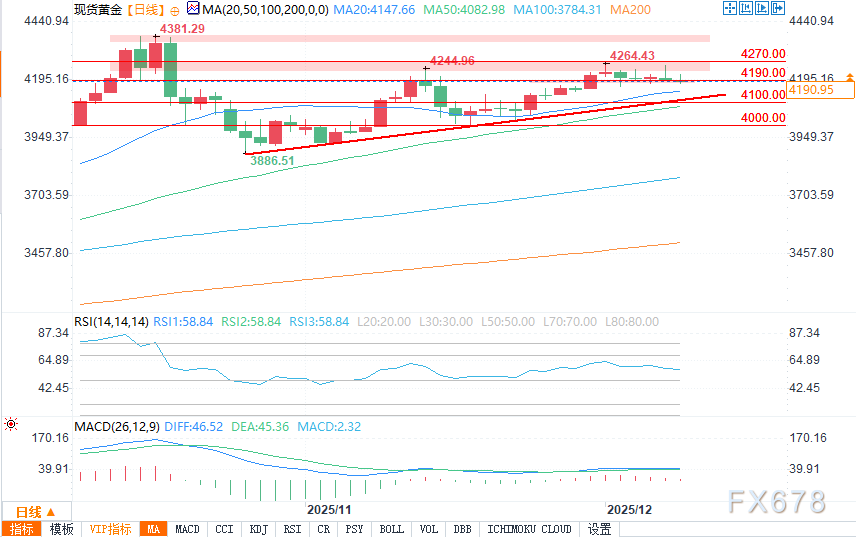
(Daily chart of spot gold, source: Internet)
From a technical perspective, although gold is still in an upward trend, the momentum is undoubtedly fading, which also casts a shadow on the outlook for gold. Once the key support level is lost, the price of gold is highly susceptible to short-term volatility.
The current gold chart needs to focus on the $4,175 to $4,190 range, which is the physical part of the gold price and where the lows have been located in the past few trading days. If gold prices effectively fall below this range, the short-term trend line and the $4,100 integer level will be back in the market focus. This level is not only an important psychological level, but also the starting point of this latest rally. If the daily level closes below $4,100, it will constitute a clear bearish signal, and the price of gold is expected to fall below the $4,000 level.
On the upside, resistance is in the $4,220 to $4,270 range. This range has been the starting point of gold's previous decline, and the market's repeated attempts to recapture the area have ended in failure. If the bulls can break through this resistance range strongly, the price of gold is expected to hit the record high again.
Please indicate the source: https://www.daoctech.com/fxoutrade/2436.html
Disclaimer: The content of this article does not represent the views of the Institute of Foreign Exchange. The content is for reference only and does not constitute investment advice. Investors operate accordingly at their own risk.