
The Bank of Japan is expected to raise interest rates the most in 30 years? Dollar against yen 160 level game
On Thursday (June 4), the exchange rate of the US dollar against the yen hovered in the 159.7-160 range, continuing the high volatility pattern. Early data showed that the exchange rate was close to the 160 round number mark, and market traders were closely watching the possible exchange rate intervention of the Japanese government and the upcoming policy meeting of the Bank of Japan. Investors passedTickmillWait for the platform to participateforeign exchange marketTrading requires close attention to these key developments.
Yields on Japan's 10-year government bonds remained high at around 2.67 per cent, reflecting expectations of inflationary pressures and policy normalisation. Recent increases in external energy costs have pushed the wholesale price index up 4.9 per cent year on year, the fastest pace in three years. This has directly exacerbated import costs and reinforced the impact of a weaker yen on domestic prices. The prevailing view in the market is that unless there is a major change in the external environment, the Bank of Japan is more likely to take action at its June 15-16 meeting.
Fundamentals Driven: JGB Trends and Potential Bank of Japan Actions
The Bank of Japan's policy rate is currently 0.75 per cent and markets are expecting a rise to 1 per cent at the meeting, which would be the highest level in three decades. Bank officials have recently signalled that the central bank is moving towards more active management of inflation risks, and several members of the policy board have expressed concern about price pressures. Accelerating wholesale price rises and higher energy costs have provided data to support the tightening of monetary policy.
In the Japanese bond market, yields have climbed to near three-decade highs, putting pressure on the central bank's bond-buying programme. The current tapering schedule ends in March 2027, and the fiscal year 2027 framework will be discussed during the meeting. The prevailing view favours a pause or slowdown in tapering to maintain bond market stability. This is linked to the exchange rate level: higher bond yields help narrow the US-Japan interest rate spread, which provides some support for the yen.
Japan implemented a large-scale exchange rate intervention in May, with a cumulative scale of 11.70 trillion yen, in order to deal with excessive volatility. But the intervention effect was limited, and the exchange rate quickly recovered to a high range. Central bank officials have repeatedly stressed that they will closely monitor market developments and take appropriate action if necessary. This constitutes an important policy buffer for current exchange rate movements.
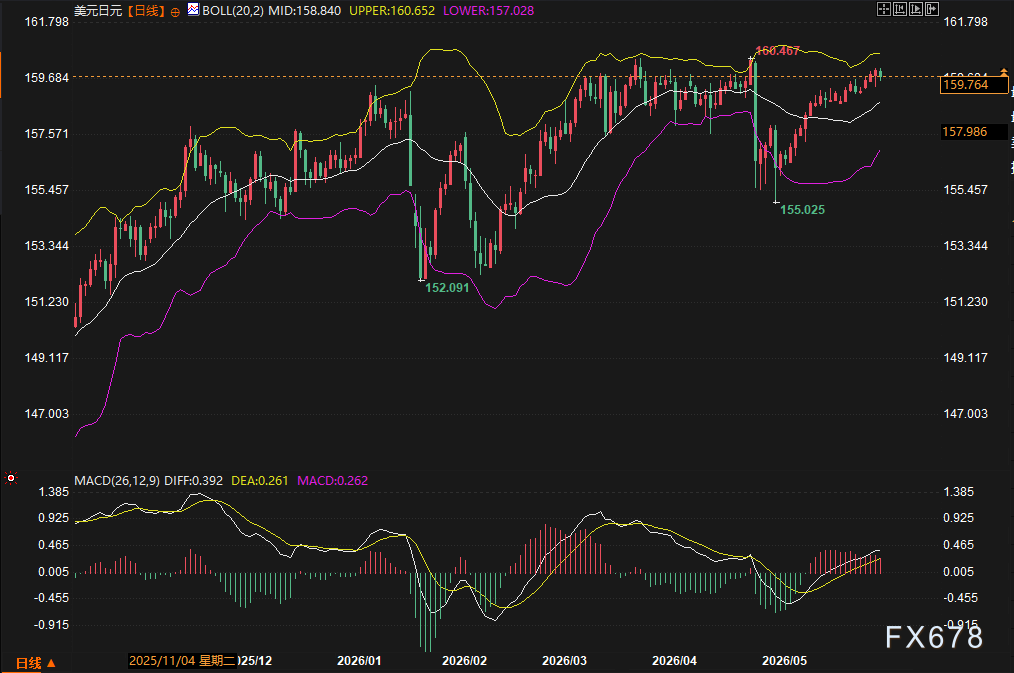
The technical and fundamental conditions confirm each other. The USD/JPY has shown a volatile upward structure since November 2025. The May correction low of 155.025 was higher than the January low of 152.091, forming a higher low and maintaining the overall upward trend. As long as the exchange rate holds key support, the medium-term direction remains unchanged.
The Bollinger Bands (20,2) indicator shows that the upper rail is at 160.652, the middle rail is 158.840, and the lower rail is 157.028. The current price of 159.764 is between the middle rail and the upper rail and is close to the upper rail, and the volatility is amplified. The MACD (26,12,9) fast line is 0.392, the slow line is 0.261, the bar chart is positive at 0.262 and continues to turn red, and the bulls are in a stable arrangement. During the historical correction, MACD turned to green, and the current red bar indicates that the momentum of bears has been digested.
Key price points:
- Strong resistance range: 160.467-160.652, with previous highs coinciding with Bollinger's upper track.
First support: 158.840, with the Bollinger mid-orbit serving as a mid-term multi-space demarcation.
- Second support: 157.028, Bollinger lower rail.
- Trend defensive position: 155.025, a break below which may change the ascending structure.
In the short term, the probability of price testing the resistance of 160.467-160.652 is high. If it breaks through effectively, the upper space may open; if it falls back, the medium track will become the primary observation point. During the session, it is necessary to focus on the synchronicity between the volatility of Japanese bond yields and the US dollar index, which together affect the direction of exchange rate breakouts.
Outlook on future trends
In the medium term, the high operation of Japanese bond yields will continue to test the ability of the Bank of Japan to balance inflation and market stability. The outcome of the June meeting will be a key catalyst. If the policy tightening is confirmed and accompanied by the adjustment of the bond purchase plan, the yen may gain temporary support. However, external energy price variables and the overall trend of the US dollar will still dominate the fluctuation range. The exchange rate is expected to operate in the wide range of 155-162, and pay attention to the disk reaction after each policy signal is released. The overall upward trend is intact, but close to the resistance area, you need to be vigilant against repeated.
Frequently Asked Questions
What is the direct impact of the current high Japanese bond yield on the dollar against the yen?
Maintaining a high 10-year Treasury yield helps narrow the US-Japan interest rate gap, which is theoretically positive for the yen. But in practice, rising yields also reflect inflationary pressures, which may strengthen the central bank's expectation of interest rate hikes, thus forming a double support for the yen. It is necessary to observe the synchronicity of yields and exchange rates. If yields continue to rise and the exchange rate is still weak, it may indicate that intervention pressure will increase.
What is the most likely action taken by the Bank of Japan at its June meeting?
Depending on market pricing, the probability of a rate hike of 25 basis points to 1% is about 80%. The meeting will also discuss the framework for bond purchases in fiscal 2027, with mainstream expectations favoring a pause or slowdown in tapering to stabilize the bond market. Together, the two measures could provide a policy-level boost to the yen.
How to evaluate the effectiveness of the large-scale exchange rate intervention in May?
The record scale of the intervention, which is mainly aimed at curbing excessive volatility in the short term and still relies on the progress of the normalisation of central bank policy in the long term, is reflected in the rapid recovery of the exchange rate to pre-intervention levels.
Where might the exchange rate go after the Bollinger Bands break through?
If you effectively stand on 160.652, you may accelerate the test of 162 or even higher in the short term. But the breakthrough needs to be accompanied by the confirmation of trading volume, otherwise it is easy to fall back to the mid-track 158.840 after a false breakout. Pay attention to the synchronized performance of the US dollar index during the session.
What are the main risks facing the yen in the medium term?
Sustained high energy costs could prolong inflationary pressures, forcing the central bank to act more aggressively; conversely, if the external environment eases and the dollar weakens, there will be room for the yen to rebound. The key observation is whether the low of 155.025 is held. Once it falls below, the uptrend structure will face challenges.
Please indicate the source: https://www.daoctech.com/fxoutrade/2470.html
Disclaimer: The content of this article does not represent the views of the Institute of Foreign Exchange. The content is for reference only and does not constitute investment advice. Investors operate accordingly at their own risk.