
Euro weakness consolidation, HYCM foreign exchange analysis outlook
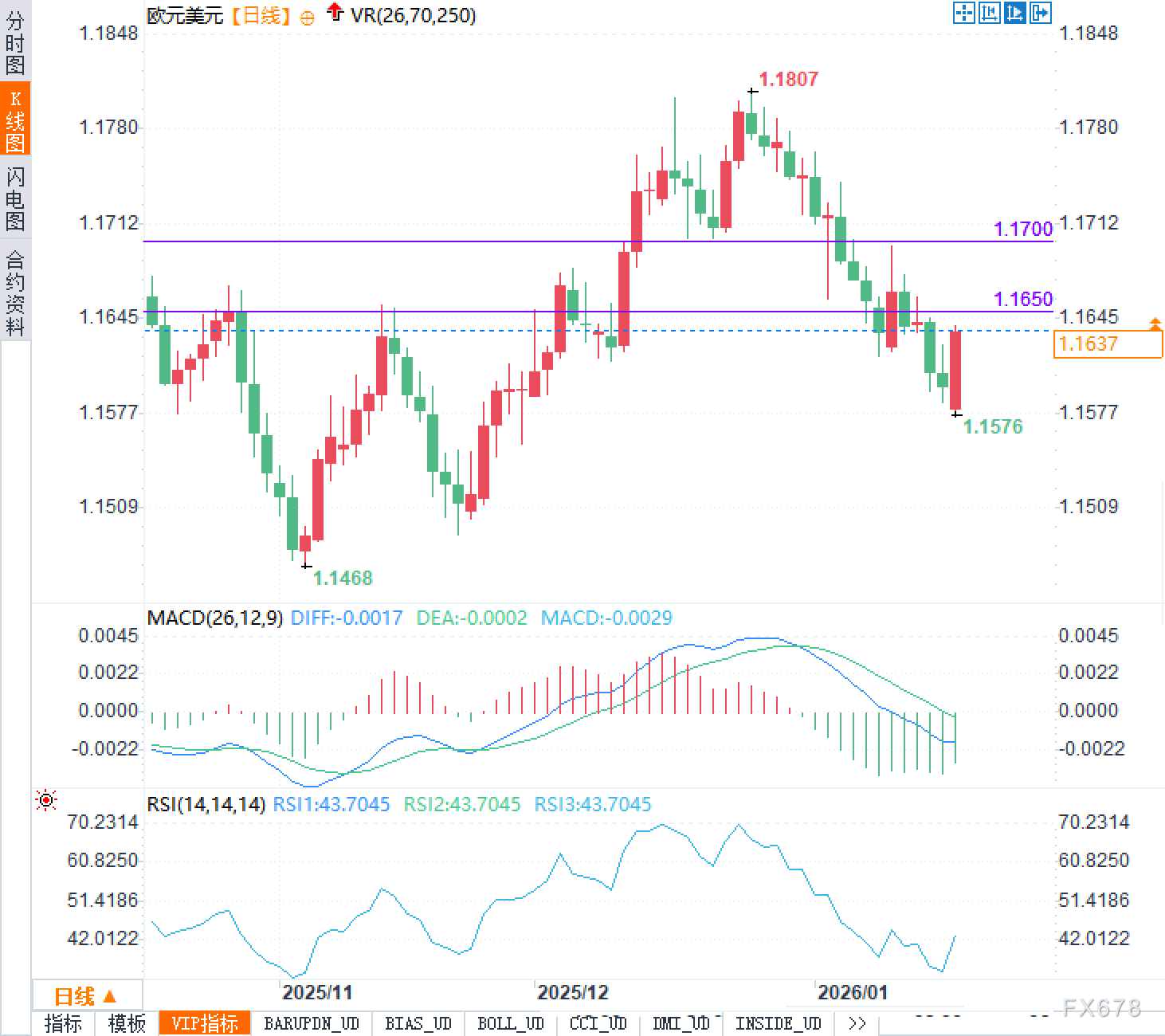
Recently, the exchange rate of the euro against the US dollar has shown a weak trend as a whole, briefly setting a low for the year. The market rebounded on Monday (January 19), and the European session was reported near 1.1630. The exchange rate encountered obvious resistance when trying to rise to 1.1700, indicating that there is strong selling pressure in the area.
From the perspective of the daily structure, the previous high was at 1.1807. After that, the price gradually fell back and fell below the key support level of 1.1650. At present, the short-term direction of the exchange rate is still unclear. Technically, the MACD indicator is still running below the zero axis. The current DIFF is -0.0017, the DEA is -0.0002, and the MACD column is -0.0029, indicating that although the momentum of bears has not expanded significantly, the trend is still bearish. The RSI indicator is about 43.7, which is in the neutral and weak range, indicating that the bears are still dominant, but have not yet entered an extreme oversold state, which means that the price may have repeated tugs near the support level. According tohycmAccording to the observation of foreign exchange platforms, technical signals suggest that the euro is still facing some pressure.
If the market outlook can regain a foothold above 1.1650, it is expected to test 1.1700 again in the short term; if it can break through this position, it is possible to ease the downward pressure and move the target up to the previous high near 1.1807. On the contrary, if 1.1600 falls, the exchange rate may quickly slide towards the low support of 1.1576, and further challenge the previous low of 1.1468.
The news is complex, and market sentiment is subject to deep-seated factors
Recently, there has been a steady stream of news on geopolitical issues in the market, such as discussions on Greenland, Iran, and other topics, which has attracted the attention of the outside world to the international situation.
Analysts believe that this kind of news is now more like "sentiment noise", which may disturb market sentiment in the short term, but it is difficult to change the underlying trend of the exchange rate. What really determines the direction of the euro is still the comparison between interest rate expectations and economic fundamentals. Especially under the current trading logic dominated by interest rates, the attractiveness of US dollar assets remains the core variable, and the lack of strong enough growth or inflation recovery signals in Europe makes it difficult for the euro to escape the passive situation.
More noteworthy are the dynamics within the Fed. The Department of Justice recently issued a subpoena to the Fed for the chairperson to provide further information on the headquarters renovation project in Congress, a move that exacerbated market concerns about its independence. At the same time, the chairperson's term ends in May this year, the choice of successor is still unclear, and there is uncertainty about whether the policy stance will shift. These factors combine to make investors' judgments about the future path of interest rates more ambiguous.
At present, Federal Reserve officials are generally suggesting that there may be only one rate cut in 2026, and there is a high probability that the meeting at the beginning of the year will not be moved; but traders still tend to bet on at least two rate cuts throughout the year. This divergence in expectations makes it difficult to agree on a direction of trading, which in turn leads toforeign exchange marketThe overall situation is a peculiar state of "news, lack of volatility" - the news is constant, but the market is calm.
The data is neutral, and the market is stuck in a wait-and-see stalemate
The series of macroeconomic data released last week did not bring enough shock to reverse the trend. The consumer price index (CPI) in the United States rose 2.7% year-on-year in December, and the core CPI was 2.6%. The month-on-month increase was 0.3%, the same as the previous value. It shows that the process of inflation falling back is not smooth, and the price pressure is sticky. This means that it is difficult for the Federal Reserve to take a step to cut interest rates in the short term, which also provides some support for the dollar.
On the demand side, retail sales in the United States rose by 0.6% month-on-month in November, a significant improvement from the revised -0.1% in October, but retail sales cgroup, which better reflects consumer trends, rose by only 0.4%, lower than the previous value of 0.6%, indicating that consumption recovery is not in full bloom and has limited momentum. In addition, the core producer price index (PPI) reached 3% year-on-year, which also suppressed the market's expectations for rapid monetary policy easing to a certain extent.
Taken together, this set of data is neither strong enough to turn the Federal Reserve into a hawk, nor weak enough to prompt the market to immediately price a sharp interest rate cut, and the overall impact is neutral. This also explains why the dollar failed to take advantage of the momentum to rise sharply, and the euro lacked the impetus to break through against the dollar.
In contrast, the European data, while improving, is limited. Germany's December harmonized CPI was confirmed to be up 2% year-on-year, real GDP growth was 0.2% (previous value was -0.5% and revised), the Eurozone Sentix investor confidence index rebounded to -1.8 (previous value was -6.2) in January, and industrial output rose 0.7% month-on-month in November. These data show signs of marginal improvement in the European economy, but they are far from enough to push the euro out of the independent market. In the current spread-centered pricing system, unless European inflation returns or growth accelerates significantly, the euro's rebound will remain highly dependent on the weakness of the dollar itself or the systemic repair of global risk appetite. HYCM foreign exchange analysts believe that this pattern will be difficult to change in the short term.
Where is the next market? Key data is coming soon
Looking ahead to the next few days, the market will usher in a baptism of multiple rounds of important data, which may open a breakthrough for the current stalemate. The Eurozone will release a number of indicators such as the final value of the harmonized CPI in December, the PPI in Germany in December, the ZEW economic sentiment survey and the preliminary value of consumer confidence. At the same time, the World Economic Forum in Davos is officially opened, and the speeches of senior officials such as European Central Bank President Lagarde may also trigger a reassessment of the market's policy rhythm of the European Central Bank.
In the US, the data is more dense: a revised third-quarter GDP reading, weekly jobless claims and the closely watched personal consumption expenditure (PCE) price index for October and November - the Fed's favourite inflation gauge - will be released on Thursday. The preliminary Markit purchasing managers' index, which covers manufacturing and services, is also released on Friday, providing an important window into economic momentum.
If the subsequent inflation data continue to show the characteristics of "slow pullback", especially the PCE remains high, it may strengthen the expectation that the Federal Reserve will maintain high interest rates for a longer period of time, thus supporting the dollar and limiting the room for the euro to rebound below 1.1650. Conversely, if the data weaken significantly, especially if the PMI falls below the boom-bust line or the PCE cools significantly, it may reignite interest rate cut expectations, providing the euro with an opportunity to repair upwards.
However, even if there is a positive trend, if the euro wants to truly reverse its decline, it must first regain the psychological level of 1.1650 and successfully challenge the strong resistance band of 1.1700. Otherwise, any rebound may be regarded as a short-term technical withdrawal, which is difficult to say. HYCM Forex will continue to monitor market dynamics.
Please indicate the source: https://www.daoctech.com/fxoutrade/2544.html
Disclaimer: The content of this article does not represent the views of the Institute of Foreign Exchange. The content is for reference only and does not constitute investment advice. Investors operate accordingly at their own risk.