
The cooling of inflation in the Eurozone coupled with the high operation of the US dollar, the EUR/USD continues to consolidate at a low level
The euro/dollar weakened during the European trading session on Wednesday, falling to around 1.1390, continuing the correction trend after the previous trading day's sideways consolidation. The current market sentiment is mainly affected by the dual pressure of slowing inflation in the eurozone and the strengthening of the US dollar. The short-term structure is weak but has not yet formed a trend breaking level.

From the fundamental perspective of the eurozone, the faster than expected cooling of inflation has become the core factor suppressing the euro. According to market research, Germany's June Consumer Price Index (CPI) fell year-on-year2.3%This is lower than the 2.6% in May and lower than the market expectation of 2.5%. The synchronized decline in inflation in major economies such as France and Italy has led to a general expectation in the market that the European Central Bank will further reduce the necessity of maintaining high interest rates.
In this context, the expected advantage of Euro interest rates has been weakened,AlfordThe attractiveness of euro assets has declined, and the exchange rate continues to be under pressure. The market is waiting for the initial data of the Eurozone HICP to further confirm whether the downward trend of inflation will continue.
At the same time, the relative strength of the US dollar has become another key factor suppressing the EUR/USD. The uncertainty of the US Iran Doha negotiations has escalated, and the demand for safe haven has supported the performance of the US dollar. At the same time, the Federal Reserve's policy path remains skewed towards hawkish expectations. According to the CME FedWatch tool, the market's probability of a rate hike in September has risen to about67%Strengthen the advantage of the US dollar interest rate differential.
In addition, speeches by Federal Reserve officials at the European Central Bank's Sintra Forum, as well as ADP employment data and ISM manufacturing PMI, will be key catalytic factors for the day, followed by non farm employment data that will further determine the short-term direction of the US dollar.
Overall, the EUR/USD is currently under a dual pressure structure of "weakened euro interest rate expectations+strengthened US dollar spread advantage", and is still weakly oscillating in the short term.
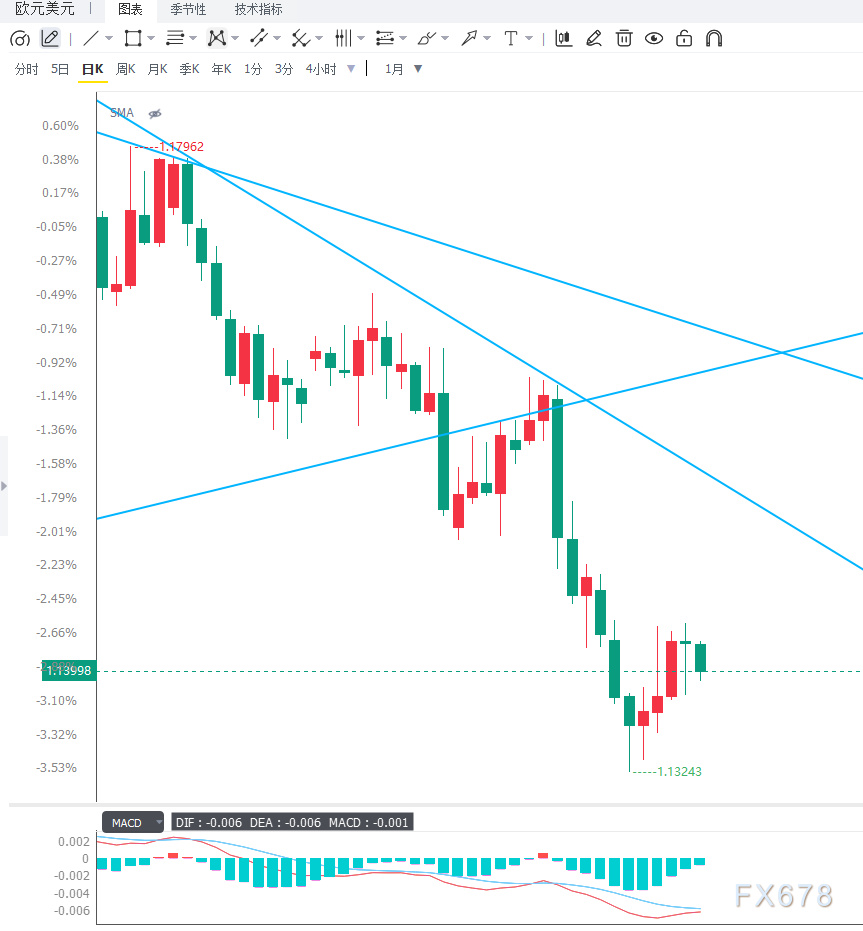
From the perspective of daily structure, the EUR/USD continued to fall after being blocked in the 1.15 area and is currently operating below the short-term moving average. The overall trend is gradually shifting from high volatility to a weak consolidation structure. The price has been quoted multiple times1.1450Encountering resistance nearby and falling back, indicating heavy selling pressure above. The current key support is located at1.1360If it falls below this level, it may open up further space for a pullback towards the 1.13 region.
From a 4-hour perspective, the exchange rate is running along a downward channel with limited rebound strength. The short-term moving average system maintains a bearish position, indicating that the bearish structure is dominant. The momentum indicator remains neutral and weak, and the market is clearly in a state of waiting for macro data to drive. Once the US employment data is stronger than expected, the exchange rate may further decline; If the data falls short of expectations, it may trigger a technical rebound1.1450Nearby.
edit summary
The core contradiction of the current EUR/USD trend still lies in the differentiation structure between "rapid cooling of inflation in the eurozone leading to a loosening of ECB policy expectations" and "maintaining high US interest rates to strengthen the advantage of the US dollar". In the short term, the US dollar has an advantage under the dual support of safe haven and interest rate differentials, while the euro has lost policy support due to falling inflation. The market is entering a critical data window period, and HICP and US employment data will become important triggering factors in determining short-term direction. Before the data is released, the exchange rate is expected to maintain a weak and volatile pattern, and the medium-term trend still depends on the differences in monetary policy paths between Europe and the United States.
Please indicate the source when reprinting: https://www.daoctech.com/fxoutrade/5291.html
Disclaimer: The content of this article does not represent the views of the Institute of Foreign Exchange. The content is for reference only and does not constitute investment advice. Investors operate accordingly at their own risk.