
How can we identify trends in the foreign exchange market?
foreign exchange marketA global financial marekt in which participants exchange the currency of one country for the currency of another. Securities traded between investors are based on market mood swingscurrency pairCurrency markets are actively traded across multiple time zones 24 hours a day, six days a weekInvestors can use a number of different techniques to identify trends in the foreign exchange market
Define trends
A foreign exchange market trend occurs when the price of a currency pair moves in an identifiable direction over a specific period of time. The price of a currency pair is quoted at the exchange rate, i.e. the value of one currency relative to another. The moving average of the price of a currency pair is one of the best trend indicators. A moving average is the average of the price of a specific number of currency pairs that changes over time. For example, a five-day moving average is the average of the last five days; on the sixth day, the average of the first day will be removed from the calculation of the average. If the moving average is climbing, the trend of the market is generally climbing; when the moving average is falling, the trend is generally declining.
Moving Average Crossing
Moving average crossovers are another way to identify trends. Many investors look at currency pairs on charts that track moving averagesexchange rateA crossover occurs when the short-term moving average of the price of a currency pair is higher or lower than the long-term moving average of the price of a currency pair. For example, if the 5-day moving average of the price of a currency pair is higher than the 20-day moving average of the price of a currency pairMoving AverageThen there may be an upward trend.
The high and low points of the price
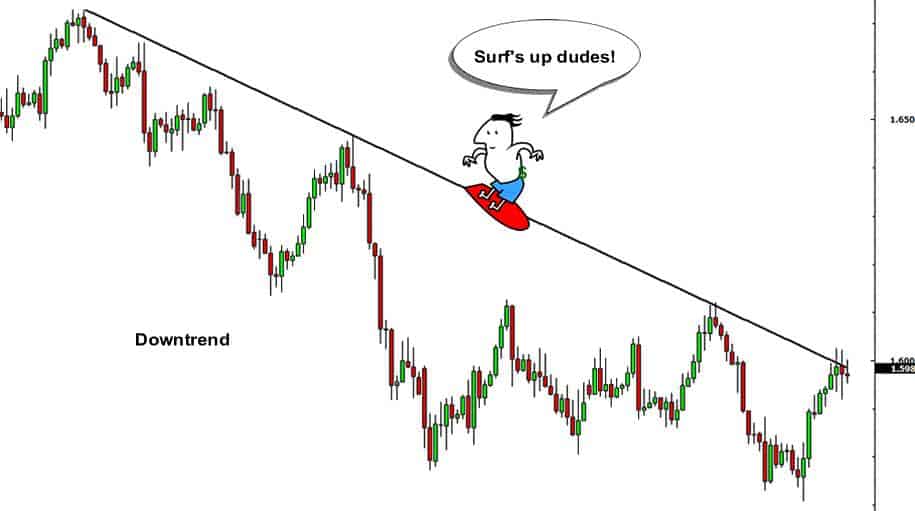
The price of a currency pair fluctuates over the course of a day and will generate a high price and a low price. A "high price" is generated when the high price of a currency pair is higher than the high price of the previous day. A "lower low" is generated when the price of a currency pair is lower than the low of the previous day. A higher high of a currency pair combined with a higher low of the currency pair also shows a foreign exchange trend. For example, if a currency pair has three consecutive higher highs and three higher lows, it indicates that an upward trend has been formed, while three consecutive lower lows and three consecutive lower highs indicate a downward trend.
technical indicator portfolio
Trends can also be identified by combining techniques. A combination of continuously moving average levels crossed with moving averages can confirm that an uptrend has formed. Investors can also combine price action with moving averages to help determine a trend. For example, a sequentially higher high with a continuously climbing moving average can confirm an uptrend.
Please indicate the source: https://www.daoctech.com/fxschool/1074.html
Disclaimer: The content of this article does not represent the views of the Institute of Foreign Exchange. The content is for reference only and does not constitute investment advice. Investors operate accordingly at their own risk.