
Popular science: "Duan" in entanglement
The "segment" in the entanglement theory is one of the basic structures that make up the price movement, used to break down market fluctuations and identify the continuation or turn of the trend. It is an important concept defined by the entangler in his theory, and is a higher-level component after "parting" and "pen". The following is a detailed analysis of the line segment:
Definition of line segment
Constituent elements: The "segment" consists of at least three "pens" (consecutive and non-overlapping pens), and must meet the top and bottom parting alternation (i.e. the rising line segment starts from the bottom parting, and the falling line segment starts from the top parting). Directionality: - Rising line segment: Starting from the bottom parting, it goes through a series of rising pens and retracement pens, and it continues to be effective until a new bottom parting is formed. - Descending line segment: Starting from the top parting, it goes through a series of falling pens and rebound pens, and it continues to be effective until a new top parting is formed.
Confirmation condition of the line segment - Termination signal: The line segment must be terminated by the line segment in the other direction (for example, the rising line segment is destroyed by the falling line segment). - Characteristic sequence: By observing whether the characteristic sequence of the pen (serializing the closing price of each stroke) appears parting, it can help determine whether the line segment ends. - If the characteristic sequence appears reverse parting (such as the top parting in the rising line segment), it may indicate the end of the line segment.
Line segment division rules
Basic rules: 1. The line segment must be composed of at least three strokes, and there can be no overlap between the pens (except for the pens that contain the relationship processing). 2. The direction of the line segment is determined by the initial parting, and subsequent pens must continue in this direction. 3. The end of the line segment must meet one of the following conditions: - A reverse line segment appears (for example, a rising line segment is followed by a falling line segment). - The characteristic sequence parting is confirmed (it needs to be judged by combining strength and position). Special cases: - Segment extension: If the price does not effectively destroy the direction of the original line segment (such as the rising line segment pullback does not break the previous low), the line segment continues. - Segment destruction: When the price breaks through the key parting and the characteristic sequence is confirmed, the original line segment ends.
The relationship between line segments and trend types
- Line segments are the basis for building pivots and trend types. Multiple line segments can be combined to form higher-level movements: - Pivots: At least three overlapping line segments form the pivots. - Trends: Line segments in the same direction are arranged continuously to form an upward or downward trend.
Notes in practical application
- Dynamic: Line segments need to be divided according to the latest price dynamics, and the original line segments may be reconfirmed due to the appearance of new pens. - Combined with other tools: It needs to be coordinated with MACD, volume and other indicators to avoid relying solely on line segment division. - Level correlation: Line segments of different time periods (such as 1 minute, daily line) need to be combined with analysis, and small-level line segments may only be one stroke in large levels.
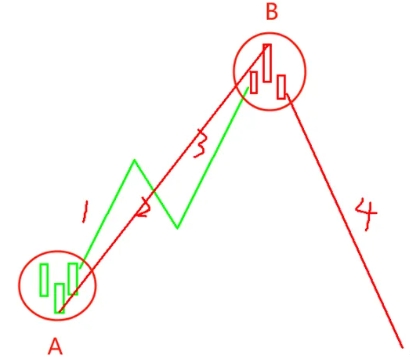
Example: End of rising line segment 1. Initial rising line segment: bottom parting A → rising pen 1 → callback pen 2 → rising pen 3 (line segment continues). 2. Top parting B appears: the price subsequently falls to form pen 4. If pen 4 falls below the starting point of pen 1 and the feature sequence confirms the top parting, the rising line segment ends. As shown in the figure, the rising line segment "AB"
summary
Line segments are the key bridge connecting micro (pen) and macro (trend) in entanglement, and their core lies in the alternation of typing and dynamic termination. Mastering the division of line segments requires a lot of practice. It is recommended to repeatedly verify it in combination with historical data, and pay attention to multi-level simultaneous analysis. The essence of entanglement is "don't predict, just follow", and line segments are exactly this
Please indicate the source: https://www.daoctech.com/fxschool/1612.html
Disclaimer: The content of this article does not represent the views of the Institute of Foreign Exchange. The content is for reference only and does not constitute investment advice. Investors operate accordingly at their own risk.