
The trend of emotional repair is uncertain, and the euro faces a choice of direction
On Monday (August 4), the euro/dollar was slightly under pressure during the session, and the US market traded around 1.1580 before the session, maintaining the high and volatile pattern after the big sun line last Friday. The exchange rate had fallen to a low of 1.1391 before the release of non-farm payroll data, and then rebounded rapidly after the US non-farm payroll data in July was significantly worse than expected. It rose more than 190 points in a single day, setting the largest one-day gain in three weeks. The market is currently digesting the possible significant impact of the data on the Federal Reserve's policy path.
Fundamentals:
On Friday, the US Labor Department announced that the number of non-farm payrolls increased by only 73,000 in July, far below the 110,000 expected by the market, and the data for the first two months were revised down sharply: from 144,000 to 19,000 in May, and from 147,000 to 14,000 in June. The series of data triggered deep concerns about the outlook for the US economy and inspired strong bets on the Federal Reserve to cut interest rates in September. According to CME Fed Watch tool data, the probability of a rate cut in September surged from 40% to 80%.
More explosive: President Donald Trump publicly accused the Bureau of Labor Statistics of falsifying the data after the data was released, and then fired BLS director Erika McEntarfer, saying it "disgraced the Republican Party and me." In addition, the resignation of Federal Reserve Governor Kugler made the market more worried about policy independence and future decision-making tendencies. This series of political and economic turmoil caused the short-term collapse of the dollar bulls and the euro to take advantage of the momentum.
However, the fundamentals of the euro area itself are also hardly optimistic. The Sentix Investor Confidence Index unexpectedly fell to a three-month low of -3.7, well below the expected 8.0 and below the previous value of 4.5, indicating that regional economic confidence has deteriorated again. Trade prospects and weak domestic demand remain medium- and long-term risk points for the euro.
Technical aspects:
From the daily chart of EUR/USD, after a strong rebound last Friday, the exchange rate is currently running below the middle Bollinger Band (1.1669). The technical rebound is beginning to appear, but the trend has not yet reversed. In the MACD indicator, the bar chart is still in the green column stage, showing that the bears are still dominant. The Relative Strength Index (RSI) rebounded from a low to 48.22. Although it is out of the oversold area, it has not yet returned to the strong area, reflecting that there is still resistance in the rebound process.
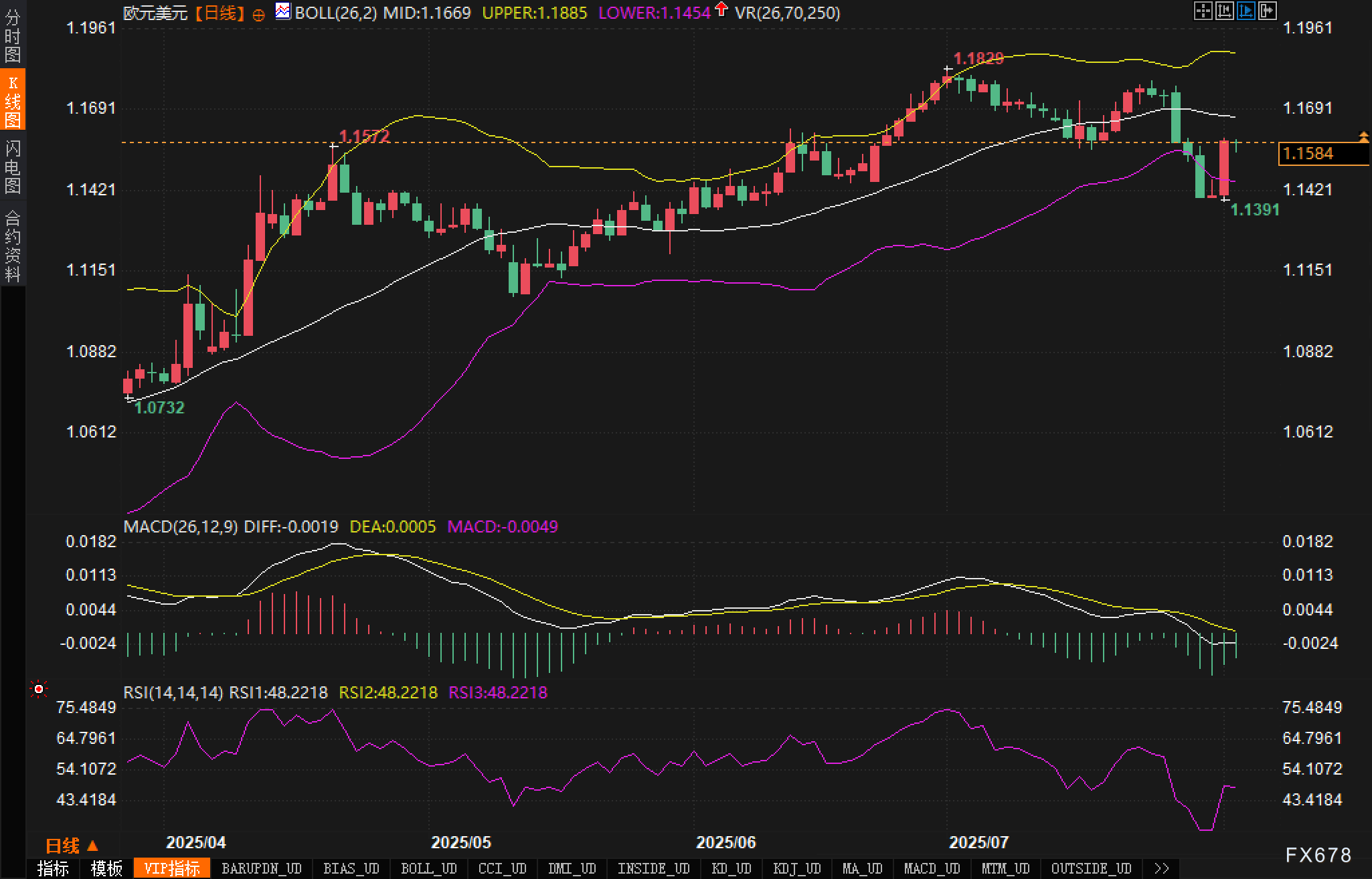
Bollinger Band track, the upper rail 1.1885 constitutes a strong resistance in the medium term, and the lower rail 1.1454 is the current key support; analysis believes that if it falls below 1.1454, the exchange rate may explore the front low of 1.1391; conversely, if it can stand on the 1.1669 track, or is expected to test the 1.1700 integer mark. The recent trend is a "technical rebound + unknown trend" pattern, and traders are wary of false breakouts.
Market sentiment observation:
The market is currently entering a period of intense volatility and emotional games. Dollar bears have increased significantly due to the chain effect of non-farm payroll data, especially in the context of rising expectations of political interference in the independence of the Federal Reserve. Traders tend to bet on easing policy in advance. However, the euro itself has not provided more convincing fundamental support, and regional confidence data has weakened sharply, allowing some funds to gradually take profits in the technical rebound.
Outlook for the future market:
The short-term outlook:
Considering that the Federal Reserve officials will speak out one after another this week, the market is expected to play a game around "whether to cut interest rates in advance". Under the short-term bearish and political sentiment, analysts believe that the euro/dollar is expected to continue to fluctuate higher, but the upper 1.1669 to 1.1700 area is a medium-term strong resistance area, and it is necessary to see whether the volume breaks through.
Medium-term outlook:
In the medium term, the analysis believes that unless the US economic data continues to weaken continuously and the Federal Reserve clearly releases the September interest rate cut signal, it will still be difficult for the euro to start a unilateral upward trend; technically, the Bollinger Band opening has not yet expanded significantly, and it is still in the early stage of range fluctuations. If the follow-up European and American economic data continue to diverge, the exchange rate may test the 1.1454 lower track support again.
Please indicate the source: https://www.daoctech.com/fxschool/1677.html
Disclaimer: The content of this article does not represent the views of the Institute of Foreign Exchange. The content is for reference only and does not constitute investment advice. Investors operate accordingly at their own risk.