
Crude oil trading reminder: Weaker U.S. demand and OPEC + production increase plan drive oil prices down to near previous lows, beware of breaking
Brent crude oil futures fell 0.45% to $66.07 a barrel in Asian trading on Friday, while West Texas Intermediate crude fell 0.5% to $62.00. Brent and WTI had fallen 1.7% and 2% respectively in the previous session, indicating that market sentiment remains under pressure.
The International Energy Agency (IEA) said in its monthly report that global supply will grow faster than expected in 2025, driven by the OPEC + production increase plan. At the same time, OPEC maintained its forecast for higher global demand growth in 2025 and 2026 in its monthly report, stressing that the global economy maintained a solid growth trend.
OPEC + decided at its latest meeting to further increase production quotas from October, and Saudi Arabia has made it clear that it wants to regain market share through increased production.

Saudi state-owned energy company Aramco plans to export about 1.65 million barrels per day of crude oil to the Asian powerhouse in October, up from 1.43 million barrels per day in September, according to market research.
UBS analyst Giovanni Staunovo said the market is questioning whether Asian powers can digest more crude oil and maintain low levels of OECD inventories for a long time, while investors focus on potential new sanctions against Russian oil.
The International Energy Agency pointed out that Russia, the world's second-largest crude oil producer since 2024, saw its revenue from crude oil and products fall in August to one of the lowest levels since the conflict in Ukraine.
According to other market sources, Russia plans to reduce ESPO crude oil exports from the far eastern port of Kozmino to 4 million tons (about 1 million barrels per day) in September, down from 4.20 million tons in August.
In the United States, consumer prices rose by the most in seven months in August, and initial jobless claims rose unexpectedly. Therefore, the market expects the Federal Reserve to cut interest rates next week to stimulate growth, which may indirectly benefit crude oil demand in the future.
However, the U.S. Energy Information Administration (EIA) reported that U.S. crude oil inventories rose by 3.90 million barrels to 424.60 million barrels last week, adding to oversupply concerns.
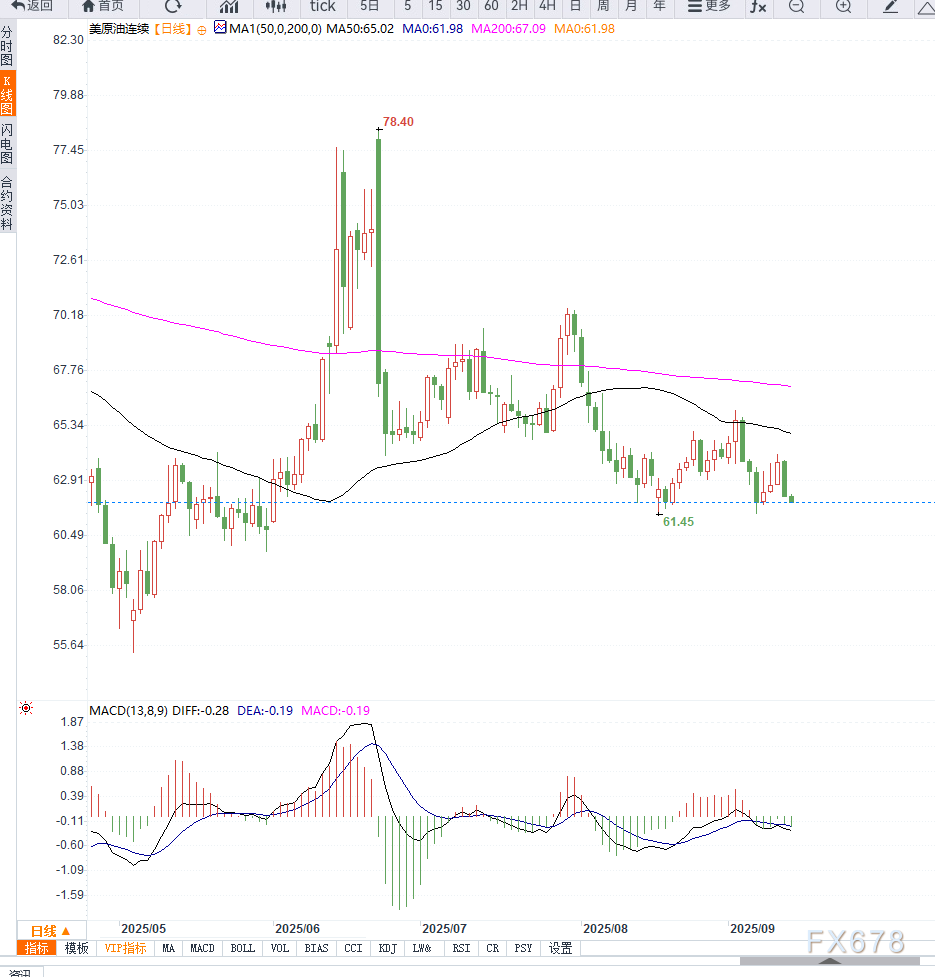
From the daily chart, WTI crude oil has been under pressure at the downward trend line resistance above $65 recently, and multiple rebounds have failed to break through, indicating that the market lacks upward mobility. In terms of technical indicators, the RSI hovers in the neutral range, indicating that the long and short forces are temporarily balanced;
But if the price falls below the key support of $61.50, it may further drop to the $60 integer mark. On the contrary, if it can effectively stand above $63.50, it is expected to usher in a phased recovery rebound.
Editorial opinion:
The current oil market is caught in a dual game of "supply increase and demand doubts". The OPEC + production increase and Saudi Arabia's move to grab market share have deepened the expectation of oversupply. Rising US inventories and weak consumption data have also left the demand side unsupported.
Although the Federal Reserve's interest rate cut may be positive for oil prices in the medium and long term, in the short term, oil prices are still facing downward pressure, especially as market confidence is gradually turning cautious.
Please indicate the source: https://www.daoctech.com/fxschool/1763.html
Disclaimer: The content of this article does not represent the views of the Institute of Foreign Exchange. The content is for reference only and does not constitute investment advice. Investors operate accordingly at their own risk.