
0.8123 to 0.80: Who is selling the dollar and buying the Swiss franc?
On Tuesday (November 11), the dollar continued its decline against the Swiss franc after retracting the previous trading day, and the current North American session price is around 0.80. The Swiss franc strengthened in stages, bringing the exchange rate down from last week's high of 0.8123. The market repriced risk and hedging weights around policy and tariff expectations, US fiscal progress, and employment clues.
Fundamentals:
In the past two weeks, the news that the United States and Switzerland may complete a tariff arrangement in the short term has become a direct driver of the exchange rate. Market rumors suggest that if it is finally implemented, the US import tax rate on Swiss goods is expected to be reduced from 39% to 15%. The figure is not small, but it has substantive significance for the marginal competitiveness of manufacturing and precision exports: the reduction of the tariff burden will improve the income statement and order visibility of Swiss exporters, thereby strengthening the stability of the current account and the basic support of the Swiss franc. Some large European and American institutions called this plan in the report as "the relative best choice in a difficult environment", but also reminded that "it has not been finally signed", so the market pricing is mainly "cautiously optimistic". In other words, the Swiss franc's strength is mixed with an uncertain option premium, which can also be quickly reversed if the details of the negotiations are not as expected.
At the same time, US macro clues have not provided additional momentum to the dollar. On the fiscal front, the Senate has passed the government funding bill and the bill is advancing to the House of Representatives. If it is approved in the middle of this week as expected, the short-term may mitigate the risk of shutdown, but the impact on the dollar liquidity and curve term premium is neutral. On monetary policy, the Fed's communication is still "data-determined"; derivatives pricing shows that the probability of another 25 basis points cut in December is about 62%. The two reductions that have been implemented this year add up to 50 basis points - a set of figures that on the one hand suppress long-end yields, and on the other hand limit the rebound height of the dollar in the context of inflation still above the 2% target.
For the Swiss franc, if the tariff arrangement proceeds, the improvement of Swiss export expectations superimposed on Switzerland's status as a safe-haven currency often makes funds willing to hold some exposure to the Swiss franc when global threat and risk assessments are on the rise. In the short term, the market will focus on tracking US employment clues and the pace of budget negotiations. Once the data and fiscal progress are more moderate, the tendency of US bond yields to fall will further suppress the dollar and indirectly benefit the Swiss franc.
Technical aspects:
From the daily K-line chart, the upward structure formed by the exchange rate from the two lows of 0.7872 and earlier 0.7828 entered a retracement after peaking at 0.8123 - the rhythm of finishing, and is currently trading around 0.80. The combination of the K-line, the recent continuous small solid negative line accompanied by the upper shadow, suggesting that the above selling pressure is still there; if the previous 0.8075 and 0.8123 are used as resistance bands, the rise is expected to re-initiate backtesting to the latter.
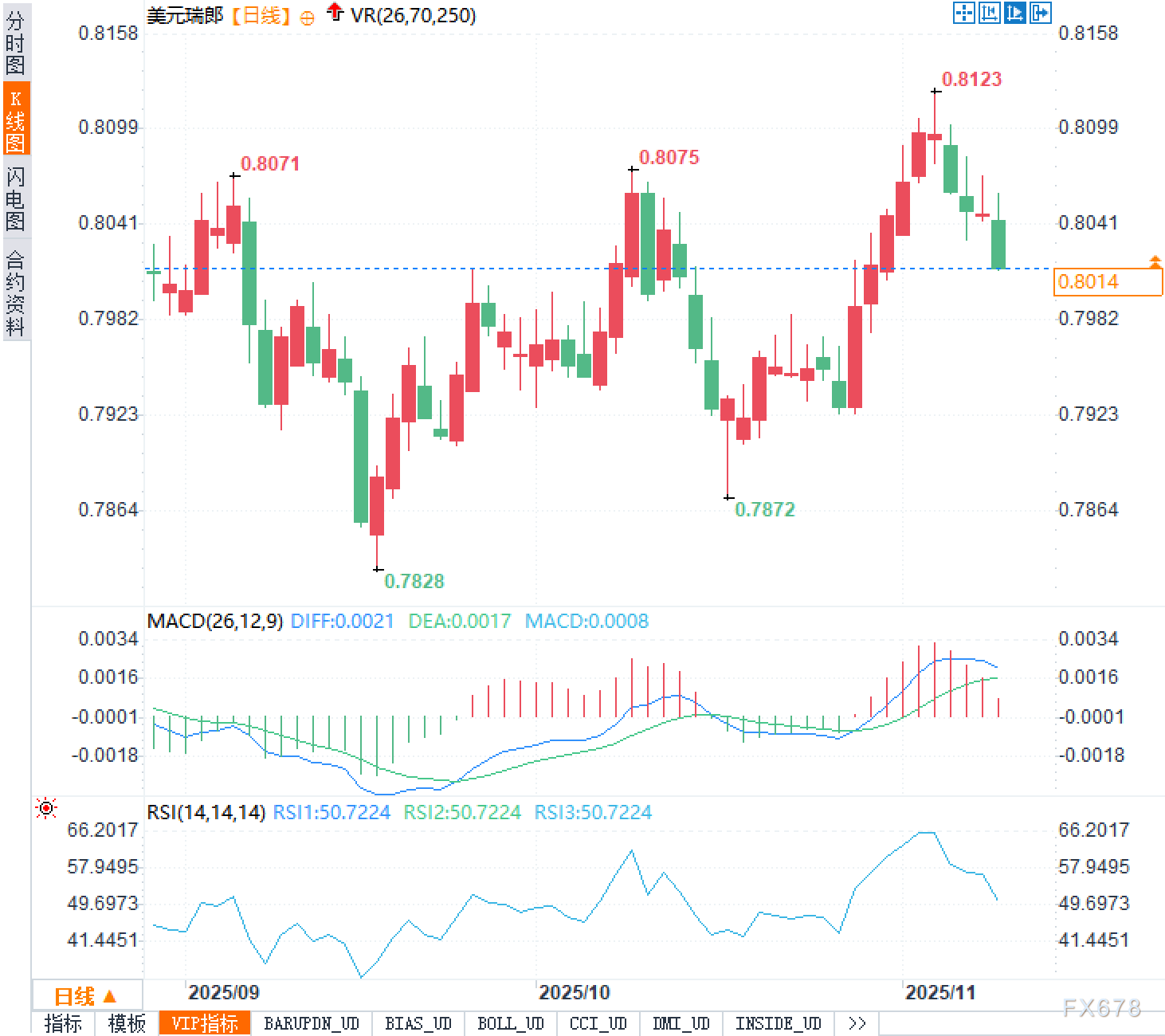
At the indicator level, MACD currently has a DIFF of about 0.0021 and a DEA of about 0.0017. It is still above the zero axis but the bar chart has narrowed, and there are signs of "volume energy shrinkage" in kinetic energy - the bulls are not out of control, but the marginal advantage is decreasing; once the DIFF turns down and approaches the signal line, be vigilant for the technical pullback caused by the "dead fork above the zero axis".
Combined with the price scale, the 0.7980 and 0.7930 bands form the first static support, and the drop points to the front lows of 0.7872 and 0.7828; on the upside, the 0.8040 scale and 0.8075 form a short-term resistance area, further forming a strong resistance of 0.8123. The key information given by the technical structure is that the trend changes from "upward retracement" to "neutral oscillation", and breaking or breaking the above interval boundary will trigger the next trend wave.
Outlook for the future market:
Short-term path (1-3 days): If the news continues to be biased towards the Swiss franc (tariff negotiations advance) and the US employment clue is not strong, the exchange rate is likely to be repeatedly pressured below 0.8040, and the shock will move down to test 0.7980; after the breakdown, the bears will try to advance towards 0.7930, and use 0.7872 as the lower edge of the "trend confirmation level" to backtest. If there is an accident of macro bullish dollar, then look at 0.8040 above, break through and stand firm, you can restart the impact on 0.8075, and further explore the demand of 0.8123 to improve in tandem with the fundamentals.
Midline framework (1-3 weeks): The structural key lies in the band boundary formed by 0.8123 and 0.7872/0.7828. If two conditions are superimposed in the future - first, the tariff arrangement is officially implemented and the details are better than rumors, and second, the Fed's caliber continues to guide easing expectations - then the Swiss franc's midline buying is expected to strengthen, and the probability of the US dollar breaking 0.7872 against the Swiss franc will increase. At that time, the trend may evolve into a downward channel of "retracement-break-continuation". On the contrary, if there are repeated negotiations, the Fed's attitude turns more cautious, or the US data gradually picks up, and the US dollar yield rises again, the "resistance band" above 0.8075 will be gradually digested, and more space can be opened above 0.8123, and the daily structure can be pulled back into the upward channel.
Please indicate the source: https://www.daoctech.com/fxschool/2039.html
Disclaimer: The content of this article does not represent the views of the Institute of Foreign Exchange. The content is for reference only and does not constitute investment advice. Investors operate accordingly at their own risk.