
The dollar has been a bit tired recently, but the Australian dollar has quietly risen for 12 consecutive days: who gave it the courage?
Monday, December 8. The US dollar as a whole maintained a weak and volatile trend, with the US dollar index hovering near a five-week low, reflecting the market's general expectation that the Federal Reserve is about to start a rate-cutting cycle. At the same time, among non-US currencies, the Australian dollar performed particularly well, rising against the US dollar for the 12th consecutive trading day. It once approached the key psychological level of 0.6650 during the session, setting a new high in more than two months.
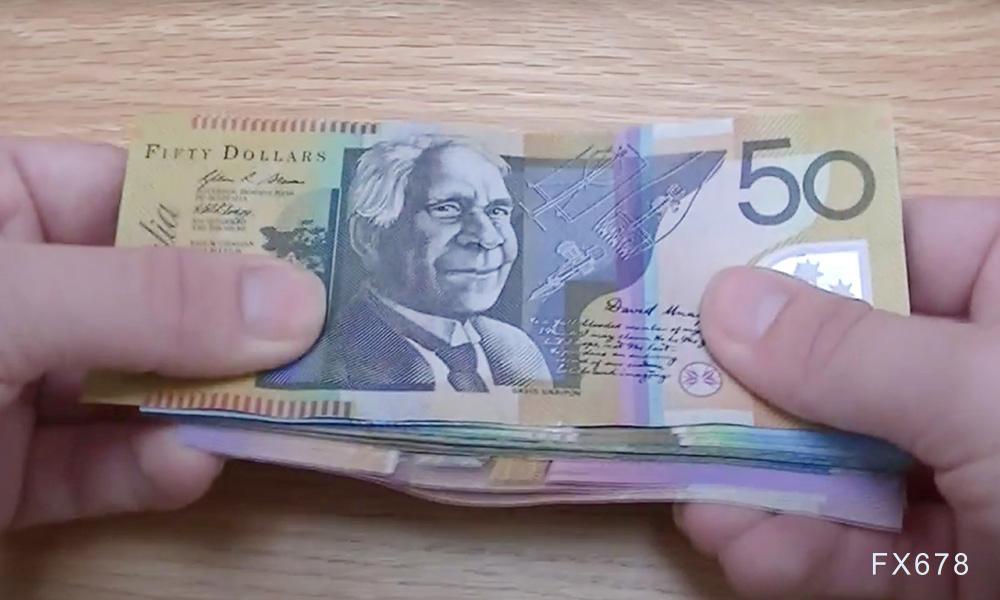
This round of strength of the Australian dollar is not an isolated market. It is caused by the fact that Australian inflation data has rebounded more than expected, and the Reserve Bank of Australia's monetary policy stance may shift to a prudent or even tight market expectations. In the context of differentiated adjustments in the monetary policy paths of major central banks around the world, the trend of the Australian dollar against the US dollar has become an important bellwether for observing changes in market risk appetite and interest rate expectations.
In the US, the latest Personal Consumption Expenditures Price Index (PCE) shows that core inflation has eased slightly to 2.8%, but it is still significantly higher than the Federal Reserve's long-term target of 2%. However, more market-focused indicators of consumer expectations for future inflation - the University of Michigan survey shows that both one- and five-year inflation expectations have declined, which is interpreted as a signal that the household sector is becoming more optimistic about the price outlook. Nonetheless, recent labour market data have continued to soften, job creation has declined, and unemployment has risen modestly, all of which have strengthened the market's judgment that the Federal Reserve will soon start cutting interest rates. According to the pricing of the interest rate futures market, the probability of the Federal Reserve announcing a 25 basis point cut in the federal funds rate on Wednesday has reached 87%. This highly consistent expectation of interest rate cuts has weakened the relative attractiveness of US dollar assets and pressured the US dollar index. It is worth noting that there are still differences within the Federal Reserve on the future policy path: some members believe that factors such as tariffs may push up prices again and advocate caution; while others prefer to follow the economic slowdown trend and push for faster interest rate cuts. Although this policy uncertainty is temporarily masked by the consensus on interest rate cuts, it may still cause market volatility once the follow-up data is repeated.
Australia's macroeconomic picture, by contrast, shows a different rhythm. Consumer prices rose 3.2 per cent year-on-year in the third quarter, a marked acceleration from the 2.1 per cent increase in the second quarter, signalling renewed inflationary pressures. The data shattered previous linear expectations that inflation would continue to fall in Australia, prompting traders to quickly adjust their bets on the RBA's future actions. Prevalent dovish expectations that the RBA would follow most of the world's central banks into a rate-cutting cycle are being revised, with a growing number of investors believing that, at least in the short term, the RBA may choose to stand still, or even rule out the possibility of reassessing tightening policy at some point in the future. This potential shift in the stance of monetary policy directly enhances the attractiveness of the Australian dollar in interest rates. In addition, the stability and recovery in commodity prices, especially for key export resources such as iron ore, also provided fundamental support for the Australian dollar. In an environment of uncertain global growth prospects, Australia's relatively strong inflation performance has instead become a unique factor supporting the strength of the local currency, reflecting the asymmetric response of different economies to cyclical fluctuations.
In terms of market performance
The technical pattern of the Australian dollar against the US dollar shows a clear upward trend. Twelve consecutive trading days of gains have not only broken through multiple short-term resistance levels, but also formed a stable long arrangement at the daily level. The price is currently 0.6644, which has returned to and stood at the previous key level, indicating a phased upward shift in the center of gravity. The upper 0.6650 area corresponds to the superposition of the front high and the psychological barrier, and there is a certain technical digestive pressure in the short term.
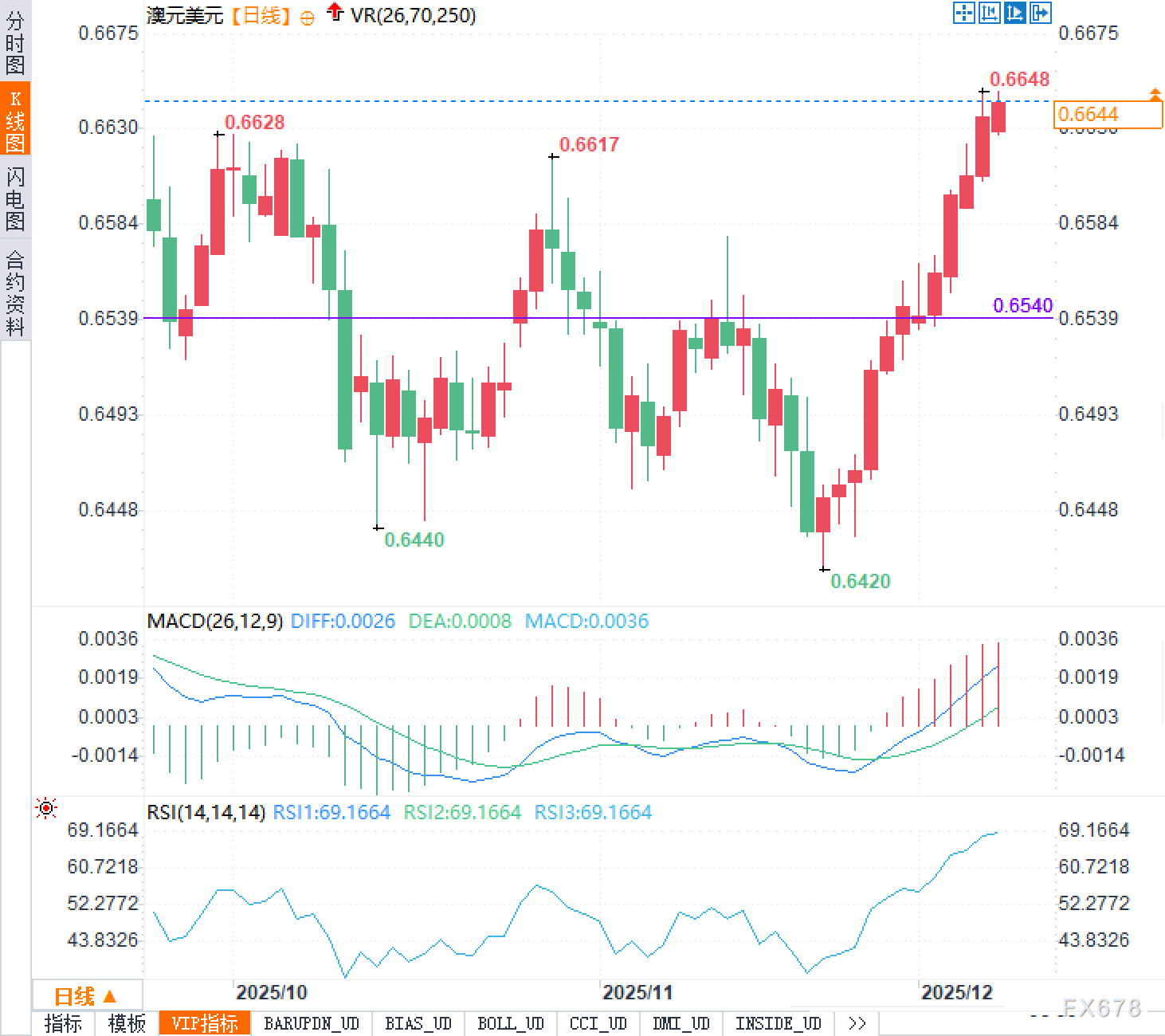
The fast and slow lines of the MACD indicator diverge upward, and the columns continue to enlarge, reflecting that the trend momentum is still there; but the RSI is around 69, close to the hot area, suggesting that the upward process may be accompanied by fluctuations and a slowdown in rhythm. Below, pay attention to the effectiveness of structural support in the 0.6540 area. If the retracement can still maintain a high level, it will be conducive to the stability of the continuation trend.
Looking to the future
The further direction of the Australian dollar against the US dollar will depend on the game of two core variables: one is whether the Reserve Bank of Australia's stance at its monetary policy meeting on Tuesday is indeed as hawkish as the market expected, or at least more vigilant; the second is whether the policy guidance provided by the Federal Reserve after Wednesday's interest rate meeting can ease market concerns about its premature or excessive rate cuts. If the Reserve Bank of Australia clearly sends a signal to pause interest rate cuts or even consider re-tightening, and the Federal Reserve emphasizes in its post-meeting statement that inflation risks are not eliminated and future actions need to rely on data, the Australian dollar is expected to break through 0.6650 and test higher levels.
Conversely, if the Reserve Bank of Australia reiterates its accommodative stance, the current rise in the Australian dollar may face pullback pressure. In addition, the market will also pay close attention to the interest rate dot chart released by the Federal Reserve, which will reveal the Fed's collective view on the future path of interest rates. In particular, the interest rate forecast for 2026 will become a key basis for judging the sustainability of policy. The lack of up-to-date non-farm payrolls and inflation data as a reference makes the communication art of this meeting particularly important.
Please indicate the source: https://www.daoctech.com/fxschool/2093.html
Disclaimer: The content of this article does not represent the views of the Institute of Foreign Exchange. The content is for reference only and does not constitute investment advice. Investors operate accordingly at their own risk.