
Short-term trading strategy: Fake breakout (fade-out breakout) app sharing
Many experienced Forex traders often employ a fade-out breakout trading strategy (i.e. a fake breakout strategy), which is a short-term trading method that captures false breakouts to gain. Breaking through resistance or support levels is an extremely important price level, but there are no strict rules for determining how much force is required to move prices through key levels and thus into a sustainable trend. Break trading at key levels can come with significant risk.
As a result, false breakouts tend to occur more frequently than real breakouts. Sometimes, prices test resistance levels multiple times, or even two or three times, before a breakout. This phenomenon has spawned many counter-trend traders, who usually focus on what appears to be a breakout in the currency market. (Provide a reference for technical analysis methods)
However, every time you try to execute a trade using a breakout fade, you also need to be wary of potential major losses. Because once a real breakout occurs, the trend is usually strong and persistent.
Therefore, traders need a screening method to identify those consolidation patterns that are more likely to lead to false breakouts. The following rules provide a reliable basis for screening such trading opportunities.
For long transactions:
First, look for currency pairs where the 14-day ADX indicator is below 20. Ideally, the ADX value should show a downward trend, which indicates that the current trend is weakening further. Wait for the market price to fall below the previous day's low by at least 15 points. Subsequently, in the next trading session, place a buy order with the price a few ticks above the previous day's high. When the risk from rising prices increases, half of the position can be closed to lock in part of the profit, and the remaining position is moved to the break-even point, and trailing stops are set for protection. In practice, some trading platforms such asAohuiProvide flexible tools to help traders better manage such positions.
For short trades:
Similarly, look for currency pairs where the 14-day ADX indicator is below 20. Ideally, the ADX value should be skewed downward, indicating that the trend is gradually weakening. Watch if the market moves at least 15 pips above the previous day's high. Afterwards, in the next session, place a sell order with the price several ticks below the previous day's low. The initial protective stop is set to no more than 20 pips. When the price moves 20 pips in a favorable direction, lock in profits by closing half of the position. Trailing stops are placed for the remaining positions to continue following the trend.
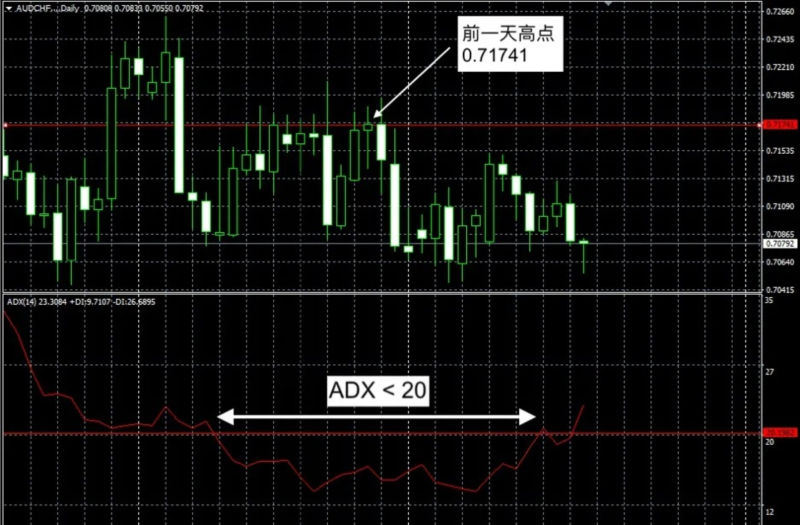
The following is illustrated by a short example. Figure 1 shows the daily chart of a currency pair, where ADX is below 20 and the indicator is pointing downward, which is the initial signal to set up a trade. In this example, the previous day's high is 0.71741. We need to wait for the price to break through this high by at least 15 points, that is, to reach the trend of at least 0.71941.
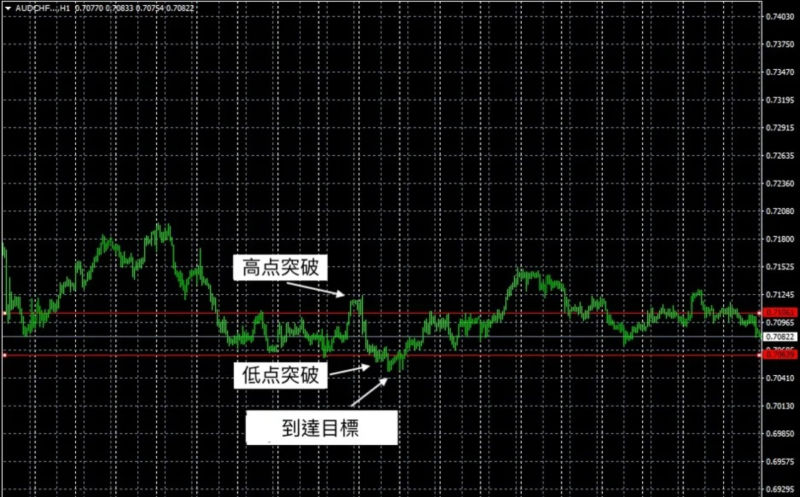
As shown in the hourly chart in Figure 2, we execute a sell order with the price located 5 points below the previous day's low of 0.7063. The stop loss is set at 0.7043 and the initial target is set at 0.7053. After the first target is reached, the remaining position stop loss is moved to the break-even point. In this example, the second half of the trade is retained and eventually closes at break-even or triggers a stop loss exit.
Please indicate the source: https://www.daoctech.com/fxschool/2398.html
Disclaimer: The content of this article does not represent the views of the Institute of Foreign Exchange. The content is for reference only and does not constitute investment advice. Investors operate accordingly at their own risk.