
Trump's tariff threats roil markets, weakening dollar, safe-haven currencies in demand
On Monday (January 19), the US dollar fell in the US market, and US President Trump issued a tariff threat to Europe over the Greenland issue, triggering market anxiety. Investors switched to safe-haven currencies such as the Swiss franc, and the global foreign exchange market heightened risk aversion. BCRforeign exchange marketThe data shows that demand for the Swiss franc has increased significantly.
Trump announced over the weekend that he would impose an additional 10% import tariff on goods from eight countries including Denmark, Norway and Switzerland from February 1 until the United States is allowed to buy Greenland. European Union leaders actively dissuaded and prepared retaliatory measures to deal with potential tariffs.
European currencies rallied collectively after brief overnight pressure, with the euro, sterling and the Scandinavian krona all emerging from lows, and the Swiss franc performing particularly strongly, on track for its biggest one-day gain against the dollar in a month.
The sell-off of the dollar is similar to the crisis of confidence in US assets triggered by tariffs last April.
Despite the obvious outflow of US dollar funds on Monday, the Swiss franc rose sharplyBCR ForexAnalysts warned that if the situation escalated, investors could return to the dollar. Kit Jax, chief foreign exchange strategist at Socie ́ te ́ Ge ́ ne ́ rale, said an escalation in the trade war would not necessarily be bad for the dollar, but it would be bad for Europe, which relies on the US market for exports.
technical analysis
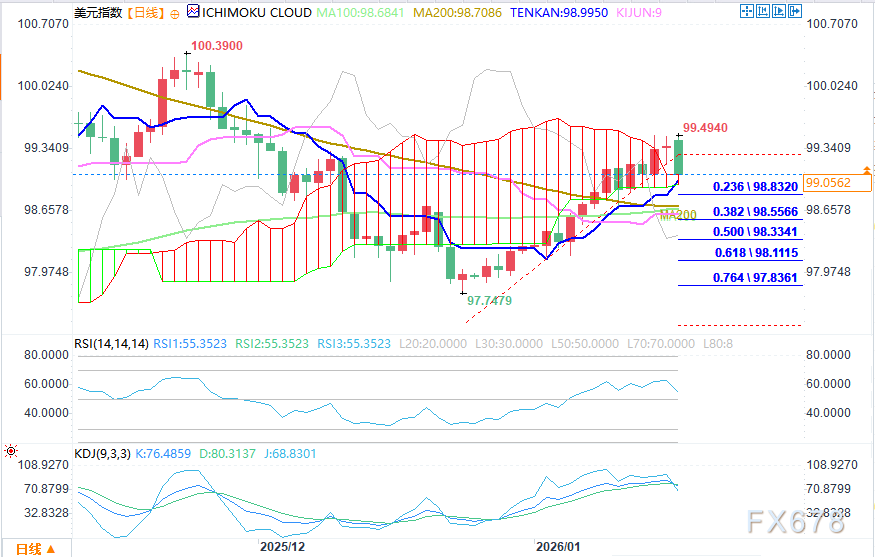
(Dollar index daily chart, source: Internet)
According to the BCR foreign exchange technical chart, the bullish momentum on the daily chart continued to decay, with the relative strength index (RSI) and the stochastic indicator KDJ both falling; the previous top deviation pattern of stochastic indicators marked the stagnation of this round of rebound, and a number of technical signals still point to medium and long-term pressure on the US dollar. In addition, the exchange rate has formed a double bull trap at the $99.20 Fibonacci resistance level, the current exchange rate rebounded to $99.04, temporarily stabilized above the $99.00 support level, but still suppressed in the short term, if we want to completely reverse the weak pattern, we need to break through the upper resistance level; on the contrary, if we fall below the $99.00 support again, we may follow the key support range of $98.83-98 - the range corresponds to the 23.6% Fibonacci support level of the $97.39-99 rising band, the daily conversion line and the bottom of the cloud chart. Further support levels below are 38.2%, 50% and 61.8% Fibonacci gears, corresponding to prices of $98.55, $98.33 and $98.11 respectively.
The current political situation is still fragile, and the European Union's countermeasures against the US tariff threat may be further escalated, which is still the core factor to suppress the US dollar. However, the technical positive signals have formed some support for the exchange rate: BCR foreign exchange technical indicators show that the daily conversion line and the benchmark line form a golden fork, and the 100-day moving average and the 200-day moving average continue to converge and are expected to build a golden fork, providing short-term support for the US dollar, which to some extent offsets the short power, which is also an important boost for the current exchange rate to recover to $99.04.
Resistance levels: 99.30, 99.49, 99.63, 100
Support levels: 99.00, 98.71, 98.55, 98.33
Please indicate the source: https://www.daoctech.com/fxschool/2439.html
Disclaimer: The content of this article does not represent the views of the Institute of Foreign Exchange. The content is for reference only and does not constitute investment advice. Investors operate accordingly at their own risk.