
The Baltic Sea index rose to a one-month high, and ship traffic rose across the board
The latest data shows that on April 8, 2026, the Baltic Dry Index (BDI) reported 2,139 points, setting a new high since March 4, 2026. It rose by 2.10% month-on-month, marking the fourth consecutive day of gains (including zero growth). Among the nearly 11 data, there were 7 positive increases and 4 negative increases. Among them, the Panamax Freight Index (BPI) reported 1,823 points, an increase of 1.17% from the previous value, the Capesize Freight Index (BCI) reported 3,220 points, an increase of 2.29%, and the Handysize Freight Index (BSI) reported 1,261 points, an increase of 2.44%. For more trend charts, please refer to the latest infographic.
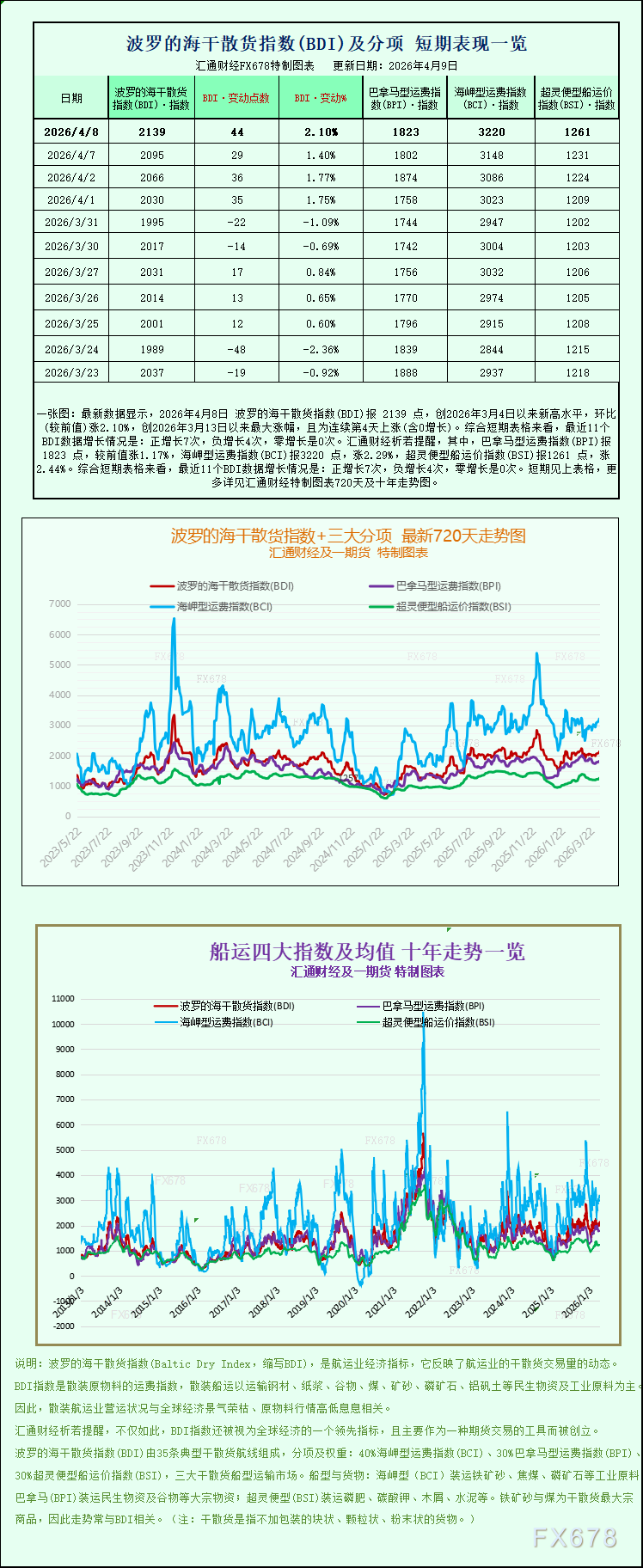
Driven by the overall recovery of the global dry bulk freight market, freight rates of various sub-sectors of ships have risen to varying degrees. The Baltic Exchange Dry Bulk Freight Index (which mainly monitors the freight rates of ships carrying dry bulk goods around the world and is a core indicator of market sentiment) climbed to its highest level in more than a month on Wednesday, marking a significant recovery in the market after a period of downturn.
The index, a core indicator of the overall trend of the dry bulk shipping market, rose 44 points, or 2.1%, to close at 2,139 on the day, the highest level since March 5, highlighting the strong recovery momentum. The index tracks the freight rates of the three mainstream ships of Capesize, Panamax and Ultrahandy. The overall increase means that the demand side of the entire industry chain has seen positive changes.KCM ForexAnalysts point out that such index increases tend to have an impact on the exchange rate of commodity-related currencies.
Among the various sub-sectors, the performance of the capesize ship market is particularly prominent. The corresponding index rose 72 points on the day, or about 2.3%, to close at 3,220 points, setting a new high in more than a month. Capesize ships usually transport 150,000 tons of bulk dry bulk, with iron ore and coal being the main categories. The sharp rise in the index is closely related to the increase in global demand for iron ore and coal transportation. The average daily revenue of Capesize ships rose in tandem, rising by $657 to $25,702 on the day, and shipowner earnings improved significantly.
The market recovery is directly related to the surge in global iron ore shipments, with major suppliers ramping up shipments of key steelmaking raw materials, driving demand for large ships. At the same time, on the geopolitical front, there are news that there are signs of thawing in US-Iran relations. KCMforeign exchange marketAnalysts pointed out that this has eased market concerns about the safety of shipping in the Strait of Hormuz, with shipping risk premiums falling and iron ore futures prices falling, further stimulating transportation demand.
The Panamax market rose steadily, with the corresponding index up 21 points, or 1.2%, to close at 1,823 on the day. This type of ship is mainly responsible for medium-scale transportation, with a carrying capacity of 6 to 70,000 tons, transporting coal, grain, etc. The rise reflects the continued recovery in global demand for grain and coal transportation. The average daily revenue of Panamax ships increased by $189 to $16,409, and the profitability level increased steadily.
The very large bulk carrier market was also bright, with the corresponding index rising 30 points, or 2.4%, to close at 1261 points. The ship type, as a supplement, mainly transports bulk cargoes on specific routes, and its freight price increase further confirms the comprehensive recovery, indicating that the active level of global commodity trade is gradually increasing. Industry insiders said that with the gradual recovery of global economic demand and the continued easing of the geopolitical situation, the dry bulk freight market is expected to maintain a recovery trend.
Please indicate the source: https://www.daoctech.com/fxschool/2557.html
Disclaimer: The content of this article does not represent the views of the Institute of Foreign Exchange. The content is for reference only and does not constitute investment advice. Investors operate accordingly at their own risk.