
Gold prices fall: Iran conflict pushes up oil prices, markets bet on Federal Reserve rate hike
On Thursday (July 23), spot gold prices fell in the US market, ending the previous four-day rally. The dollar index rebounded, and the expansion of the war in the Middle East drove oil prices higher. Spot gold was trading around $4,042.65, while gold prices hit a two-week high of $4,165 on Wednesday.
The United States has launched strikes against Iran for the 12th night in a row, and Iran has launched a counterattack, attacking US military bases in Jordan and Bahrain.
After Yemen's Houthi militants attacked two Saudi oil tankers in the Red Sea, the risk of crude oil supply disruptions around the Strait of Hormuz further spread to the Bab el-Mandeb Strait.
US President Donald Trump warned of the attack in a tweet on Facebook: "If such attacks happen again, the United States will hold Iran accountable" and called the Houthis proxies of Iran. He added that the US would carry out "large-scale military strikes" against Iran and the Yemeni militants.
The renewed tensions have pushed West Texas Light crude oil (WTI) to its highest level since June 11, with oil prices approaching $91 a barrel at the time of writing, up about 30% this month.
Rising energy costs have exacerbated market inflation concerns, and more and more investors expect the Federal Reserve to start raising interest rates this year.
Chicago Mercantile Exchange Federal Reserve Watch data show that the current market pricing shows that the probability of the Federal Reserve raising interest rates in September has risen to 78%; a week ago, the probability was only 52%.
As a result, traders are reluctant to take large long positions in gold, which continues to face multiple bearish pressures: hawkish expectations from the Federal Reserve, a stronger dollar overall, and high Treasury yields.
Yields on benchmark 10-year Treasuries rose to near 4.71 per cent, the highest since January 2025. Higher yields make interest-paying assets more attractive and are usually bearish on gold prices.
Canada's TD Securities warned: "The high interest rate environment means that the price of gold will most likely fall back to the $3,900/oz support level again, and it may be a year before the price of gold reaches a new high."
Technical analysis: $4,200 remains a key resistance level
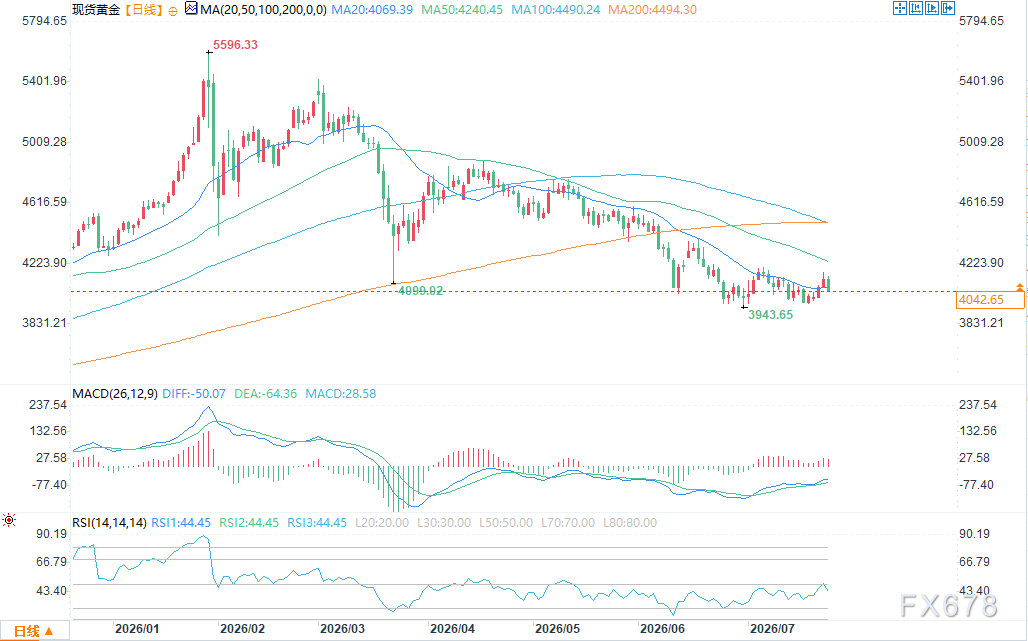
(Daily chart of spot gold, source: Internet)
On the daily level, spot gold maintained a short-term bearish trend. The current price of $4,042.65 was difficult to stand at the 20-day simple moving average of $4,069.39, while the price was well below the 50-day moving average of $4,240.45. The medium- and long-term trend of gold prices continued to be suppressed by the resistance zone formed by the 100-day moving average of $4,490.24 and the 200-day moving average of $4,494.30.
The current reading of the Relative Strength Index (RSI) is 44.45, below the axis of 50, indicating that the bulls have insufficient momentum and the market is only showing a mild range repair state.
The MACD indicator DIFF is -50.07 and the DEA is -64.36, forming a golden cross, but the DIFF and DEA main lines are still below the zero axis, indicating only that the downward pressure has eased; before the price breaks through the multiple moving average resistance above, it does not yet constitute a deterministic bulls reversal signal.
The first initial resistance above is the 20-day moving average at $4,069.39, followed by the $4,200 level resistance, and the next important resistance is the 50-day moving average at $4,240.45. If the daily closing price stands above this level, gold has a chance to hit $4,400 and further test the mid- to long-term resistance range near $4,490.
The immediate support below is located at the psychological level of $4,000, with stronger support at the recent low of $3943.65. Once the price of gold effectively falls below $4,000, it is highly likely that a deeper adjustment will be initiated, testing the 3943.65 low support again.
Please indicate the source: https://www.daoctech.com/fxschool/2754.html
Disclaimer: The content of this article does not represent the views of the Institute of Foreign Exchange. The content is for reference only and does not constitute investment advice. Investors operate accordingly at their own risk.