
The simplest and most effective trading strategy: trade using horizontal positions and price action
For foreign exchange traders, theforeign exchange marketThere are a variety of effective trading strategies. If you want to choose one of the simplest and most feasible trading strategies from the wide variety of profitable trading strategies, it is:Horizontal position and price action trading strategiesTraders can trade these signals by plotting important level positions on the trading chart and then observing and waiting for price action signals near these important level positions
Why is the horizontal position so important?
If you want to learn to trade naked K price charts, you need to know at least two things: price action and level positions. Everything in the market starts with a horizontal line, which is at the heart of the trading methods of many great traders. In fact, great traders like Jesse Livermore and George Soros pay close attention to key level positions in the market because they know they are important and can have a significant impact on the current price direction.
Horizontal positions can help us time, and they can provide a value area that can help you define your risk, and you can place stops outside this price level. Horizontal positions can provide us with a confluence area for trading, and the odds are higher when multiple price factors converge and a price action signal resonates.
Horizontal position in a trending market trading pivot price action signal
My favorite way to trade is to trade price pendulums at horizontal positions in trending markets. Since the market is in a trend, when the market pulls back and rises, they create horizontal positions. These horizontal positions are what I call pendulums. Through these pendulums in the market, we can find very high success rate price action entry signals.
When the market is in an uptrend, its highs continue to rise, and as the price rises, the resistance increases, and the price usually falls back from these highs and then gains some support at the previous highs (pivots). In this way, past resistance levels become new support levels in an uptrend, and in a downtrend, past support levels become new resistance levels, which is also called pivots.
The way we take advantage of these horizontal positions is to pay attention to price action strategies near them when the market pulls back. Here are the pivots that you need to pay attention to, which are easy to form price action entry signals, so that you can trade a valuable price consolidation point in a trending market.
Trading price action at a horizontal position in a range-bound market
Another good way to trade horizontal lines in a market is to pay attention to the price action entry signals formed at the boundaries of the oscillation range in a volatile market. Unfortunately, markets are not always trending as we would like them to be. Instead, sometimes they oscillate back and forth between support and resistance levels. Fortunately, trading price action signals allows us to trade under any market conditions, so even in volatile markets, we can still find entry signals with high winning rates.
What can happen in a volatile market is that the price oscillates back and forth between support and resistance levels. We can wait for the price to reach one of the boundaries and then observe the price-based WeChat signals that appear there. This usually gives us a high winning rate entry signal and a simple trading strategy. It also gives us a very clear horizontal line to define our risk and reward. Risk is beyond the highest or lowest point of the entry signal on the boundary, and reward is near the opposite boundary of the trading range.
Trading price action at the level of the "event area"
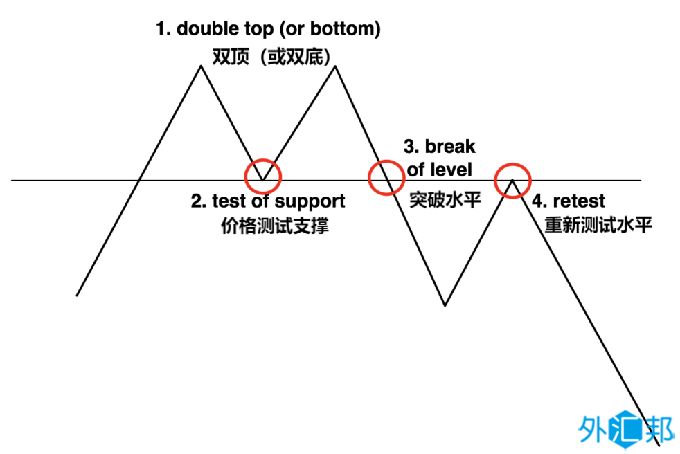
An event area is a horizontal position that has a high winning rate entry area, and you need to pay attention to price action signals forming around that area. Essentially, when there is a major price event in the market, such as an inside bar break or a pin bar reversal, the price will create an "event area" at this horizontal position. You need to note that most of the time, these event areas are significant because prices often stop or reverse when the price tests these positions in the book.
Essentially, any price action signal can create an event area if it creates a potential price movement from the event area/level area. For example, there is a downward breakout, and then the price comes back and tests the event area/level position again. When the price tests the event area again, we need to pay close attention to the price action signal. When the price action signal forms in the event area, it will be a very high entry event.
However, the event area also provides us with an opportunity to enter the market using price action signals without confirmation. This is a more advanced strategy I introduced in the price action trading course, but when the price pulls back to test the event area again, it is easy to enter the market "blindly", in other words, without confirmation from the price signal.
In addition, horizontal positions can also help us identify trends and reversal points in the market. When the price approaches or reaches an important horizontal position, we can observe price action, such as whether the price rebounds or breaks through that level. These price action signals can help us predict the movement of the market and make corresponding trading decisions.
In addition, horizontal positions can also serve as reference points for support and resistance. When the price approaches or reaches important horizontal positions, these positions can become areas of support or resistance for the market. If the price breaks through the resistance level, it may mean that the market will continue to rise; if the price falls below the support level, it may mean that the market will continue to fall. Therefore, horizontal positions can help us identify key turning points in the market.
In conclusion, horizontal positions play an important role in forex trading. By observing and waiting for price action signals near important horizontal positions, traders can develop effective trading strategies and increase the chances of winning trades.
Trading price action signals at horizontal positions is the main technique I use to analyze and trade. It is essentially the cornerstone of my trading strategy and I am convinced that it is the simplest trading strategy in the world and the most effective. Obviously, horizontal positions are very important in the market. By combining horizontal positions with price action strategies, you can get a very simple and effective trading strategy.
Please indicate the source: https://www.daoctech.com/fxschool/953.html
Disclaimer: The content of this article does not represent the views of the Institute of Foreign Exchange. The content is for reference only and does not constitute investment advice. Investors operate accordingly at their own risk.