
Weekly Review: Non-agricultural "bright and blind" dollar rebound ends three consecutive weekly declines, gold prices shock nearly $150 a week, and the yen flies out of the "black swan"
This week, the market has been in a frenzy. Gold surged to a record high at the beginning of the week, but quickly fell back to more than $150. After a series of data in the United States showed signs of cooling in the labor market, the bright eyes of non-farmers broke all this. In addition, the Bank of Japan "flew out" of the black swan, and the yen soared wildly on the early exit of negative interest rate bets.
December 4th - December 8th Market Roundup: Last week, the market caught a frenzy. The golden week skyrocketed to set a record high, but quickly fell back to more than $100. After a series of data in the United States showed signs of cooling the labor market, the bright non-farm broke all this. In addition, the Bank of Japan "flew out" of the black swan, and the yen soared wildly due to the early exit of negative interest rate bets.
In terms of market performance, gold shook nearly $150 last week, finally ending a three-week rally, while the dollar continued to rebound and end a three-week losing streak. Crude oil prices fell for seven weeks, setting the longest weekly decline since 2018. The yen fluctuated wildly last week, gaining nearly 200 points a week.
The foreign exchange market: last week, the dollar closed down only on Thursday in five trading days, showing a volatile rise as a whole. Since the beginning of the week, it rose slightly near 103.20, reaching the highest level of 104.29. However, the expectation of the central bank's interest rate cut suppressed the upward space of the US index. Finally, the dollar ended its previous three consecutive weeks of decline and ended last week with a small increase of 0.77%.
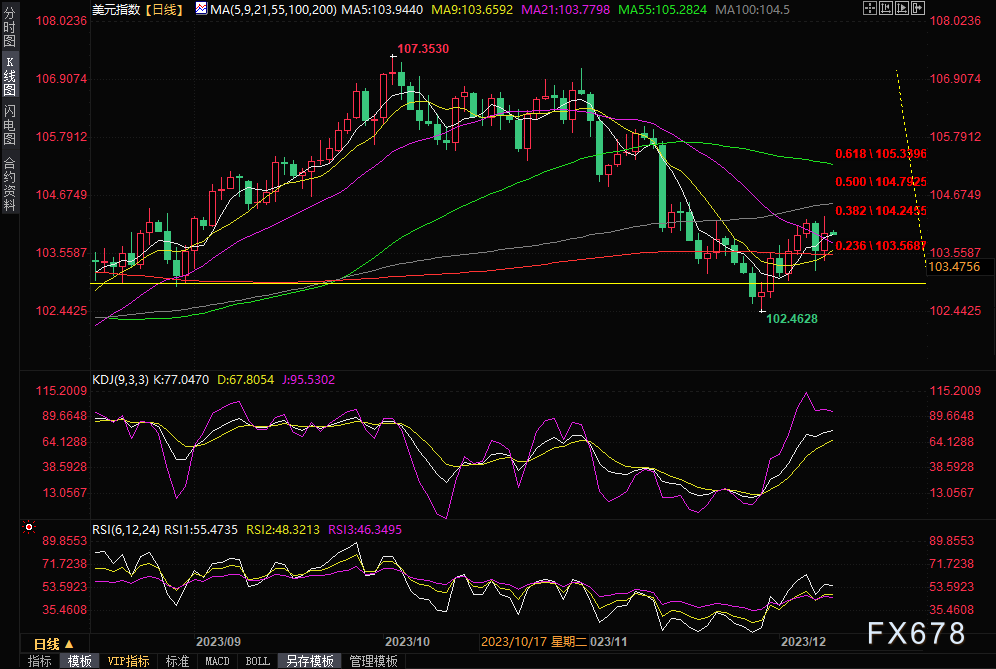
(Dollar index daily chart)
When the dollar rallied, the euro moved in the opposite direction. Since the beginning of the week, it fluctuated and fell near 1.0880. It closed higher in only one trading day and finally fell to the 1.08 mark. The lowest level reached 1.0723, and the weekly decline exceeded 100 points, reaching 1.11%. It was the second consecutive week of decline. The market paid attention to the European Central Bank's decision this week. The pound's trend last week was similar to that of the euro. It closed up on Thursday only last week, and the remaining few trading days were volatile and downwards. It continued to decline from around 1.2650 at the beginning of the week, and finally fell to the 1.26 level, reaching the lowest level of 1.2502. It closed down for the first week in four weeks, and the weekly increase reached 1.28%, or 162 points. The dollar/yen rallied sharply last week. After a rare hawkish speech from a Bank of Japan official on Thursday, the yen soared beyond 200 points, hitting the 141.615 level against the dollar at one point, the highest level in four months. It rose and fell back on Friday and finally closed at the 144.89 level. Last week, it rose by 1.28%, marking the fourth consecutive week of gains.
Commodities: Gold last week burst riot market, Monday in the light Asian market continued to surge through a record high, once touched $2144.68, then quickly fell back, the day closed at $2028, intraday volatility of more than $100, after this false breakthrough, gold prices followed a few days in the vicinity of 2030 shock, Friday in the strong non-agricultural pressure once approached the 2000 level, and finally fell more than $60 last week, weekly decline of more than 3%, the end of three weeks of rising trend. At the same time, spot silver last week was dismal, falling for five consecutive trading days, from $25.90 at the beginning of the week continued to decline, last Friday it fell below $23, the lowest hit 22.97 level, weekly decline reached an astonishing 9%, bid farewell to three weeks of rising momentum.
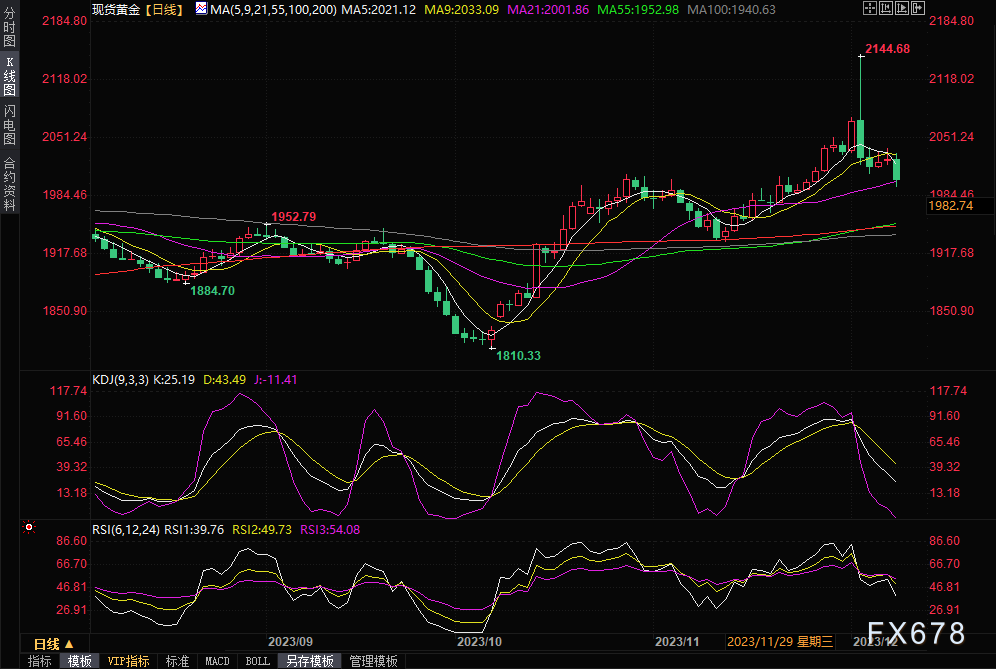
(Daily chart of spot gold)
The crude oil market suffered a severe setback last week. US WTI crude oil futures closed at $71.23, falling 3.83% last week, marking the seventh consecutive week of pressure and the longest losing streak in five years. Brent crude oil's rebound on Friday failed to reverse its losses. It fell 4.51% last week and ended the seventh consecutive week of losses.
Global stock markets: The three major U.S. stock indexes closed slightly higher last week. Last week, the Dow rose slightly by 0.01%, the index rebounded by 0.2%, and the Nasdaq rose by 0.7%. The European STOXX 600 index closed up 0.74% at 472.26 points, up 1.30% for the whole week. Germany's DAX 30 index hit a new record closing high, rising 2.21% for the whole week, rising for the sixth consecutive week.
In the bond market, the yield of the 10-year benchmark US Treasury bond rose by 8.19 basis points to 4.2314% last Friday, rising 3.78 basis points for the whole week. The yield of the two-year US bond rose by 12.42 basis points to 4.7188%, rising 18.25 basis points for the whole week.
Highlights of the week:
Non-agricultural "bright eyes" blow up the market
Last week, before the release of the non-farm payroll report, a series of forward-looking indicators suggested that the US labor market was cooling, and the market generally predicted that the non-farm payroll would strengthen this sign. However, this playbook did not play out as expected. The number of new non-farm payrolls in November not only exceeded expectations, but also the unemployment rate unexpectedly fell to 3.7%, with hourly wages exceeding expectations.
On Friday, December 8th, the US Bureau of Labor Statistics released data showing that the US non-farm payrolls increased by 199,000 in November, higher than the consensus expectation of 185,000 and much higher than the previous value of 150,000. It should be noted that the re-acceleration of employment growth is in part due to the return of striking workers in Hollywood and the auto industry.
Health care, leisure and hospitality, government hiring, and a pick-up in manufacturing following the resolution of the UAW strike drove job growth in November. The return of workers from the auto strike added 30,000 jobs, and the resolution of labor disputes in Hollywood added 17,000 jobs. The increase in government employment was dominated by state and local governments. Growth in health care was driven by demand for home care. Employment in other industry categories, such as retail, showed moderate growth or outright declines.
Meanwhile, the U.S. unemployment rate was 3.7% in November, below expectations of 3.9% and down from 3.9% in October. The number of unemployed workers actually fell by 215,000 to 6.30 million.
In terms of wages, it is worth noting that the increase in wages in November slightly exceeded expectations. Average hourly wages rose by 0.4% month-on-month, exceeding expectations by 0.3%, higher than 0.2% in October, and the highest growth rate in the year. But the year-on-year growth rate slowed to 4%, in line with market expectations, and slowed to 4% from 4.1% last month.
After the data was released, the three major U.S. stock index futures declined further, with the Nasdaq futures falling 0.83%, the S & P 500 index futures falling 0.50%, and the Dow futures falling 0.39%. However, after the opening, the three major stock indexes all rose during the session.
The US 10-year yield rallied significantly, rising as much as 16 basis points to 4.284 per cent, while the Fed rate-sensitive 2-year yield climbed 11 basis points to 4.74 per cent as expectations of a rate cut in the swap market cooled slightly.
Precious metals, which had been strong, were in a sharp reversal. On Friday, spot gold fell below the $2,000 intra-day psychological level for the first time since November 27, falling as much as 1.5%. COMEX silver futures fell 3% in the day to $23.34 an ounce.
After the release of US non-farm payroll data in November, swap contracts showed that the market lowered its expectations for the Federal Reserve to cut interest rates in 2024, and the probability of maintaining interest rates unchanged in December rose slightly.
Fed officials are widely expected to keep borrowing costs at their highest level in two decades when they meet next week and are expected to cut interest rates by at least 125 basis points over the next 12 months.
Acting Labor Secretary Julie Su told Bloomberg TV that overall job growth in the U.S. was better than expected and real wages also rose. Lombard Odier Asset Management believes the employment data gives the Federal Reserve a reason not to cut interest rates in March next year.
And before that, forward-looking data from the U.S. series hinted at the beginning of cracks in the labor market.
Data released by the US Labor Department on the 5th showed that the number of job vacancies in the United States fell to 8.73 million in October this year, far below market expectations and the lowest level since March 2021. The data showed that the number of job vacancies in the United States decreased by 617,000 to 8.73 million in October, a decrease of 6.6%. This figure is far below the 9.40 million widely expected by the market, indicating that the continued tight labor market may be easing.
Then, on December 6, the ADP employment data commonly known as "small non-farmers" showed that the number of ADP jobs in the United States increased by 103,000 in November, while the market expected 130,000, which was less than expected for the fourth consecutive month. While the employment number slowed, wage growth also further cooled. Remainers' wages rose by 5.6% in November from the same period last year, and the growth rate fell for the 14th consecutive month, falling to the weakest growth level since September 2021.
On December 7, the U.S. Department of Labor announced that the number of first-time jobless claims for the week ended December 2 increased by 1,000, recording 220,000, in line with expectations; the number of continuing claims for unemployment benefits for the week ended November 25 decreased by 64,000, the largest decrease since July, and the second decline after September. The number fell to 1.861 million, less than the expected 1.91 million, but the numbers may fluctuate because of the Thanksgiving holiday.
Japan suddenly flew out of the "black swan"
Last week, the yen rallied sharply, climbing for a fourth consecutive week as traders speculated that the ultra-dovish Bank of Japan was moving towards tighter monetary policy.
The yen hit its highest level since August and rallied against the dollar from a near 30-year low last month, rising 1.25 per cent last week and 1.7 per cent the week before amid speculation that the Bank of Japan will soon start raising its base rate below zero.
The yen rose more than 2 per cent on Thursday after Kazuo Ueda, governor of the Bank of Japan, predicted a "more challenging" year ahead, in what traders saw as a signal that the central bank could end its negative interest rate policy as soon as January, when it sets its next monetary policy.
Ueda's comments on Thursday came a day after his deputy, Ryozo Himino, appeared to be laying the groundwork for eventual normalization, noting that the Bank of Japan's first rate hike since 2007 might not be as harmful as some had feared.
"The direction is not surprising," said Bart Wakabayashi, a Tokyo branch manager at State Street. "But the move and its speed have exceeded my expectations."
Then came revised figures released by the cabinet on Friday showing gross domestic product contracted at an annualised rate of 2.9 per cent in the three months to September from the previous quarter as households cut back on spending. The updated figures marked the biggest fall since the spring of 2020, compared with a preliminary reading of -2.1 per cent and the consensus estimate of a slightly smaller contraction.
Separate monthly data showed an even weaker economy in the current quarter, with household spending falling 2.5% in October from a year earlier, the eighth straight monthly decline. Nominal wages rose 1.5% in the month, but remained well below inflation, which is weighing on consumer spending.
Taken together, Friday's data complicates the central bank's calculations as authorities wait for more evidence of a positive wage-price cycle before exiting a massive stimulus experiment that has lasted more than a decade.
Before the yen's surge last Thursday, almost all economists surveyed by Bloomberg did not expect the BoJ to change policy by the end of its next meeting on Dec. 19. Two-thirds of respondents believed the BoJ would eliminate negative interest rates early next year. April was seen as the most likely time, with January likely to act sooner.
"This could be a temporary market phenomenon," Hideo Hayakawa, a former BoJ official, said in an interview on Friday. "Ueda is looking for evidence. He deliberately chose to be behind until now, there is no need to rush now."
Mr. Hayakawa, one of the few economists who correctly predicted Mr. Ueda's surprise change in yield curve control in July, said the BoJ might not end negative interest rates until April.
Gold skyrocketed to a new historical high, a false breakthrough?
Last week, gold experienced a shock rally and crash. After the lackluster Asian market opened on Monday, bets on the Federal Reserve to cut interest rates drove gold prices higher, briefly breaking through $2,100 and setting a new all-time high of $2,135.40. Then it quickly fell back to give up all the gains.
Gold prices rose to a record high of $2,144 last Monday as bets on the Federal Reserve to cut interest rates increased, but fell more than $100 in the same session on uncertainty over the timing of monetary policy easing.
"Gold may need a particularly weak set of data to start rising strongly from now on, as many bullish fingers could get hurt when gold falsely breaks through to record highs," said Simpson, senior analyst at City Index.
Federal Reserve officials are in a period of silence ahead of their December 12-13 meeting, where a key focus will be their latest projections for the level of interest rates in 2024.
ANZ analysts predict that the conditions for the Federal Reserve to start cutting interest rates will emerge around mid-2024, but warn that Fed Chairperson Jerome Powell will need to maintain hawkish guidance during the transition to low growth and low inflation.
A Reuters poll of currency strategists showed that a widely expected 2024 interest rate cut would lead the dollar to loosen its grip on other G10 currencies next year, dimming the outlook for the dollar.
Ole Hansen, head of commodity strategy at Saxo Bank, said: "Technically, gold still has a lot of work to do to make up for the damage."
Hansen said that in addition to overbought momentum, the gold market has gone too far in terms of a possible rate cut in 2024, which could keep gold prices below $2,050 in the short term.
Phillip Stredible, chief market strategist at Blue Line Futures, said he expects some downward pressure on gold. He added that Federal Reserve Chairperson Jerome Powell is unlikely to change his hawkish stance following Friday's jobs report, although the central bank is expected to keep interest rates on hold.
Please indicate the source: https://www.daoctech.com/fxnews/1021.html
Disclaimer: The content of this article does not represent the views of the Institute of Foreign Exchange. The content is for reference only and does not constitute investment advice. Investors operate accordingly at their own risk.