
The economy has been performing better than expected, and the Federal Reserve may not cut interest rates this year?
At present, no one expects the Federal Reserve to change interest rates at its policy meeting next week, but whether Fed officials stick to their previous outlook for rate cuts is a more open question as the economy has been outperforming expectations.
Data since the Fed's last meeting has confirmed a widely shared baseline among policymakers that their overnight rates will fall this year, with Jerome Powell, the Fed chairperson, saying last week that the central bank was "sufficiently confident of falling inflation" and would lower rates.
But policymakers' new projections show whether they expect fewer rate cuts this year than the three quarter-rate cuts expected in December, or whether they still think the economy can continue to expand while inflation continues to fall, allowing interest rates to fall as well.

This is effectively a vote that will determine whether improved economic supply dynamics and unexpected productivity surges can continue to provide relatively painless relief from price pressures, or whether policymakers see slower growth and a prolonged period of tightening as the price of completing their inflationary blow.
Last week, Michael Gapen, chief U.S. economist at Bank of America, said: "There have been doubts about the durability of the recovery, but the economy continues to have the desire to move forward." He outlined what he called a "no landing scenario," in which supply-side improvements allow the Federal Reserve to start lowering interest rates in June while inflation falls and the economy continues to grow by 2 percent or more throughout the year, higher than many estimate its potential.
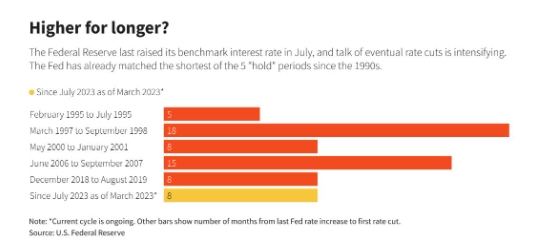
Investors are hesitant about whether a "soft landing" of low inflation and low unemployment can be achieved. They also see signs of interest rate cuts beginning in June, and will look for signs of this when the Federal Reserve meets on March 19-20. The policy rate has remained in the 5.25% to 5.5% range since last July, the holding period between the last rate hike and a rate cut in line with previous monetary policy cycles.
mixed signal
In their December forecasts, 11 of 19 policymakers expected at least a 3 percentage point cut this year, and just two officials taking a more hawkish view could change the median forecast to suggest fewer cuts.
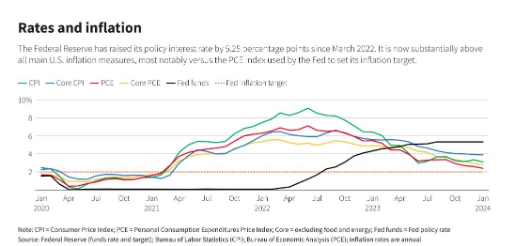
A key figure is the consumer price index for February, which will be released on Tuesday. Economists expect the core consumer price index, which excludes food and energy prices, to slow from a pace of 3.9 percent in January.
Even though investors have already confirmed a rate cut for June and expect a full rate cut this year, the data since December, both hard and forecast, is full of mixed signals.
The February jobs report, for example, showed the unemployment rate rising to 3.9 percent from 3.7 percent and monthly wage growth slowing, suggesting that the ultra-tight job market that formed during the epidemic may be gradually returning to normal.
But overall job growth remains above average, hiring has become more widespread across industries, and annual wage growth remains above what the Fed considers sustainable. Notably, the details of the jobs report show that rising unemployment reflects people entering the labor force, often as a sign of economic strength and confidence.
Nick Bunker, director of North American research at Indeed Hiring Lab, said the rise in unemployment was "driven by movements in the periphery" rather than a surge in job losses. He said the data showed that the pace of job search may be slowing, but there was still strong participation among workers in the critical 25 to 54 age bracket.
The overall labor force increased by 150,000 for the first time in three straight months, which helped keep the labor force participation rate steady as about 1.90 million people started looking for work but have yet to find one, the biggest surge in the job market in more than two years.
"The speed is not slowing down"
The Federal Reserve's latest collection of field reports on the economy, the so-called Beige Book, indicates that activity has remained stable or growing in 11 of the 12 Federal Reserve regions.
Drawing on contacts with companies in the Southeast, Atlanta Fed Chairperson Raphael Bostic noted that the "potential euphoria" they feel could fuel demand and price pressures, if all at once released, is just one of the "upside" inflation risks that Fed policymakers have noted.
The inflation data itself, which showed an excessively strong consumer price report, continued increases in housing costs and tapering wholesale price data, helped keep the Fed's target inflation rate down. The personal consumption expenditure price index, which the Fed uses to set its 2 per cent target, rose 2.4 per cent in January.
Even this figure, which is close to the target, makes Federal Reserve officials reluctant to declare that inflation has disappeared or is certaininterest rate cutPossible start time.
After Powell confirmed that interest rates could be cut this year, Christopher Waller and others insisted that the strong performance of the data made them "in no hurry" to make a decision, while Michelle Bowman and others pointed out that rising asset prices and easing financial conditions could fuel inflation and could signal that the Federal Reserve's policy is not as strict as people think.
For some, this leaves the outcome of the Fed debate still uncertain.
"The Fed is not going to cut rates this year," Torsten Slok, chief economist at Apollo Global Management, said in early March. "Interest rates will stay high for a long time." "The reality is that the U.S. economy is not slowing at all."
Please indicate the source: https://www.daoctech.com/fxnews/1071.html
Disclaimer: The content of this article does not represent the views of the Institute of Foreign Exchange. The content is for reference only and does not constitute investment advice. Investors operate accordingly at their own risk.