
Crude oil trading reminder: Worried about the rise in US interest rates, oil prices have fallen to a new low in nearly three months
Forex Platform- U.S. crude oil extended its decline in early Asian trading on Friday and is trading near $76.77 a barrel. Oil prices fell for a fourth straight day on Thursday on concerns that if inflation spikes, U.S. borrowing costs could rise again, which could hurt oil demand.
Brent crude futures fell $0.20, or 0.2 percent, to $81.70 a barrel on Thursday. U.S. West Texas Intermediate crude futures fell $0.29, or 0.4 percent, to $77.28. Both indices fell more than 1 percent on Wednesday.
Minutes from the Fed's most recent policy meeting, released on Wednesday, showed that the Fed's response to sticky inflation would "involve maintaining" the policy rate range, but they also reflected discussions about the possibility of further increases in borrowing costs.
"Several participants mentioned their willingness to take such action if inflation risks materialize and further tightening becomes appropriate," the minutes said.
Initial jobless claims fell last week in the United States, a sign that the underlying strength of the labor market should be able to continue supporting the economy. Initial jobless claims fell for a second week in a row, giving back most of the increase at the start of the month, when they hit their highest level since late August, according to data released Thursday by the Labor Department. The Federal Reserve's sharp interest rate hikes in 2022 and 2023 have led to slower job growth, but layoffs remain small.
"Initial jobless claims are down from the week before, so the acceleration that some had feared is not happening," said Robert Frick, corporate economist at Navy Federal Credit Union. "The labour market is still strong and if jobless claims are the canary in the coal mine, it's not even coughing slightly."
Initial claims for state unemployment benefits fell by 8,000 to a seasonally adjusted 215,000 in the week ending May 18. Economists had forecast 220,000. Claims fell significantly in California and Indiana.
Separately, U.S. business activity accelerated to its highest level in more than two years in May, but manufacturers reported a sharp rise in the prices of a range of inputs, suggesting that commodity inflation could pick up in the coming months.
S & P Global said on Thursday that the US composite purchasing managers' index (PMI), which tracks manufacturing and services, jumped to 54.4 at the beginning of May. This is the highest level since April 2022, and the final value in April was 51.3.
A reading above 50 indicates expansion in the private sector. Economists had forecast an initial composite PMI reading of 51.1 for May. The growth was driven by the services sector, which rose to 54.8 in May from 51.3 in April. The manufacturing PMI edged up to 50.9 from 50.0.
"The improvement in business confidence bodes well for a brighter year ahead," said Chris Williamson, chief business economist at S & P Global Market Intelligence. "However, the future path of inflation and interest rates is uncertain, companies remain cautious about the economic outlook and continue to worry about geopolitical instability and the presidential election."
The strong US data further weighed on the Federal Reserve's interest rate cut expectations, and even some interest rate hike bets emerged in the market.
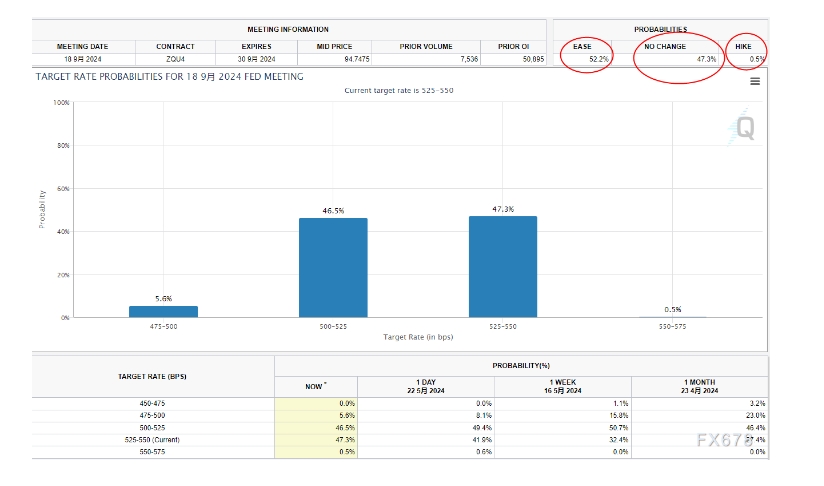
According to CME "Fed Watch", the market expects the probability of the Fed cutting interest rates by 25 basis points in September to drop to 52.2% (from 64% the previous day), the probability of keeping interest rates unchanged is 47.3%, and the probability of raising interest rates by 25 basis points is 0.5%.
Data from the U.S. Energy Information Administration (EIA) on Wednesday showed that U.S. crude oil inventories rose by 1.80 million barrels last week, while market expectations were 2.50 million barrels lower. This also weighed on the market.
Globally, the physical crude oil market has come under pressure recently due to weak refinery demand and abundant supply.
"The recent weakness in the market is due to weak data, including rising oil inventories, subdued demand, weak refinery profits and increased risk of production cuts," Citibank analysts said in a note on Thursday.
Russia exceeded its OPEC + production quota in April due to "technical reasons" and will soon submit a plan to the Organization of the Petroleum Exporting Countries (OPEC) secretariat to remedy the mistake, the energy ministry said late on Wednesday.
Citi Research said it continues to expect OPEC + to maintain its production cut plan into the third quarter when it meets on June 1. Citi still expects Brent crude to average $86 in the second quarter of 2024.
Andrew Lipow, president of Houston-based Lipow Oil Associates, said the recent weakness in crude prices has increased the likelihood that OPEC + will maintain existing output limits until at least the end of September.
The U.S. Energy Information Administration (EIA) reported that U.S. gasoline demand reached its highest level since November, providing some support for energy markets ahead of the Memorial Day holiday weekend, which is considered the start of the U.S. summer driving season.
American airlines are expected to carry a record number of passengers this summer. Their industry group estimates that 271 million passengers will fly between June 1 and August 31, breaking the record of 255 million set last summer
Energy demand is forecast to rise as Americans head home for a weekend getaway. National gasoline prices are about $3.60 a gallon, about $0.06 higher than a year ago, according to the American Automobile Association.
Gasoline consumption in the US accounts for about 9 per cent of global oil demand. "The gasoline price report is pretty good and positive on all fronts," said Bob Yawger, analyst at Mizuho. "However, one report doesn't tell the trend, so everyone is watching to see if gasoline prices will continue to rise in the future."
US crude oil technical analysis:
Resistance: 77.36; 77.70; 78.39; 79.14;
Support: 75.83; 75.53; 74.48; 73.54;
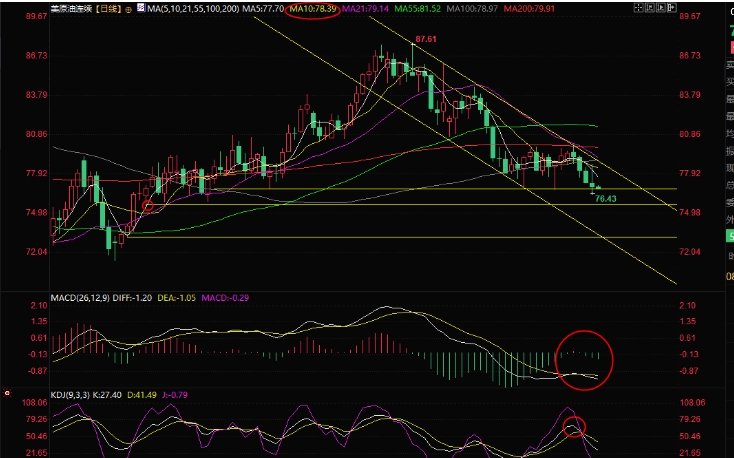
Daily level, U.S. crude oil initially fell below the 76.70 line of support, the moving average is close to the bearish arrangement, KDJ dead fork running, MACD downward divergence, short-term may further test the February 12 low near 75.53 support, falling channel lower rail support is currently around 73.20. The upper 10-day moving average resistance is currently around 78.39, if the unexpected recovery of this position, it will weaken the short-term bearish signal.
At 08:45 Beijing time, US crude oil is now trading at $76.80 per barrel.
Please indicate the source: https://www.daoctech.com/fxnews/1170.html
Disclaimer: The content of this article does not represent the views of the Institute of Foreign Exchange. The content is for reference only and does not constitute investment advice. Investors operate accordingly at their own risk.