
The dollar is approaching the upper edge of the box against the yen, and the short-term yen continues to be under pressure
The yen continued to come under pressure amid trade tensions, falling to a near three-week low against the dollar. In Asian trading, the dollar/yen continued last week's gains and traded above 147.30.
Markets are betting that the Federal Reserve will maintain higher interest rates for a longer period of time, while doubts about the prospect of the Bank of Japan raising interest rates in the near future have formed a strong pattern of monetary policy differentiation, supporting the trend of the dollar/yen.
"The Fed remains wary of inflation and expectations for a rate cut this month have cooled."
Trump's announcement of a new round of tariffs has heightened risk aversion, but failed to significantly boost the yen.
President Donald Trump sent separate letters on Saturday to Mexico's president and the head of the European Union Commission announcing a 30 per cent tariff on exports from next month. In addition, the United States also issued trade ultimatums to more than 20 economies, including Japan, and announced a 50 per cent tariff on copper imports.
Despite this, the yen has failed to exhibit its typical risk-off behaviour, an anomaly that analysts believe stems from three key factors:
Bank of Japan interest rate expectations are cooling: Despite reports that the Bank of Japan will raise its inflation forecast at its July policy meeting, investors believe this will not be enough to support the decision to raise interest rates, especially against the backdrop of continued domestic real wage declines and cooling inflation.

Japan's domestic political uncertainty has risen: the latest polls show that the Liberal Democratic Party and Komeito may struggle to maintain a majority in the July 20 upper house election, raising market concerns about political stability.
The US economy remains robust: strong non-farm payrolls have reduced the likelihood of a short-term interest rate cut by the Federal Reserve, and high import taxes could push up inflation, strengthening expectations that the Fed will keep interest rates unchanged.
The USD/JPY broke through last week and closed above the 100-day moving average (currently around 145.80), marking the first confirmation of this technical signal since February this year, indicating that the medium-term trend has turned from volatile to bullish.
In the daily chart, the MACD indicator shows a golden cross and continues to increase in volume, while the RSI indicator remains at a medium-high level, but has not yet entered the overbought range, indicating that there is still room for further growth.
If the current price can effectively stand in the 147.50-147 area, it will provide a foundation for challenging the 148.00 integer mark (June high). If it continues to break through, it may continue to rise to 148.65 (May high) and further test the 149.00 psychological mark.
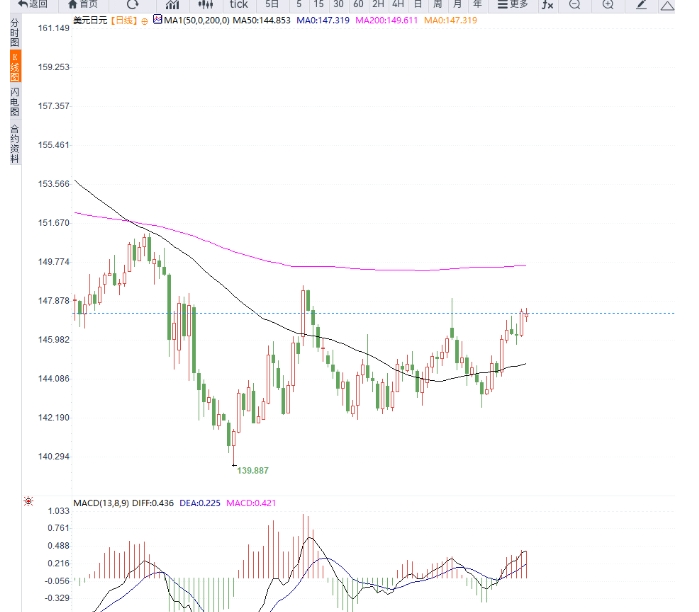
The lower support is located in the 146.60-146 area, followed by the relay support at 146.25 and 146.00. If it falls below the 100-day moving average (about 145.80), it will likely trigger further technical pullbacks, targeting the 145.50-145 area, or even the 145.00 integer.
The yen's weakness reflects both fundamental and technical pressures, with traditional safe-haven currencies failing to deliver on their protective value at a time of rising global risk sentiment, suggesting that the market is now more concerned about differences in monetary policy expectations.
Please indicate the source: https://www.daoctech.com/fxnews/1633.html
Disclaimer: The content of this article does not represent the views of the Institute of Foreign Exchange. The content is for reference only and does not constitute investment advice. Investors operate accordingly at their own risk.