
The Reserve Bank of New Zealand cut interest rates as scheduled but released a dovish signal beyond expectations, and the future interest rate cut cycle has already begun
The Reserve Bank of New Zealand (RBNZ) announced on Wednesday (August 20) that it will cut the official cash rate (OCR) by 25 basis points from 3.25% to 3.00% after the August policy meeting. The decision is in line with market expectations.

The Reserve Bank of New Zealand cut interest rates to 3.00% and released an ultra-dovish signal, causing the New Zealand dollar to plunge 1.2%.
The Reserve Bank of New Zealand released its latest forecast at the same time as it cut the official cash rate from 3.25% to 3.00% as scheduled.The Reserve Bank of New Zealand's latest forecast shows that OCR will fall to 2.7% in the fourth quarter of 2025 and further to 2.5% in Quarter 1 in 2026. This is a significant downward revision from the 2.9% interest rate level in the two quarters in the May forecast.
The New Zealand dollar reacted sharply to the change in the OCR outlook, hitting 0.5819 against the U.S. dollar at one point, a new low since April 14, down about 1.2%.
Markets were surprised by the dovish tone, with the New Zealand dollar and swaps falling.
The Reserve Bank of New Zealand admitted that the economic recovery stalled in the second quarter due to "global economic policy uncertainty, falling employment, rising prices of some essential goods and property depreciation". The Reserve Bank of New Zealand said there were both upside and downside risks to the future economic outlook, but stillIt is believed that there is room for further interest rate cuts.
At least one economist - Stephen Toplis of the Bank of New Zealand (BNZ) - has adjusted his forecast to include an additional rate cut, in line with the Fed's guidance.
The Reserve Bank of New Zealand now expects consumer price inflation to peak at 3% (at the upper end of its 1% -3% target range) in the third quarter, with a quarterly increase of 0.9%, slightly higher than the 0.8% forecast in May. Inflation is expected to slow to 0.3% in the fourth quarter, still higher than the previous forecast of 0.2%. Quarterly inflation expectations are revised slightly upward during 2026 and slightly downward for most of 2027.
Annual CPI growth forecasts are revised upwards across the board: Quarter 1 2026 from 1.9% to 2.3%, second quarter from 1.9% to 2.2%, and third quarter from 2.1% to 2.2%.
The unemployment rate is expected to peak at 5.3% this quarter (up from 5.2% forecast in May), and will remain above 5% until the fourth quarter of next year.
The current quarterly economic growth forecast has been fine-tuned from 0.2% to 0.3%.But fourth-quarter growth was revised down from 0.9 per cent to 0.8 per cent, next year from 0.8 per cent to 0.7 per cent in Quarter 1 and from 0.7 per cent to 0.6 per cent in both the second and third quarters.The follow-up data on the pace of economic recovery in New Zealand will affect the future adjustment path of the OCR.
New Zealand's economic recovery stalled in the second quarter of this year. The Reserve Bank of New Zealand warned that global and domestic economic growth faces headwinds. Conversely, if the effect of interest rate cuts is fully transmitted to the economic system, the recovery process may also accelerate.
Speaking after the interest rate decision, the president of the Reserve Bank of New Zealand further clarified the stance of monetary policy and the judgment of the economic outlook. He said that the past 250 basis points of easing policy will provide support for economic growth, butThe pace of future rate cuts will be "entirely data dependent"He also pointed out that New Zealand's economy "stagnated" in the second quarter of 2025, with economic activity "much weaker than expected"
technical analysis
The bearish trend remains solid as the exchange rate continues to decline in the downward channel pattern. Short-term price momentum is weak, and the NZD/USD is currently below the nine-day exponential moving average (EMA) of 0.5909. In addition, the bearish outlook has been strengthened as the 14-day Relative Strength Index (RSI) has been hovering below the midline of 50.
On the downside, the New Zealand dollar may gain near-term support near 0.5770 on the lower track of the downward channel. If it effectively falls below the lower track of the channel, it may exacerbate bearish sentiment and open space for the lowest point since March 2020 at 0.5486.
On the upside, the pair's primary resistance is at the nine-day EMA (0.5905), followed by the confluence resistance band of the 50-day EMA (0.5951) and the upper ramp of the descending channel (0.5980). If this key resistance area can be broken through, the short-term and medium-term price momentum may improve, driving the pair up to the ten-month high of 0.6121 reached on July 1.
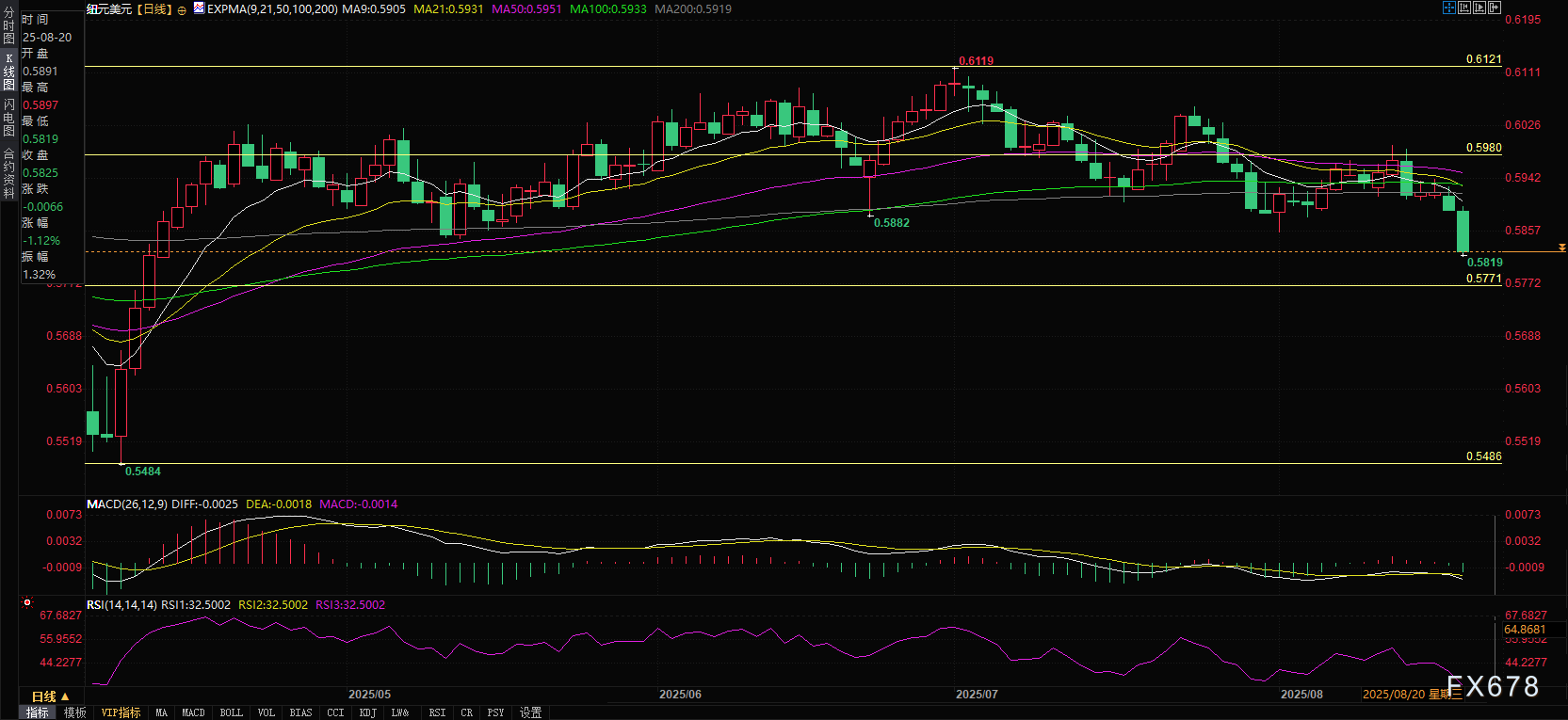
(New Zealand dollar/US dollar daily chart, source: Internet)
At 15:36 Beijing time, the New Zealand dollar was trading at 0.5818/19 against the US dollar.
Please indicate the source: https://www.daoctech.com/fxnews/1714.html
Disclaimer: The content of this article does not represent the views of the Institute of Foreign Exchange. The content is for reference only and does not constitute investment advice. Investors operate accordingly at their own risk.