
Ignoring supply and demand fundamentals, could crude oil investors be overly optimistic?
Leading energy forecasters have previously predicted that oil supply will far exceed demand in the coming months and even in 2026.
The International Energy Agency (IEA) forecasts that global oil production will increase by 2.50 million barrels per day in 2025, reaching 105.50 million barrels per day; and another 1.90 million barrels per day in 2026, of which Quarter 1 is expected to surge 4.10 million barrels per day in 2026. The US Energy Information Administration (EIA) also expects a significant increase in crude oil inventories this year and next. Meanwhile, global oil consumption is expected to be only 103.74 million barrels per day this year and 104.44 million barrels per day next year.
In response, the spot price of Brent crude oil has weakened: from above $73 a barrel on July 30 to just under $66 this week, which also reflects the weakening of summer oil demand in the northern hemisphere.
But the forward end of the crude oil futures curve is a different story.
Forward "smile" curve
Like other commodity markets, oil market participants can buy futures contracts for delivery in the coming months or years, allowing producers, refiners, consumers and speculators to hedge their risks and place bets on price movements.
The forward curve reflects these expectations and is mainly divided into two patterns:
Spot premium (backwardation): that is, the recent contract price is higher than the forward contract price, usually indicating that the market supply is tight, which will prompt oil producers to increase production.
Futures Premium (Contango): The price of a forward contract is higher than the price of a recent contract, usually indicating a supply glut, at which point storing crude oil is more economically attractive than continuing to extract it.
Given that many experts have pointed to a severe oversupply in the current oil market, investors should have expected a steep futures premium pattern on the Brent forward curve for the full year 2026.
But the reality is that from the recent October contract to the March 2026 contract, the curve shows a significant spot premium; from March to September 2026, it is basically flat; only then does it shift to a large futures premium. The resulting pattern is known as the forward "smile" curve.
This pattern is rare and confusing. If the market does face a large oversupply, traders are likely to need to store more crude in tanks and, in extreme cases, tankers in the coming months.
This means that oil prices may be about to experience a major correction.
Investors' optimism about the "smile curve"
Investors are cautiously optimistic about the "smile" pattern of the Brent forward curve, which stems from confidence in OPEC +'s ability to intervene and complex expectations of geopolitical risk. Investors may be betting that OPEC + will re-impose production cuts to avoid further falls in oil prices before the supply glut intensifies. This expectation partly explains why the forward curve does not fully reflect the inventory build-up forecast by the IEA and EIA. This optimism may underestimate the disagreement within OPEC + and the impact of increased production by non-OPEC + producers such as Brazil and Canada.
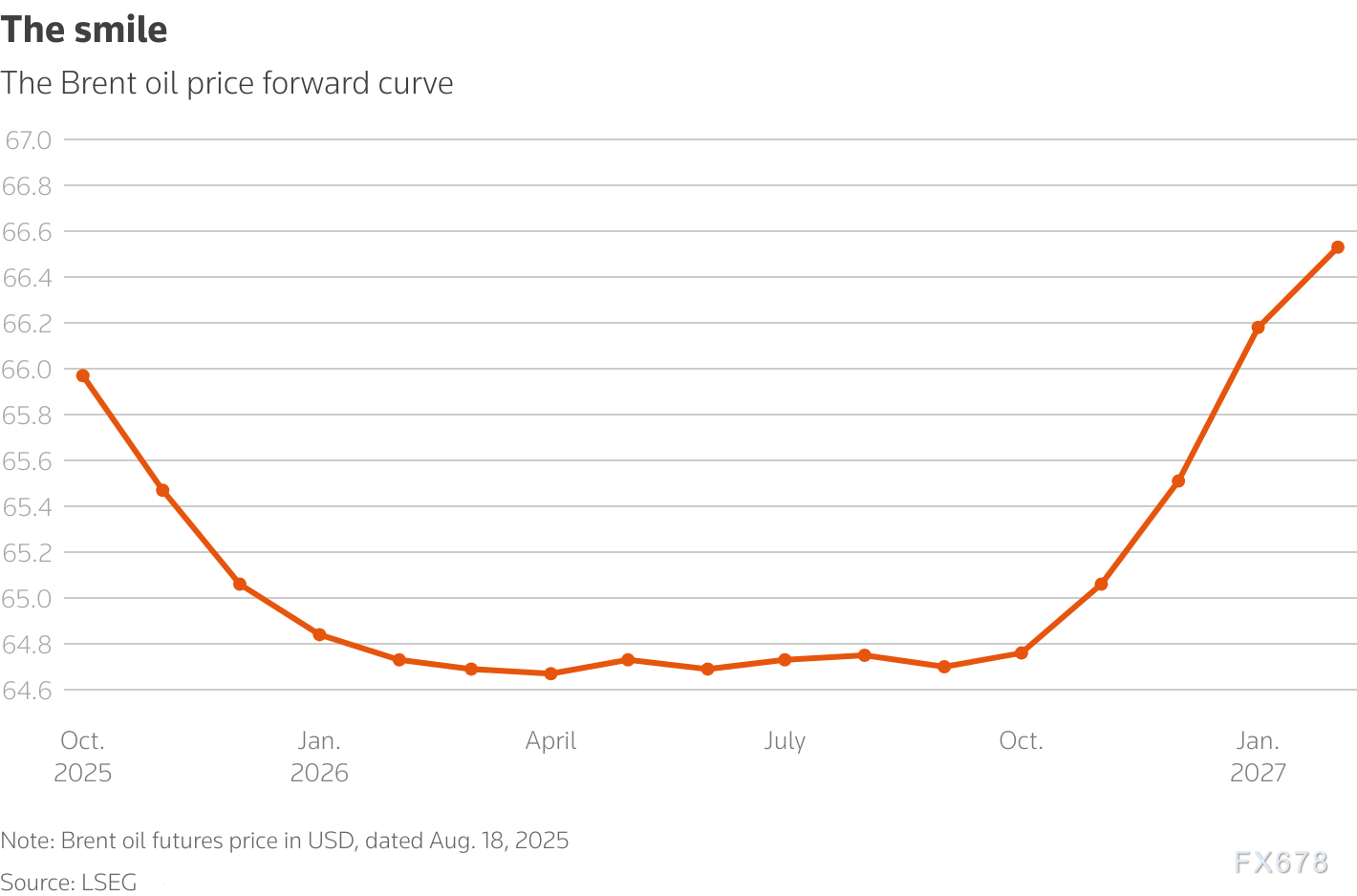
(Brent crude oil price forward curve)
Some traders are sceptical of the IEA and EIA's oversupply forecasts, arguing that they may overstate the actual size of the glut or underestimate the potential for a recovery in demand. Some hedge funds and speculators believe that the global economy may see an unexpected rebound in 2026, especially with oil demand in Asian markets such as India spurred by new energy policies. In addition, traders may believe that non-OPEC + producers (such as US shale oil) will struggle to increase production sustainably due to cost pressures.
Ambivalence about geopolitical risks
Investors' interpretations of geopolitical factors are mixed. On the one hand, they are concerned that Trump's trade war and sanctions against Russia and Iran may tighten supply and push up short-term oil prices; on the other hand, they believe that these factors have limited impact on long-term supply and demand, so the forward curve does not turn upward until after 2026. This mentality reflects investors' attempts to balance short-term volatility with long-term excess expectations, but this "two-headed bet" strategy may ignore the uncertainty of geopolitical events and increase the risk of market miscalculation.
The risk of ignoring supply and demand fundamentals
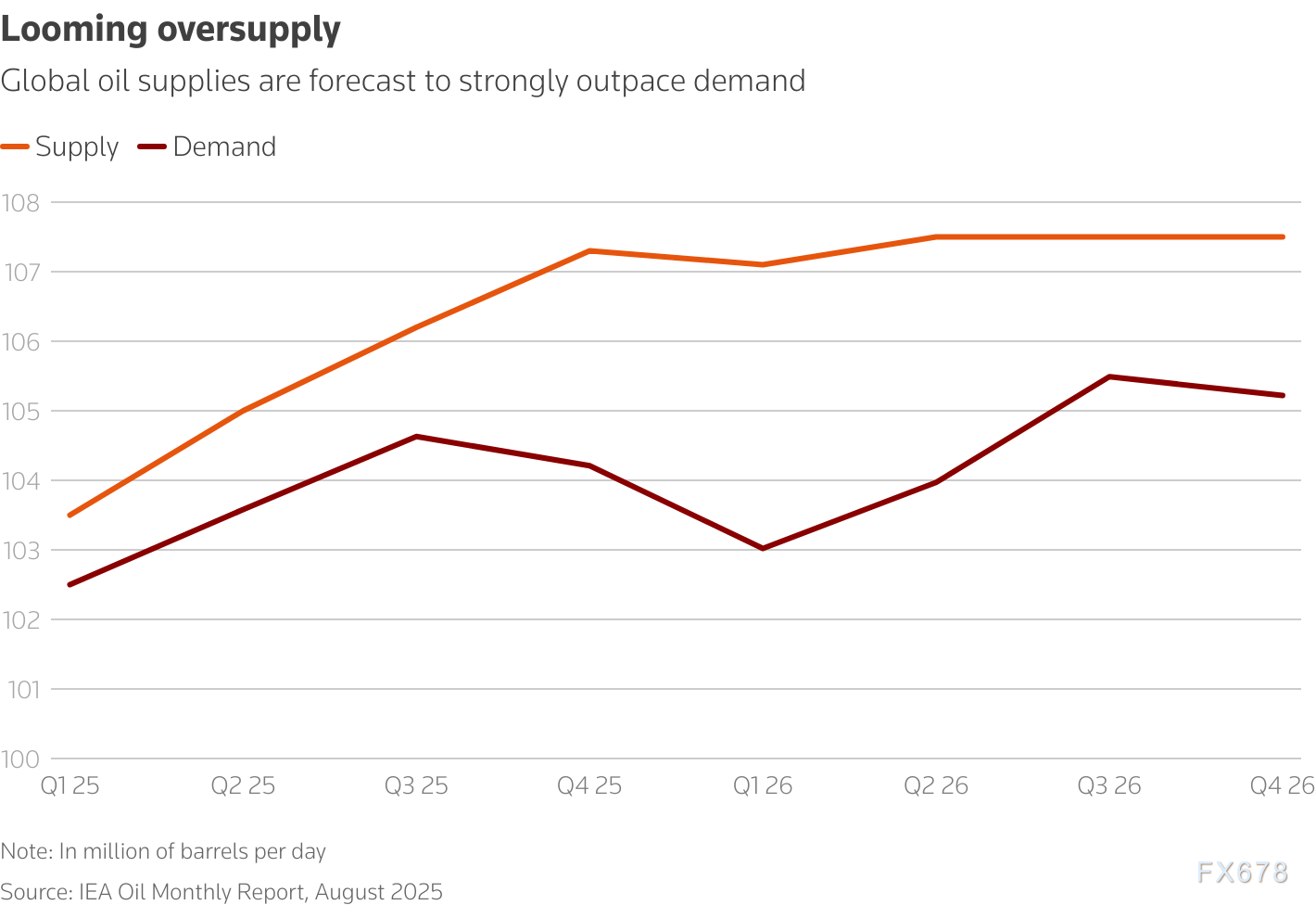
(Global crude oil supply and demand)
Investors may have relied too heavily on historical experience and underestimated the current changes in supply and demand fundamentals. Investors' trust in OPEC + stems from its past record of stabilizing the market by cutting production, but the desire to increase production within OPEC +, such as in the United Arab Emirates and Iraq, may have weakened its ability to coordinate.
In addition, investors do not appear to have fully taken into account the reality of slowing global demand growth, especially the sluggish economic recovery in some parts of the world. This neglect of fundamentals could catch traders off guard when inventories build up rapidly, triggering sharp price adjustments.
Speculative mentality and market volatility
Some investors' reaction to the "smile curve" is speculative, seeking to profit from the discount pattern of forward contracts rather than making long-term investments based on supply and demand forecasts. This shortsightedness is particularly pronounced when oil price volatility increases, potentially amplifying market instability.
The abnormal shape of the current curve may attract more speculative funds into the market, but if the oversupply hits as expected, speculators could face huge losses, especially if they lack sufficient storage capacity.
Summary: The Hidden Dangers of Blind Optimism
Investors' mindset towards the "smile curve" of oil prices shows an overly optimistic and speculative tendency, relying too much on OPEC +'s ability to intervene, while underappreciating the complexities of geopolitics and supply and demand fundamentals. This mindset can lead traders to underestimate market risks, especially in the context of global oversupply and weak demand. If the IEA's forecast comes true, the build-up of inventories will force the forward curve to overshoot, at which point investors' blind optimism could turn into significant losses. Traders need to keep a close watch on supply and demand dynamics and OPEC +'s policy adjustments.
Please indicate the source: https://www.daoctech.com/fxnews/1713.html
Disclaimer: The content of this article does not represent the views of the Institute of Foreign Exchange. The content is for reference only and does not constitute investment advice. Investors operate accordingly at their own risk.