
The foreign exchange market trading range narrowed as the market awaited Powell's Jackson Hole annual speech on Friday
On Friday (August 22) at around 22:00 Beijing time, Federal Reserve Chairperson Jerome Powell will deliver a speech at the annual meeting in Jackson Hole. With a number of key data still to be awaited before the September FOMC meeting (including the August non-farm payrolls report, the August consumer price index (CPI) and the August producer price index (PPI) - which the market is particularly sensitive to after the July data rose sharply), most views believe that the speech will not send a strong signal on the September resolution. However, the tone of the speech may hint at the mechanism of the Fed's response to subsequent data.
It would have been more interesting if Mr. Powell had spoken about "Fed independence" and pointed out the risks of continued fiscal profligacy; but such topics may not be brought up until he "resigns, is fired or ends his term".
Moreover, Mr. Powell's Fed is about to launch a five-yearly policy review. The last review was in 2020, when the Fed announced that it would allow a period of "catch-up inflation" to ensure that the long-term average inflation rate reached its 2 per cent target. However, in a post-epidemic inflation environment that has far exceeded the Fed's expectations, the target of "catch-up inflation" has long been exceeded, and this concept will soon be thrown into the "trash can of history" and should be formally abolished in this review (in fact, the concept is meaningless).
What is also doomed to be eliminated is any new policy to replace it - because the funding pressure on US Treasury bonds will only get heavier from now on, which means that the Federal Reserve will lose much (or even all) of its independence and become a "ancillary tool" to the Treasury. Specific possible forms include yield curve control, quantitative easing (QE), even "mild modern monetary theory (MMT) ", and in extreme cases capital controls, or a combination of all three. Unfortunately, these potential changes will not be reflected in this review either.
In my opinion, the most logical and common sense approach for the Fed would be to abolish the "dot plot" - a tool originally designed for another era in economic history to signal to the market through forward guidance after the 2008 financial crisis that "the Fed will underwrite the market". Today, the Fed's forward guidance is basically "reputational risk" and has no benefit.
The euro is hard to break 1.1700 against the dollar, and the dollar is silent against the yen: what are the markets waiting for?
The current lack of clear direction in the market: multiple attempts to restart the dollar's downtrend have failed, probably due to the very low volatility in risky assets and global bond markets. This suggests that the dollar may be at risk of a "path of least resistance up", but on the other hand, when price action provides no clues and there are no short-term catalysts other than the short-term volatility that may be triggered by the Jackson Hole meeting, this upside expectation is also not sufficiently supported.
As discussed above and below, sovereign bond markets are in a state of "hair trigger": new policy measures are needed to ease pressure on government finances; and when yields fail to adjust to market forces, currencies act as "safety valves", with explosive potential volatility. Notably, long-term yields are adding to market stress in Germany and the UK, where 30-year yields are on the verge of reaching multi-year highs today after a sharp climb yesterday.
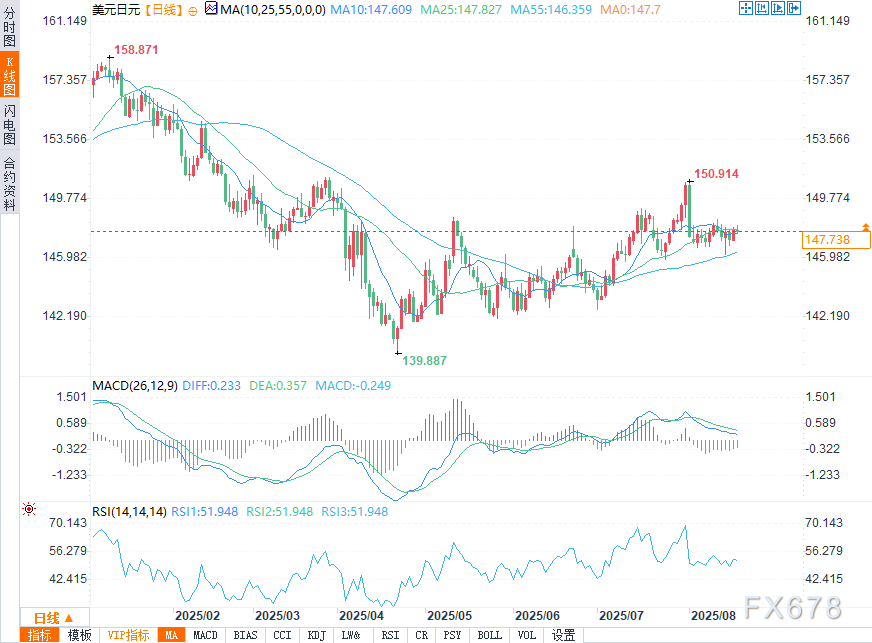
(USD/JPY daily chart, source: Internet)
Yields are now up slightly, but not enough to support a new round of gains against the dollar and the yen. In fact, the MOVE index, which measures US yield volatility, has fallen to its lowest level since late 2021. Looking back to November 2021, when the appointments of Powell and Brainard (nominated to chair and vice chair of the Federal Reserve, respectively) were given speeches, it marked the beginning of the "battle against inflation" at the Federal Reserve, and then interest rate volatility entered a long-term upward phase.
The irony is that interest rate volatility continues to decline today, when secular pressures in the sovereign bond markets of countries such as the US, Japan and the UK are more pressing than ever. In the long run, the direction of the dollar against the yen will be determined by the policy choices of the Japanese Ministry of Finance/Bank of Japan and the US Federal Reserve/US Treasury.
From a technical point of view, the "short run" of the US dollar against the yen after breaking through the 150.00 mark caused a major reversal, and then fell into a sideways trade for 12 trading days. Although the impact of this reversal has not been completely eliminated, it has weakened. To confirm the formation of a new trend, two conditions need to be met: one is that the daily closing price of the US dollar against the yen exceeds 146.00 or 149.00; the other is that there is a policy change, or the volatility of the global bond market increases.
New Zealand Federal Reserve Resolution: Focusing on Inflation or the Labor Market?
The Federal Reserve Bank of New Zealand (RBNZ) is widely expected to cut its policy rate by 25 basis points to 3.00% tonight, and the forward curve reflects only the pricing of "another rate cut". Therefore, the RBNZ's policy guidance is crucial - it needs to be focused on whether it prefers to "pause interest rate cuts to assess whether further easing is required in the future" (hawkish signal), or "keep the possibility of further rate cuts in the event of continued economic weakness, especially in the labor market" (dovish signal).
The Reserve Bank of New Zealand has previously expressed concerns about the "impact of US tariffs", so I expect that its concerns about economic growth may overshadow the signal of "a small pick-up in inflation", or suggest that interest rate cuts after today's rate cuts are still possible. However, the actual risk may be more two-way than I judged.
In any case, the AUD/NZD has been trading in the range of 1.0885 to 1.0995 for more than a month, and this decision by the Reserve Bank of New Zealand will be the best opportunity to push the pair in a breakout direction in the near future.
Please indicate the source: https://www.daoctech.com/fxnews/1710.html
Disclaimer: The content of this article does not represent the views of the Institute of Foreign Exchange. The content is for reference only and does not constitute investment advice. Investors operate accordingly at their own risk.