
The Federal Reserve's interest rate cut expectations are intertwined with the unexpected rise in UK inflation, causing the pound to consolidate at a high level against the dollar
Sterling fell under pressure against the dollar in Asian trading on Monday. The pair encountered selling pressure around 1.3495, and the dollar resumed some demand in the short term.
Fed policy expectations took centre stage. Speaking at the Jackson Hole meeting, Mr. Powell said the Fed could resume cutting interest rates at its September meeting, while stressing that the economy faced a "dual challenge" with inflation risks still on the upside and the labour market under downward pressure.
The market interpreted as a dovish signal, and the CME FedWatch tool showed that the probability of a 25 basis point rate cut in September has risen to 85%. This puts pressure on the dollar in the medium and long term, but the short-term demand for dollar cover limits the rise of the pound.
Higher-than-expected inflation in the UK has led the central bank to be cautious. Stronger-than-expected CPI data for July has led investors to believe the Bank of England may delay further easing after cutting interest rates from 4.25 per cent to 4.0 per cent at the start of the month and emphasising a "gradual and cautious" approach to easing.
The market currently expects the next 25 basis point rate cut to be possible until March 2026.
In the absence of high-grade UK data, the short-term volatility of the exchange rate is mainly determined by the performance of the dollar. This week, the market will also focus on US new home sales and the Chicago Fed National Activity Index to capture the direction of the dollar.
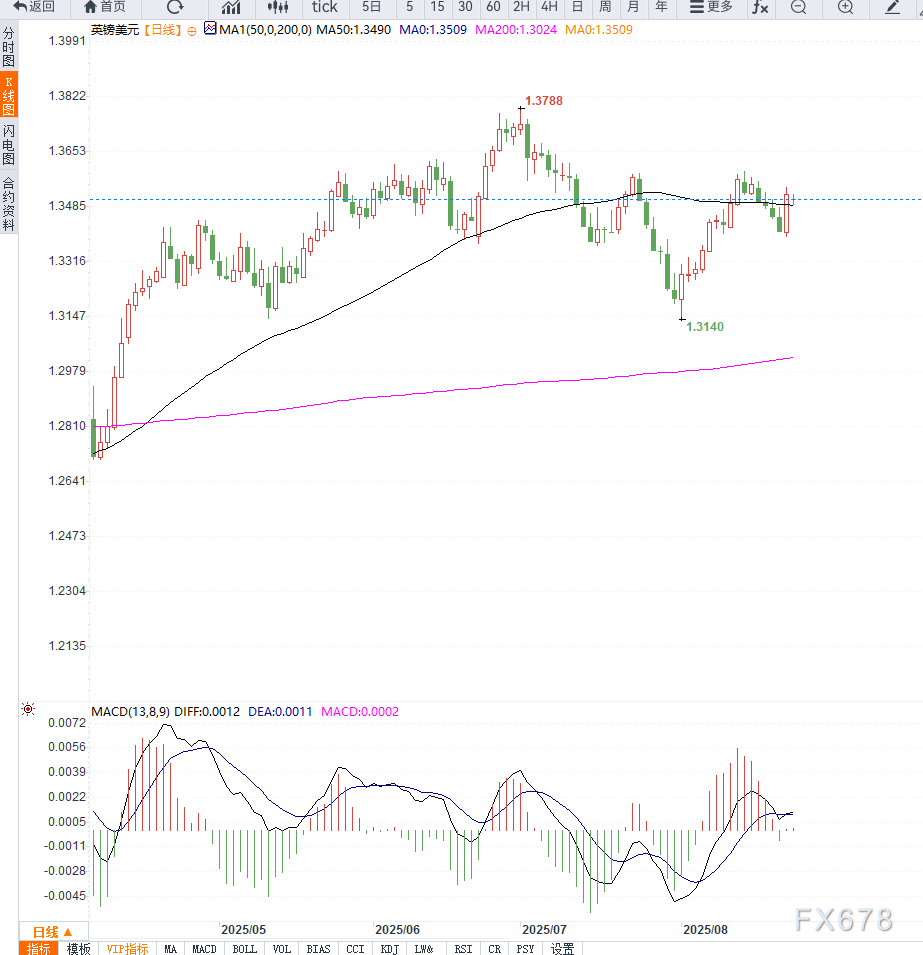
Looking at the daily chart, GBP/USD fell back after encountering resistance around 1.3520. Short-term support is at 1.3460, and if it falls below it, it may further decline to the 1.3400 mark. Above resistance is in the range of 1.3550-1.3580. If it breaks through this area, it will reopen the upward space and target 1.3650.
The overall technical pattern shows that the currency pair is in a volatile consolidation pattern, with a weak short-term operation.
Editorial Views:
The current trend of the pound against the dollar is affected by the policy divergence between the Federal Reserve and the Bank of England. The Federal Reserve's interest rate cut signal is positive for the pound in the medium and long term, but the dollar is strong in the short term due to risk aversion and data-driven performance.
At the same time, UK inflation exceeded expectations, strengthening market expectations for the Bank of England to suspend easing, providing some support for the pound. Overall, the exchange rate is more likely to fluctuate in the 1.34-1.36 range, and the direction still needs to be confirmed by US core data and the Federal Reserve's September meeting.
Please indicate the source: https://www.daoctech.com/fxnews/1723.html
Disclaimer: The content of this article does not represent the views of the Institute of Foreign Exchange. The content is for reference only and does not constitute investment advice. Investors operate accordingly at their own risk.