
Dollar stabilizes + data comes first: Where does the euro retreat?
In early European trading on Tuesday (September 2), the euro/dollar ended three consecutive days, and the intraday exchange rate fell from near the 1.17 line. The latest price fluctuated at 1.1630, which has cooled significantly compared with the high near 1.1735 on Monday. Market risk appetite downgraded, the dollar strengthened driven by risk aversion, and the combination of "slightly hot and unchanged" inflation in the euro area did not change the market's judgment that the European Central Bank (ECB) will stay put in the short term.

Fundamentals:
Eurozone CPI in August was 2.1% year-on-year, higher than the market expectation of 2.0%; the core CPI was 2.2% year-on-year, in line with the previous value, and higher than the consensus of a slight decline to 2.2% previously expected. In line with the recent macro performance of the euro area, the market interpreted it as "inflation is not weak but there is no need to ease up the ante", thus providing a basis for the tone of "maintaining interest rates unchanged" in next week's interest rate negotiations. ECB Governor Isabel Schnabel said on the same day that interest rates are still "moderately loose" and there is no need for further easing in the short term; while Lagarde stressed on Monday that concerns about the French banking system are exaggerated, and said economic uncertainty is "significantly reduced", suggesting that monetary policy may remain stable after September. At the same time, the final value of the HCOB manufacturing PMI in the euro area was revised up from an estimate of 50.5 to 50.7, returning to the expansion range for the first time in nearly three years. Although it is not strong, it provides some confidence for the euro.
On the dollar side, it rebounded after falling in the previous period. The debate over the independence of the Federal Reserve and the path of policy has been disturbed, and the comments of the senior financial department on "the Federal Reserve has made a lot of mistakes" have not calmed the market sentiment. The legal controversy over the formation of the committee is also brewing, which has increased the short-term uncertainty. However, in terms of data, the US will face an intensive test this week: the activity data of manufacturing and services, and the non-farm payrolls report on Friday will provide key clues to the policy landing point in September. According to the current consensus, the ISM manufacturing PMI is expected to rebound from 48 to 49, still in the contraction range, indicating that the momentum of the manufacturing side is weak. The above combination forms a two-way pull of "the dollar is subject to risk aversion and data forward resonance, and the euro is underpinned by fundamental
Technical aspects:
From the observation of the 240-minute K-line, the exchange rate formed a clear retracement after rising on Monday. Bollinger bands show: upper rail 1.1743, middle rail 1.1669, lower rail 1.1595. The recent high has touched near the two marks of 1.1742 and 1.1736 (corresponding to the resistance area near the upper rail), and then the continuous negative line has pushed the price back to the lower rail, currently hovering at 1.1635, and there is still about 40 points buffer from the lower rail. The lower front low of 1582/1.1573 is a key support zone in stages, forming a "multiple support cluster" with the lower Bollinger rail 1.1595.
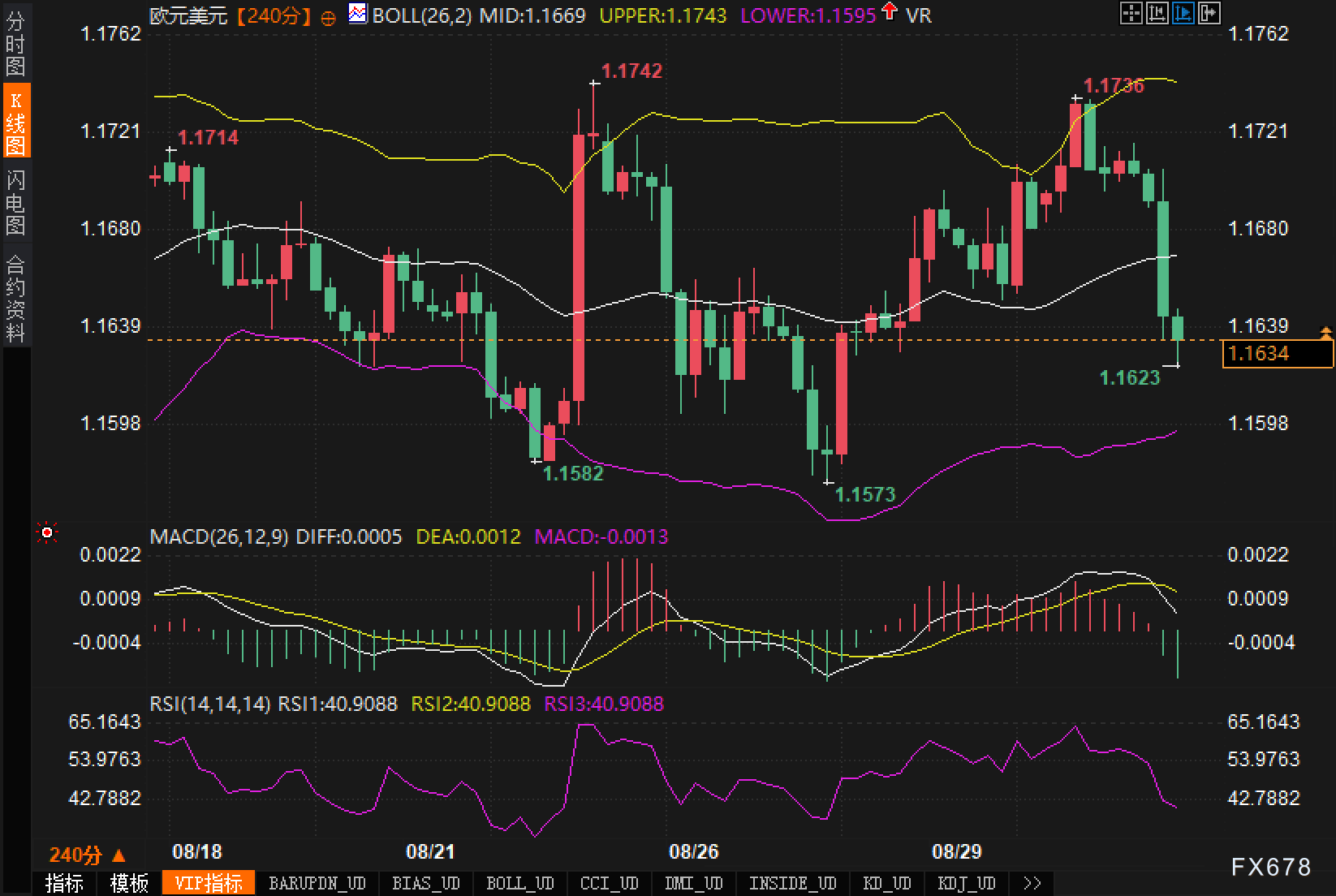
MACD: DIFF0.0005, DEA0.0012, MACD column -0.0013, and the zero axis is enlarged again, indicating that the short-term kinetic energy has turned empty and sustained. RSI (14) is at 40.9088, located below the neutral bias, and has not yet entered the extreme oversold, but has released the "weak shock to the bearish trend" signal. After the price falls below the Brin mid-rail 1.1669, if the rebound is blocked in the mid-rail and repeated backtesting fails, it will form a typical downward organizational structure of "mid-rail transfer pressure"; conversely, if it can quickly recover and stabilize above the mid-rail, it can re-point to the dense resistance of 1736/1.1742 above. Overall, the 4-hour K-line shows a rhythm of "upper rail is under pressure - middle rail falls below - pointing to lower rail". The short-term trend is favorable to the bears, but the support strength in the 1.1595-1.1573 range below cannot be underestimated.
Key position combing:
Resistance: 1.1669 (middle Bollinger, first resistance), 1.1714 (stage rebound high mark), 1736/1.1742 (strong upward resistance), 1.1743 (upper Bollinger).
Support: 1.1600 (integer pass), 1.1595 (Bollinger lower rail), 1582/1.1573 (double front low).
Market sentiment observation:
This round of pullback is accompanied by "risk aversion heating up + uncertain data outlook". The US dollar has been passively bought, and liquidity is biased towards the US dollar side; the euro side is underpinned by the fundamentals of "inflation is not weak + policy is not moving", and it is difficult for bear sentiment to unilaterally break through strong support. From the perspective of the sentiment cycle, the short-term long positions accumulated by Lianyang in the early stage have a tendency of "profit taking and risk hedging". Superimposed US data is approaching, and volatility is expected to rise but the direction is not fully priced. Sentiment indicators are not extreme, and RSI has not yet entered the traditional oversold area, which means that although bears have the first hand, it is not a "crowded trade". Once external disturbances ease or the data falls short of expectations, short covering may trigger a technical rebound; conversely, if US data resilience exceeds expectations and risk aversion continues to ferment, sentiment may quickly slide to the stage of "short-term panic - down-track test".
Please indicate the source: https://www.daoctech.com/fxnews/1809.html
Disclaimer: The content of this article does not represent the views of the Institute of Foreign Exchange. The content is for reference only and does not constitute investment advice. Investors operate accordingly at their own risk.