
The euro is back! On the way to the collapse of the dollar, it is gradually regaining its throne
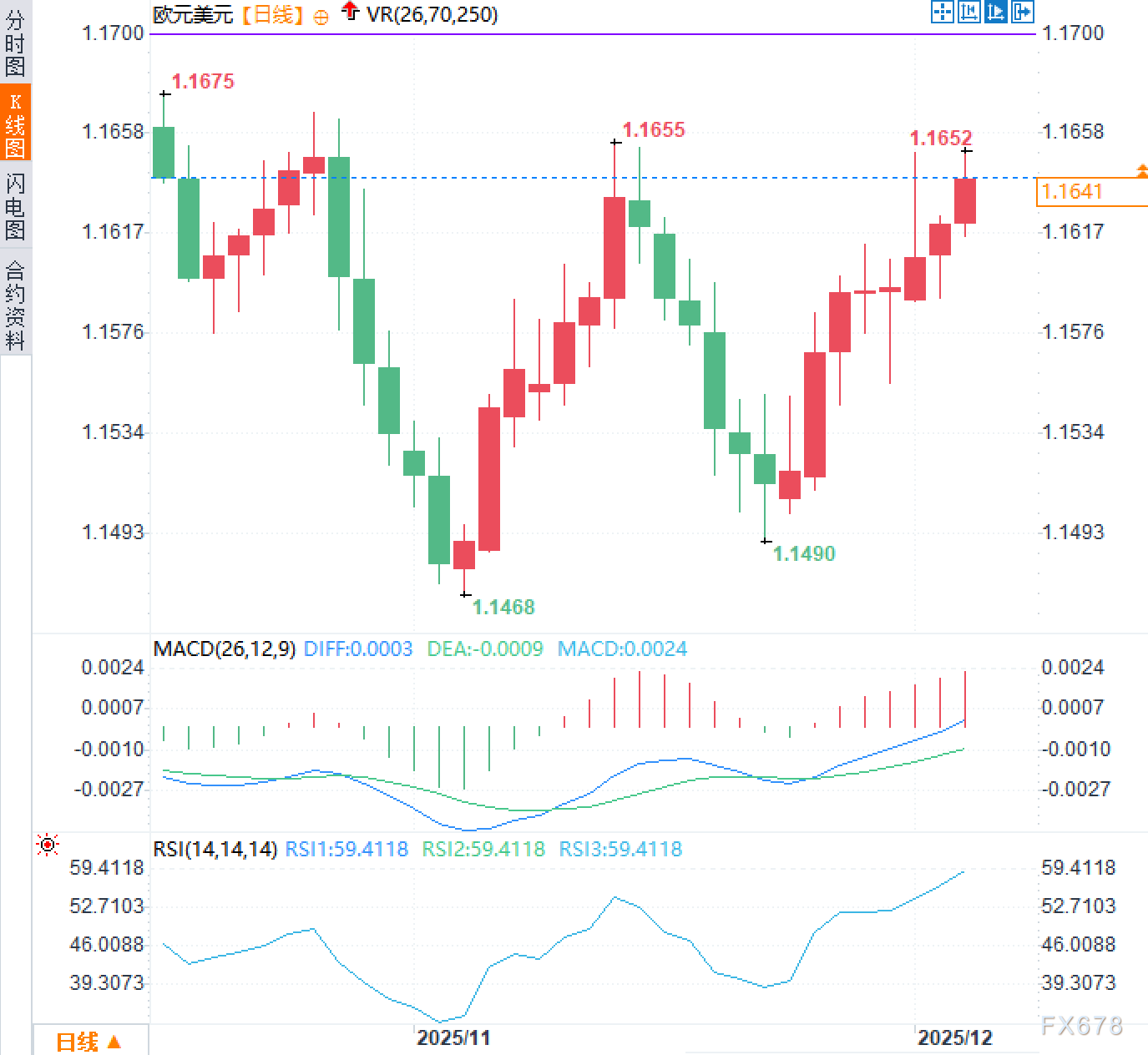
On December 3rd, in early European trading on Wednesday, the euro maintained a strong pattern against the dollar, and the price rebounded to around 1.1650, continuing the positive closing trend of the previous two trading days. The current exchange rate shows a clear short-term bullish signal on the technical form, and the overall market sentiment is biased to support the further strengthening of the euro. The main driving force for this round of gains is not the outbreak of economic data in the euro area itself, but the overall weakness of the dollar index.
Recently, the market's expectations for the future policy path of the Federal Reserve have turned significantly dovish, which has become the core factor suppressing the trend of the dollar. As the US FOMC (FOMC) is about to hold its last meeting of the year, investors are closely watching whether various economic data are sufficient to support the expectation of an early interest rate cut. At present, the market has set the probability of an interest rate cut next year as high as 95%. This strong policy shift has significantly weakened the attractiveness of the US dollar. The high interest rate environment was originally the foundation for supporting the strength of the US dollar, but once the interest rate cut is approaching, the yield advantage of holding US dollar assets will quickly shrink, and funds will naturally flow to other relatively more attractive currencies.
More notably, US President Donald Trump recently signalled his intention to nominate Kevin Hassett, the current chief economic adviser, to replace outgoing Federal Reserve Chair Jerome Powell. Hassett is widely regarded as a "dovish" representative of monetary policy, whose policy preference is more focused on supporting economic growth and job expansion than controlling inflation. If the staffing arrangement is finally implemented, it will further consolidate the market's judgment that the Federal Reserve will take an accommodative stance in the future, thus continuing to put downward pressure on the dollar and support the euro against the dollar.
Key data will be revealed, and the market is waiting with bated breath for the wind vane
The US will release two important economic indicators in the next few days: one is the private sector employment report (ADP) released by the automatic data processing company, and the other is the November service purchasing managers' index (PMI) released by the Institute for Supply Management (ISM). Among them, the employment sub-item in the ISM service PMI is particularly critical. Since the next non-farm payrolls data will be released after the Federal Reserve's interest rate meeting, this PMI employment index will become an important forward-looking indicator to judge the warmth of the labor market.
If the index rebounds to above the 50-point line, indicating that the service industry employment activity has resumed expansion, it may temporarily boost confidence in the dollar and limit the upside of the euro against the dollar; conversely, if the reading continues to be lower than the 48.2 level in October, it will further strengthen the market's concerns about the slowdown in the US economy, exacerbate the pressure on the dollar, and push the euro to open a new upward channel against the dollar.
At the same time, global bond market volatility is alsoforeign exchange marketProvides additional background. Yesterday's Japanese-led bond sell-off eased, but failed to extend the rise during the European and American trading hours. The volatility range of US bond yields was concentrated between negative 2.1 basis points and positive 0.9 basis points throughout the day, showing a narrow range of fluctuations. The German government bond curve steepened synchronously, the short-end interest rate fell by about 1.4 basis points, the British government bond also turned from rising to falling, and the full-term yield generally fell slightly. Despite this, the yield of long-term Japanese government bonds rose again in early Asian trading today, and the 30-year variety was approaching a new high. The market is waiting for the results of the key government bond auction to be held tomorrow. The follow-up trend is still uncertain.
The political turmoil has not shaken the euro, and monetary policy is the main reason
Despite renewed fissures in the French political landscape - local newspaper Le Figaro reported that one of the coalition members, Horizons, would not support Prime Minister Le Cornu's proposed social security budget bill, with a vote scheduled for December 9 - the euro exchange rate did not respond significantly. As a result, French government bonds (OATs) performed weaker than other European sovereign bonds, and interest rate spreads widened.
However, the euro has not come under pressure, indicating that the main pricing logic of the current foreign exchange market is still focused on the differences in monetary policy between the United States and Europe, rather than the political risks of a single country. In fact, as European Central Bank President Christine Lagarde is about to appear in the parliamentary hearing, the market is more concerned about whether she will release any clues about future policy adjustments. Although the European Central Bank has not yet shown obvious easing intentions, the relative stability of monetary policy in the euro area has supported the euro's valuation to some extent, compared with the more certain prospect of interest rate cuts by the Federal Reserve.
In cross trading, the euro encountered resistance at the 0.88 mark after rising against the pound for three consecutive days. Considering that the UK's economic fundamentals still face multiple challenges, analysts maintain a bearish view on the pound and believe that the fair value of the euro against the pound should be above 0.90. This means that there is still room for the euro to appreciate against the pound in the medium term, indirectly strengthening the overall strong position of the euro.
Let's put it all together.
Against the backdrop of continued dovish Federal Reserve policy expectations, widespread pressure on the dollar, and the absence of systemic risks within Europe, the euro has the basis for further upside against the dollar. Despite the political turmoil in France, it has not yet formed enough impact to reverse the exchange rate trend. As long as key US data do not show a stronger-than-expected performance, the dollar will not be able to escape the weak pattern, and the euro is expected to continue to test important technical resistance upwards.
Of course, the possibility of a short-term correction cannot be completely ruled out. Once the market heats up due to French fiscal concerns, or the global risk aversion reignites, it may lead to a short-term return of funds to dollar assets. But unless US economic data show significant resilience and shake expectations of interest rate cuts, this rebound is likely to be only corrective in nature, and it is difficult to change the medium-term downward trend. Overall, the main line of the current market is clear: monetary policy differentiation dominates the direction of the exchange rate, while the euro is benefiting from the relative weakness of the dollar. In the absence of a major reversal signal, the euro will continue to operate with strong volatility against the dollar. The key observation point in the next stage is the subtle change in the European Central Bank's policy communication.
Please indicate the source: https://www.daoctech.com/fxnews/1941.html
Disclaimer: The content of this article does not represent the views of the Institute of Foreign Exchange. The content is for reference only and does not constitute investment advice. Investors operate accordingly at their own risk.