
Spot gold has fallen for two consecutive years, but bulls are expected to counterattack at any time, and the FED is waiting to lift market doubts
Spot gold fell back for a second straight session as a rally in equities dented the gold's safe-haven appeal. But investors continued to assess measures taken by authorities around the world to quell fears over a crisis in the global banking system. While Chairperson Jerome Powell left the door open for further rate hikes if necessary, markets expect the Federal Reserve to keep rates on hold at its next meeting in May and project a more than 60% chance of a rate cut starting as early as July. That could continue to be bullish for gold prices.
Spot gold fell back for a second straight session on Monday as a rally in equities dented the gold's safe-haven appeal. But investors continued to assess measures taken by authorities to calm fears over a crisis in the global banking system. The rising outlook for dovish policy from the Federal Reserve continues to be positive for gold prices.
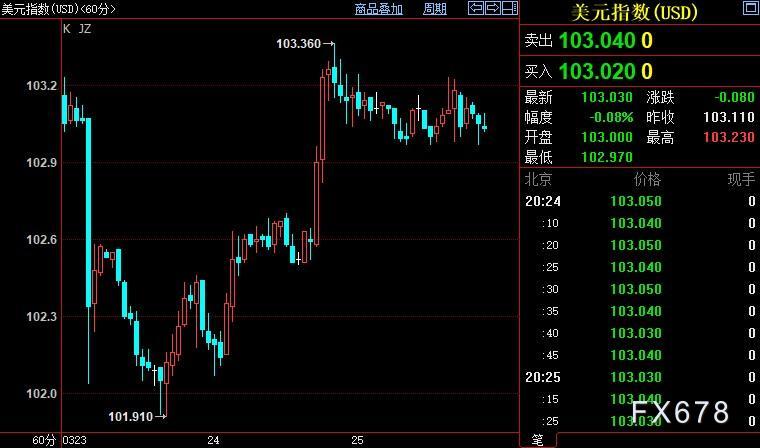
Beijing time 20:24, spot gold fell 1.20% to $1955.12/ounce; COMEX gold futures main contract fell 1.39% to $1956.2/ounce; the dollar index rose 0.02% to 103.045.

Last week, the Federal Reserve said it was about to suspend further interest rate hikes, which boosted the attractiveness of non-yielding asset gold to a new high of $2009.70/ounce since March 9, 2022. But the dollar index rebounded sharply by more than 0.5% on Friday (March 24), reducing the attractiveness of gold.
ING economists think the risks to the dollar index are more balanced this week, but volatility is likely to remain high. Rising pressure on European banks has forced a temporary softening of bearish views on the dollar, at least until there is a clearer picture of the stability of the European Union banking sector.
Acquisition of Silicon Valley bank deposits and loans
The Federal Deposit Insurance Corporation (FDIC) said on Monday that First Citizens Banc Shares Inc. will acquire all deposits and loans from Silicon Valley banks from regulators. The news was positive for European bank stocks and sent gold prices further back.
A press release from the Federal Deposit Insurance Corporation (FDIC) said First Citizen Bank has taken over all of Silicon Valley Bank's $119 billion deposits and loans and purchased $72 billion of its assets at a $16.50 billion discount.
The deal limited, but did not eliminate, losses from the collapse of Silicon Valley banks, which still cost the FDIC nearly $20 billion. Federal Reserve policymakers expressed concern that more banking contagion could trigger a possible recession.
Mr. Kashkari, the Minneapolis Fed president, said on Sunday that recent stress in the banking sector and the possibility of a subsequent credit crunch had brought the US closer to recession. "What we don't know is how much of this bank stress will lead to a broad credit crunch. That credit crunch... then slows the economy, and that's something we're watching very, very closely."
Although the Financial Stability Oversight Council has said the US banking system is "robust and resilient", investors remain cautious, fearing that the worst problems in the banking sector since the 2008 financial crisis have not been contained, and the overall trend for gold remains bullish.
The Fed urgently needs a clear stance
The Federal Reserve raised interest rates by 25 basis points as scheduled last week, but the central bank is cautious about the outlook due to the turmoil in the banking sector. While Chairperson Jerome Powell has left the door open for further rate hikes if necessary, markets expect the Fed to leave rates unchanged at its next meeting in May and put the odds of a rate cut starting as early as July at more than 60%.

KPMG Chief Economist Diane Swonk said Monday that the Federal Reserve's decision last week shows that the central bank is strongly considering stopping monetary tightening, including ending balance sheet tightening, as the recent banking crisis could prove to be a material drag on the economy and inflation.
"This is the most dovish rate hike I can imagine," Mr. Swonk said. "If inflation cools much faster without plunging the economy into a deep recession, the Fed could start easing at the end of this year and next. But if the credit crunch hits the economy harder than officials expect, the Fed could be forced into such a policy reversal. Policymakers are trying to estimate the impact of a sudden credit tightening on growth, employment and inflation, but it is too early to make a correct judgment. FOMC members appear concerned that raising rates from zero to nearly 5 per cent in just one year may be excessive in the face of financial turmoil. Their goal is simply to cool the economy, not send it into a deep recession."
Niels Christensen, chief analyst at Nordea, said: "Traders are very cautious and don't know if there will be any new negative news from the financial sector in Europe or the US. They have had a lot of panic over the past two weeks, but if the pressure wears off, the market will be more focused on central bank expectations going forward."
Economists at Cre ́ dit Agricole say our recent historical analysis of currency price movements over the six Fed tightening cycles since 1980 suggests investors should not sell dollars until the Fed has actually finished raising rates. The combination of continued Fed rate rises and heightened recession risks tends to provide a modest boost to the dollar on average.
fxtmLukman Otunuga, senior research analyst, said: "After breaking the psychological level of $2,000 last week, bears used technical resistance to attack. The stabilisation of the dollar and the disarray of signals on the Fed's monetary policy outlook have also weakened appetite for precious metals. With the Fed expected to cut interest rates in 2023, gold will shine in the market chaos." But he added that it would take major events for fundamentals to get gold back to the psychological level of $2,000 and the peak since March 2022 in order to reach another all-time high.
ING economists argue that the Fed's policy outlook is bearish on the dollar because the lack of clear communication has left the door open to dovish speculation, and the US's own banking crisis has not been resolved, putting the current monetary policy outlook in the US in sharp contrast to that of the European Central Bank.
Spot gold short-term down to $1938
Looking at the daily line, the price of gold has started to adjust the trend of wave ii since 2010 dollars. Looking at the hourly chart, the price of gold has started to adjust the trend of wave (C) since 2003 dollars, and the lower support looks towards the 85.4% target level of $1938. (C)) wave is a sub-wave of wave ii.

Please indicate the source: https://www.daoctech.com/fxnews/210.html
Disclaimer: The content of this article does not represent the views of the Institute of Foreign Exchange. The content is for reference only and does not constitute investment advice. Investors operate accordingly at their own risk.