
Geopolitical risks push up crude oil rebound, medium-term trend remains weak
US crude oil traded modestly in Asia on Tuesday, trading near $58.00 a barrel, failing to extend yesterday's gains as the dominant force in global energy markets shifts from fundamentals to geopolitical security premiums.
The Caribbean Sea, the Middle East, and the Black Sea have seen military or sanctions escalation signals in the same time dimension, causing the market's assessment of the stability of the crude oil supply chain to rapidly deteriorate.
Driven by multiple uncertainties, crude oil futures prices have strengthened significantly, market sentiment has shifted from "demand concerns" to "sudden interruption defense", short positions have been forced to cover, and oil prices have received support beyond fundamentals.
At the same time, US restrictions on Venezuelan energy exports are evolving from financial and trade sanctions to direct maritime enforcement actions. Recently, the US Coast Guard has repeatedly tried to intercept oil tankers linked to the Venezuelan crude oil trade in international waters, indicating a significant escalation of the blockade.
In less than two weeks, a number of oil tankers involved in Venezuela have been inspected, detained or forced to return, reminding the market that previous judgments about the continuity of supply in Venezuela were too optimistic. Despite the country's limited crude oil production, its supply uncertainty is enough to amplify the risk premium.
From a technical perspective, modern satellite and radar monitoring systems have greatly reduced the "gray transportation" space, making it significantly more difficult for related trade to evade sanctions, and the probability of actual exports being blocked continues to increase.
UBS analyst Giovanni Staunovo said that the market had underestimated the risk of sanctions implementation, and the continuous interception actions changed expectations for the stability of Venezuelan supply. The Pakatan Harapan related discussions also pointed out that the impact of similar sanctions on the global trade pattern cannot be ignored.
Parker, head of emerging markets at Resta Energy, pointed out that tankers can hardly avoid monitoring entirely under current technical conditions, which makes the practical effect of the blockade far more than paper sanctions.
At the same time, there are also dissenting voices in the United States, with some politicians warning that overly aggressive lockdown measures could trigger broader regional frictions and increase strategic risks.
The Middle East has once again become a highly sensitive variable in energy markets, with recent news of a new Israeli military campaign rapidly cooling expectations of a fragile regional detente.
The market is concerned that once relevant actions are taken, not only will the regional security situation deteriorate, but also the negotiating space between the United States and Iran may be further compressed.
According to the analysis, the key to the current risk in the Middle East is not whether a conflict will break out immediately, but the probability of "strategic miscalculation" is increasing.
Any escalation of local conflicts could quickly spill over into key shipping lanes and oil-producing regions, causing a structural impact on the global crude oil supply map.
In Eastern Europe, energy infrastructure is becoming a direct target of conflict. Recent drone attacks have damaged ports and terminal facilities along the Black Sea coast, once again reminding the market of the high vulnerability of energy transportation routes in the region.
The Black Sea is an important hub for crude oil and refined products. Any attack on ports, terminals or ships will amplify the risk of logistics disruptions. Although the parties are still advancing negotiation and engagement, the reality of "talking while fighting" makes it difficult for the market to establish stable expectations.
Ritterbusch and Associates pointed out in the report that the news of the attack on the Black Sea ports directly triggered the return of risk premia and was one of the important drivers of the recent rebound in oil prices.
Under the influence of the above multiple factors, international oil prices rose significantly.
The analysis pointed out that the current oil price is not based on a strong recovery in demand, but is supported by the continuous accumulation of geopolitical uncertainties. In the context of weak inventories and macro data, risk premiums have become the main driver of prices. PH is concerned that such price fluctuations driven by external events often lack long-term sustainability.
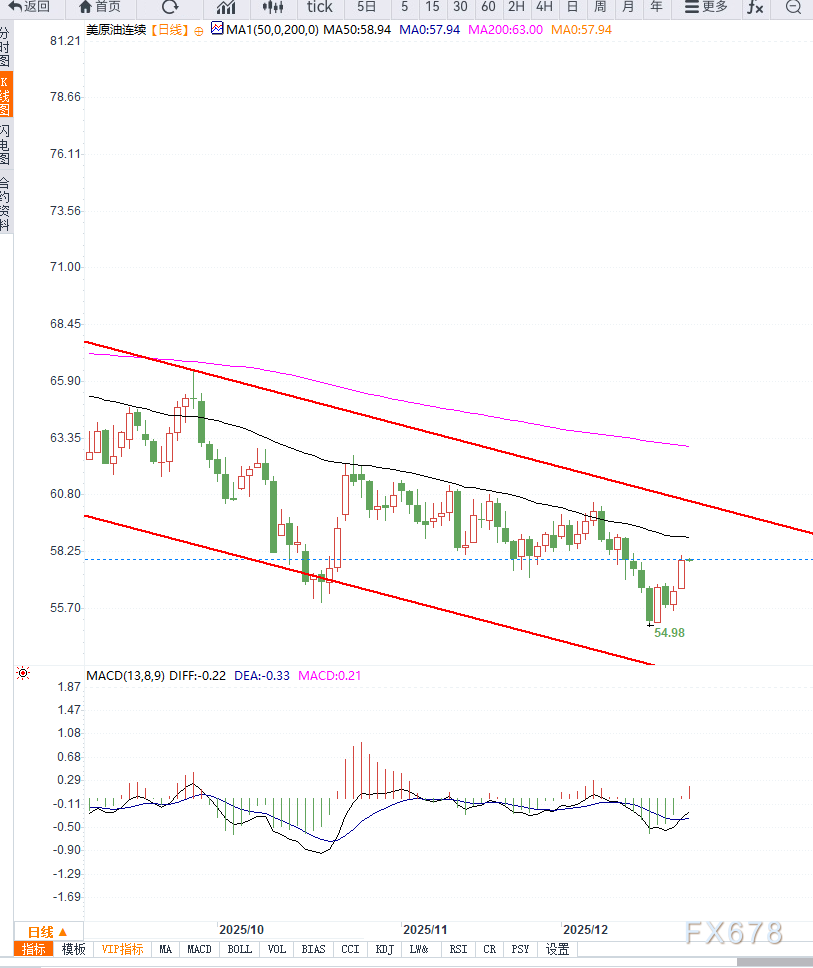
From a daily perspective, U.S. crude oil (WTI) has received significant support in the early stage, falling back to around $56 in a row. This position corresponds to the low area of the year, and it is also a high-volume area in the early stage, with a strong willingness to buy and defend. The price has re-stood on the short-term moving average of 5 and 10 days, indicating that the bullish sentiment has been significantly restored under the impetus of geopolitical risks.
However, looking at the overall structure, WTI is still operating in a medium-term downward channel, with the $60-61 area above corresponding to the 20-day moving average and the intense pressure in the previous period, forming an important resistance to the short-term rebound.
In terms of indicators, the RSI has rebounded from the oversold range to around 41, the momentum has improved but has not yet entered the strong area, the MACD green column has converged significantly, and there is a possibility of forming a golden fork.
Overall, WTI is biased towards the continuation of the technical rebound in the short term, but before effectively breaking through the $60 mark, the trend is still viewed as a "rebound rather than a reversal", and the subsequent height will still depend on whether the geopolitical risk is further escalated.
editorial opinion
:
Judging from the current pattern, the crude oil market is entering a "high-risk sensitive period". Even if the fundamentals are difficult to provide sustained upward momentum, the simultaneous fermentation of multi-regional geopolitical events has forced the market to increase the defensive pricing of extreme events. Ximeng believes that investors need to pay close attention to the follow-up developments.
In the short term, oil prices are likely to remain highly volatile around geopolitical news, and any new signs of risk escalation could quickly amplify the price response.
Please indicate the source: https://www.daoctech.com/fxnews/2307.html
Disclaimer: The content of this article does not represent the views of the Institute of Foreign Exchange. The content is for reference only and does not constitute investment advice. Investors operate accordingly at their own risk.