
Forex Valet Banking Accounts: Analysis of PAMM, LAMM and MAM
In the field of foreign exchange online trading, PAMM accounts, LAMM accounts, and MAM accounts are common valet accounts, also known as fund manager management accounts. Investors and account managers distribute profits according to the agreed proportion, which means that the account manager's income is mainly derived from the performance of the account. Normally, other types of financial assets are rarely traded in this type of account, but technically, traders can trade any financial instrument on these accounts. This article will introduce the concepts of these three types of accounts and their differences to help you better understand the valet model.
PAMM
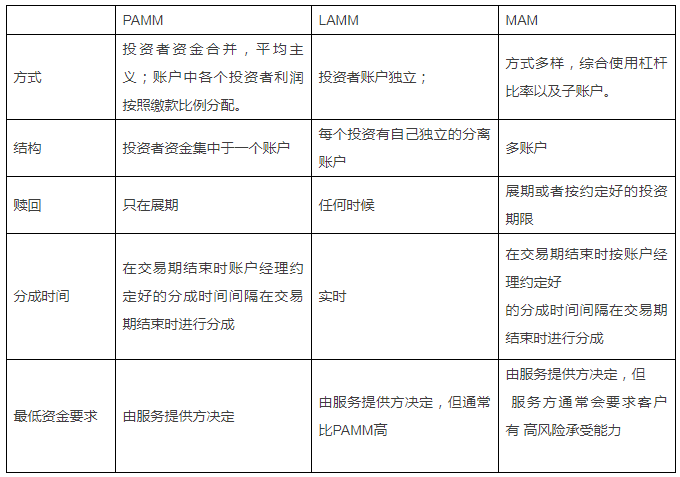
PAMM accounts, or Percentage Allocation Management Module (also known as Percentage Allocation Management Module). As the name suggests, this is a way for an investment manager (account manager) to perform account management services on behalf of clients. Trading and related profits, losses, interest and commissions are distributed proportionally, and the account manager will also draw corresponding rewards according to the proportion agreed with the investor. Some investors, due to lack of time or experience, will choose to open a PAMM account and let a professional trader manage it on their behalf. In addition, fund managers who use a consistent trading strategy and leverage ratio usually use PAMM accounts. Of course, not allbrokerAll offer such services.
The entire account is composed of PAMM Trader and PAMM Investors, and the account can continue to operate without PAMM investors. In a PAMM account, the trader and the investor share the risk of the funds in the account. PAMM on most platforms pays performance fees to traders only when they are profitable.
LAMM
LAMM accounts work slightly differently, in contrast to PAMM.
LAMM accounts, that is, the Lot Allocation Management Module. If PAMM allocates the trading portion as a percentage, then LAMM is based on the trading "lot number". Accounts are run through a management interface, and each account is treated as a separate entity. Accounts under LAMM are read-only accounts, and clients cannot trade on their own. Since the money manager manages each client's account separately, there may be differences in margin, profit and loss, and other fees for different clients.
Typically, money managers using different trading strategies or different leverage ratios use LAMM accounts, but they are rarely used these days and are said to be burdensome for brokers, liquidity providers and MetaTrader servers.
MAM
MAM, or Multi Account Manager. This type of account is equivalent to a main account, with several independent follower accounts linked below, which can be regarded as a form of copying (see remarks). Investors only need to enter the total number of trading lots, and the system will execute the trade according to the selected allocation method, automatically allocating the lot number to different investors. Account managers can quickly, efficiently and accurately trade for multiple investors through a single trading account.
MAM generally has four ways to place orders, which are allocated according to the total volume of each order, equal share, equity ratio, and available margin ratio. MAM accounts are suitable for investors with high risk tolerance and market understanding.
Overall, the simple understanding is: the PAMM account is to pool everyone's funds and operate it by a fund manager; the LAMM account is for fund managers to differentiate different customer accounts on a unified interface; and the MAM account is for fund managers to operate the main account, and other accounts follow the transaction. When selecting investment products, some platforms such asatfxIt also provides investors with a convenient experience in valet banking operations.
Notes: The difference between MAM and the documentary system
The principles of the two are very similar, but there are still differences in some aspects.
For example, the trading direction of the MAM sub-account is the same as that of the main account, that is, when the main account makes profits, the sub-account will also make profits at the same time. In the copy system, followers can choose to copy forward or reverse without restrictions. In addition, MAM's investment method is that the system executes transactions according to the allocation method selected by investors, and then automatically allocates the number of trading lots to each investor; in the copy mode, investors in the sub-account place orders as followers, rather than being assigned orders.
For multi-account management systems, the allocation of funds is pro-rated, and the total amount of funds in the main account should always equal the sum of funds in the sub-accounts, while there are no such restrictions in documentary systems.
Comparison of three types of accounts
As identified by regulators, individuals without relevant licenses often promise higher rates of return as a sales strategy to attract clients. As a result, regulators in the US, UK, Australia and Europe have set service restrictions for PAMM account money managers, such as leverage multiples and the need for the account manager and client to have sufficient knowledge of financial marekt. Investors interested in managing accounts should exercise caution and conduct extensive due diligence before partnering.
Please indicate the source: https://www.daoctech.com/fxnews/2382.html
Disclaimer: The content of this article does not represent the views of the Institute of Foreign Exchange. The content is for reference only and does not constitute investment advice. Investors operate accordingly at their own risk.